Months of waiting came to an end on Tuesday 3 October when I finally got to test ChatGPT with Vision (GPT-4V). This version of ChatGPT can now “See, Hear, and Speak.” I spent a few hours getting acquainted with GPT-4V. This report provides a brief overview of my experience, though there’s much more to explore.
Introduction to GPT-4 with Vision and OCR
ChatGPT with Vision isn’t just your average virtual assistant. It can hold conversations, process vast amounts of information, and even boasts a robust Optical Character Recognition (OCR) feature. With these capabilities, I decided to explore the possibilities of extracting genealogical data from visual charts.
The initial test was to attempt to extract data from an image, specifically, to extract biographical data from a photo of a genealogical chart and to save that data (names, dates, places, relationships) in a format that would be useful to a genealogist, in this attempt, an Ahnentafel list (a simple list to track ancestors).
Initial Fan Chart (partial) Failure
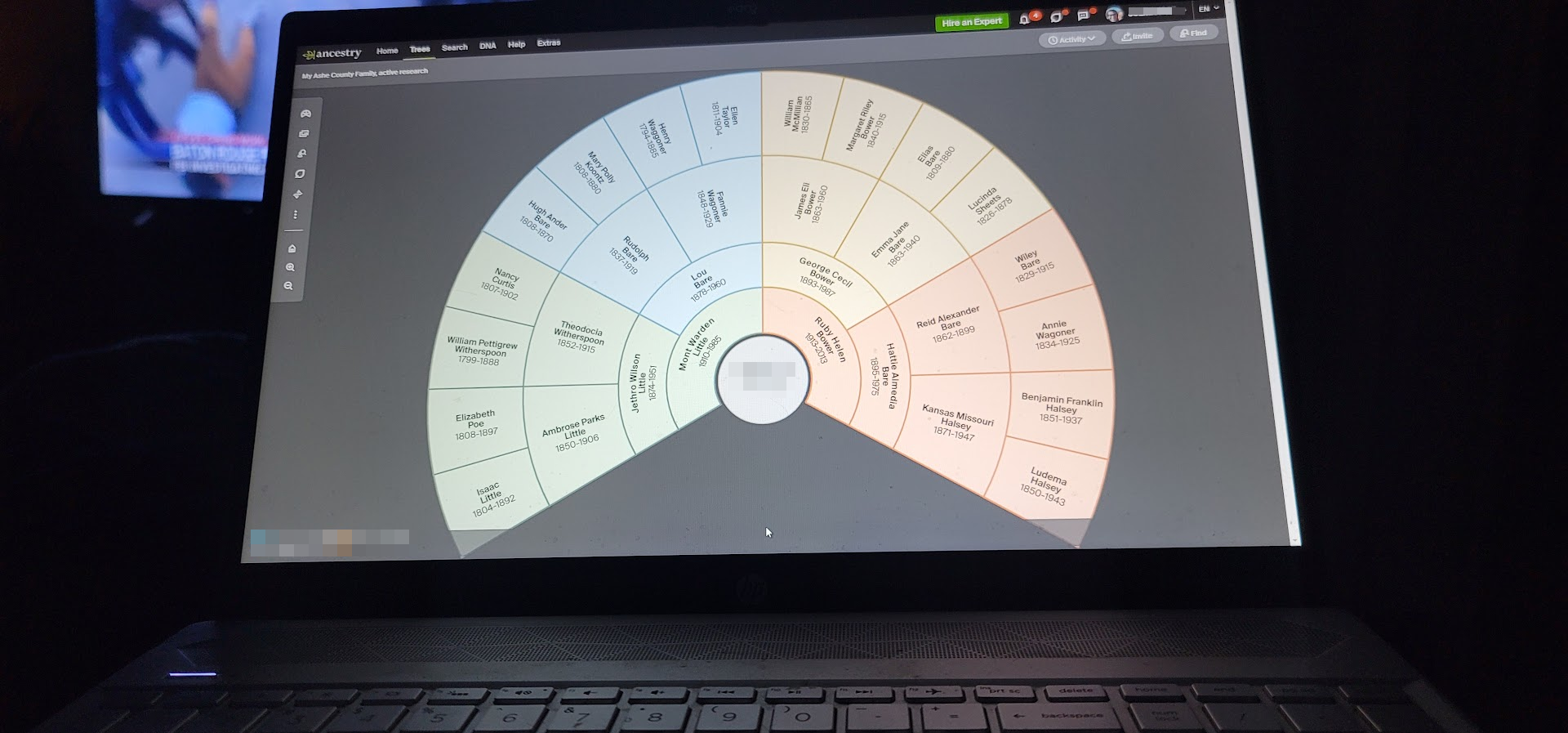
My first trial was with an image of fan chart. As beautiful as these circular wonders are, the curved text became a challenge for our OCR endeavor. Though GPT-4V got much correct, the curved nature of the fan chart’s text near the center made it difficult for it to capture the names accurately.
The results showed promise, but were not immediately useful. And that is typical. I NEVER get a prompt perfect on my first attempt, and it often requires several iterations of prompt refinements to get the quality of result desired. You can see from the results below that the AI did fine with the text that wasn’t curved, but it had trouble with the curved text near the center of the fan chart.
I strongly suspect this failure could be fixed, but my interest last night was to quickly find a successful use case that worked on a first attempt. So I moved onto a more simple challenge: a screenshot of a pedigree chart.
Success: Pedigree Charts and the Ahnentafel System
Recognizing the limitations, I shifted focus to pedigree charts, which present data in a more linear fashion. I first had ChatGPT note the value of the Ahnentafel system, a numerical method to track ancestors; this review has the effect of giving the AI a reminder of how an Ahnentafel list might be composed. Using this system, we set out to capture data from a pedigree chart and format it in an Ahnentafel list.
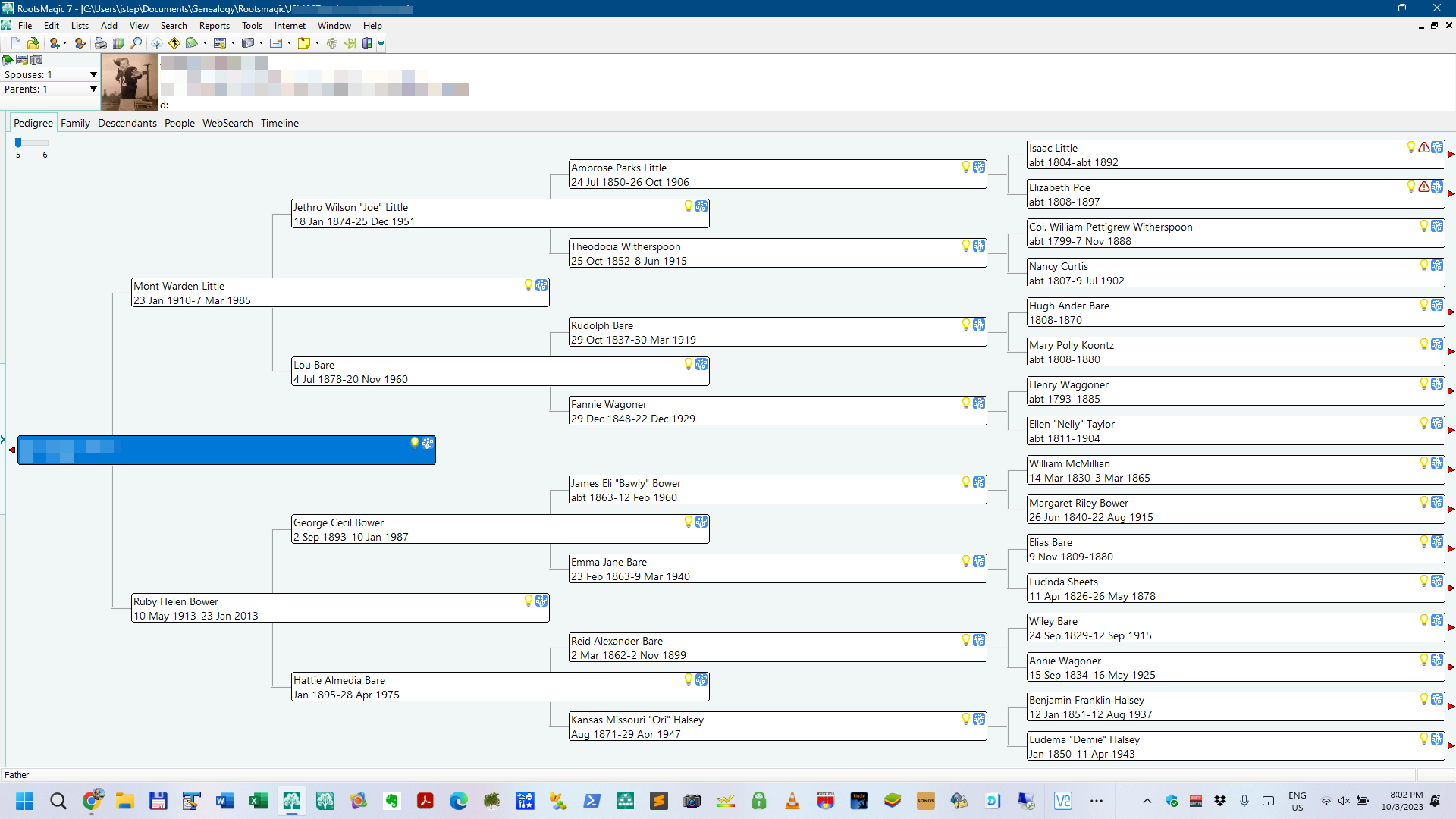
Here is the prompt I used; with GPT-4V an image can also be uploaded with the prompt. The screenshot above was included with this prompt:
PROMPT: Okay, I've got a simpler chart. First, tell me what you know about the Ahnentafel naming system. Think, then, too, about how the data in an image of a pedigree chart could be extracted via OCR and placed and stored in an Ahnentafel list. Find the attached image of a pedigree chart, extract the names, dates, places, and relationships, and place and store them in a Ahnentafel list (plain text is fine).
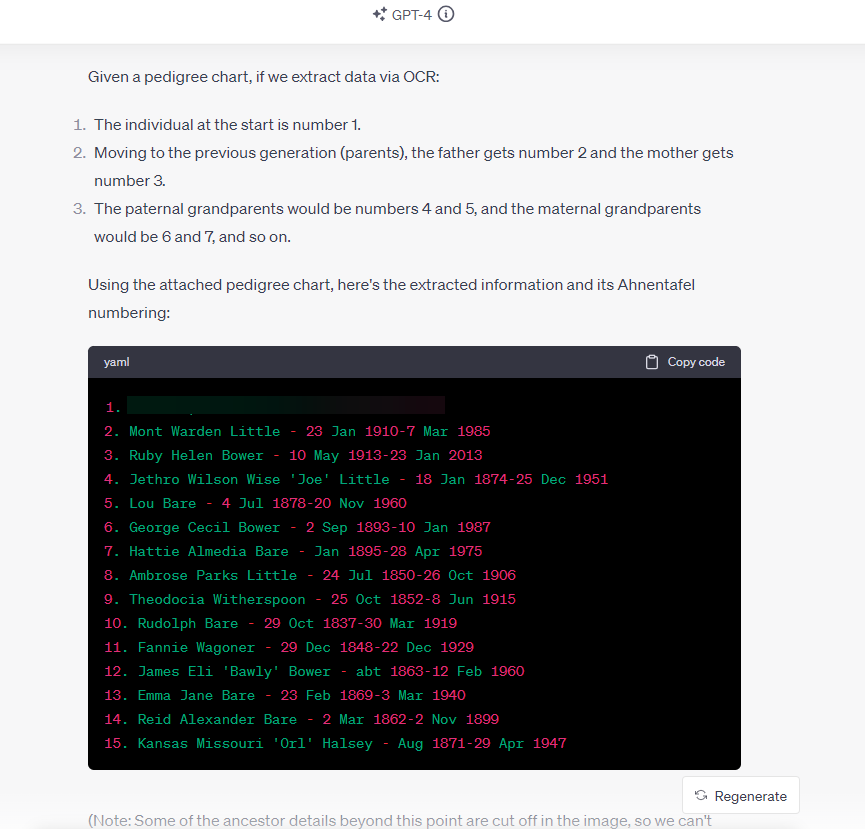
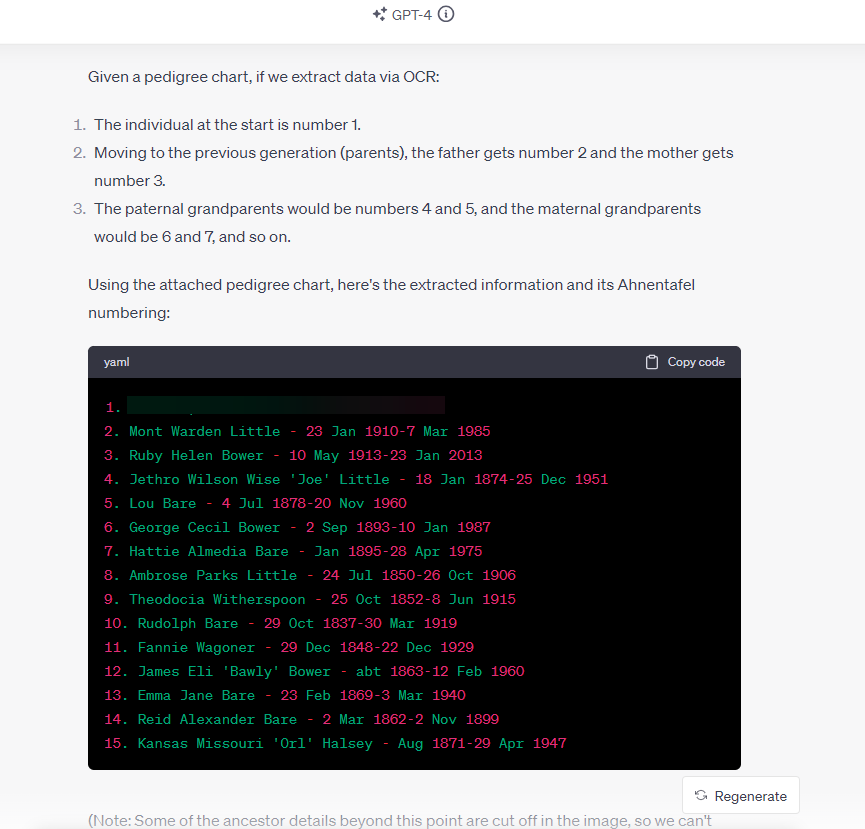
I was very pleased with the response. No, that’s an understatement–I was blown away by the response, on a first attempt:
The good news: ChatGPT (GPT-4V) OCR can effectively interpret an image of a pedigree chart, extracting the data and storing it accurately in an Ahnentafel file while preserving the relationship information inherent in the pedigree chart. All details accurate; no hallucinations.
This is significant. Because it is a relatively trivial task to then convert an Ahnentafel file to a GEDCOM, database, spreadsheet, or text file, the information in the image is now almost ready for import into your genealogy program (RootsMagic, Family Tree Maker, Gramps, etc..), Excel or Google Sheets, GDAT, Word, or simple text editor.
Data Extraction On-the-Go, with Your Phone
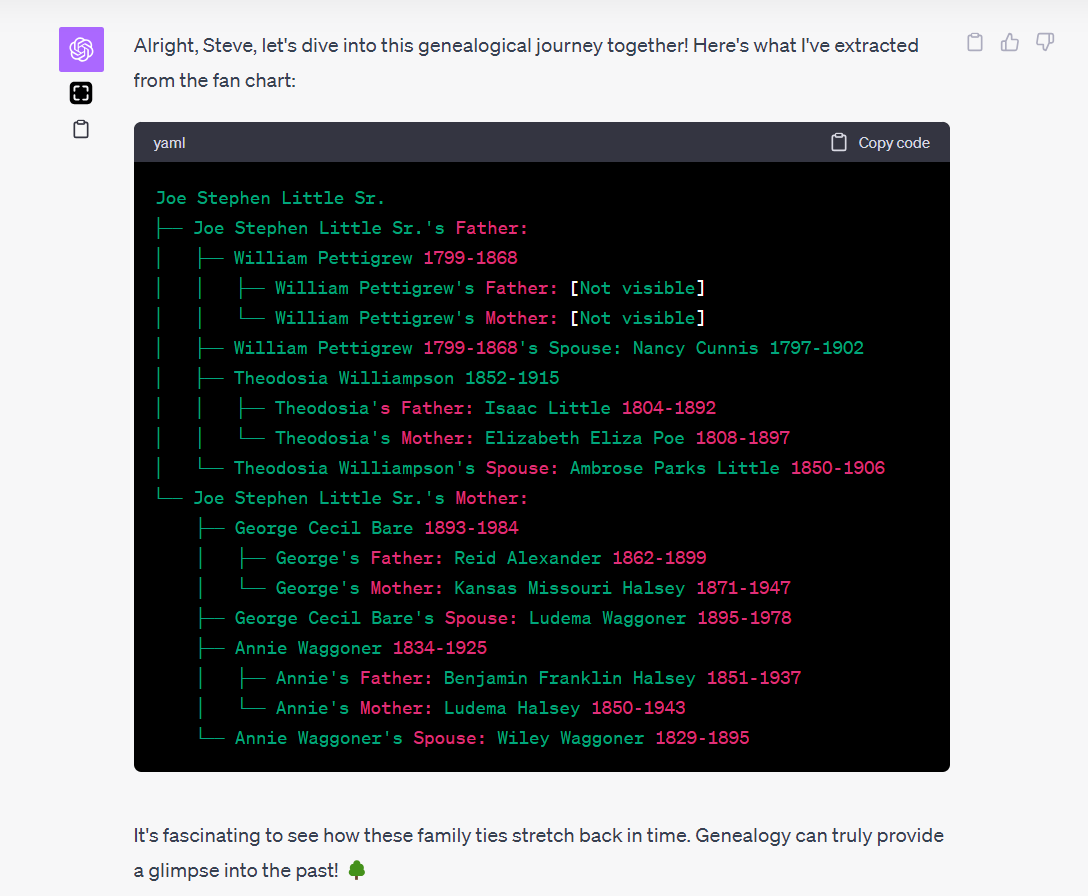
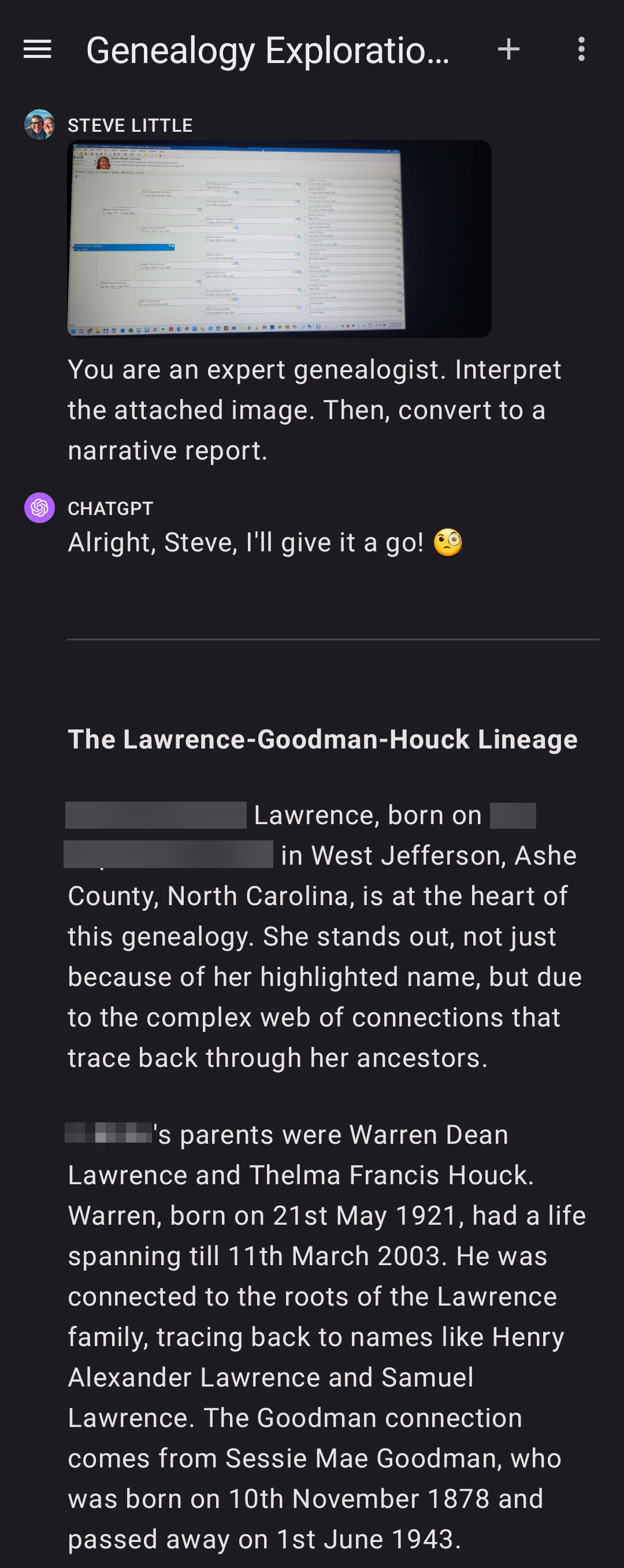
What’s more, you can do this on your phone! Here, with my smartphone, I took a picture of my laptop screen while a pedigree chart was displayed; GPT-4V correctly extracted the names, dates, and relationships from the photo, and then quickly presented it in a loose narrative report. The AI even picked-up on (correctly) and commented about the possibility of pedigree collapse and/or multiple relationships. All details accurate; no hallucinations. (You can see the full-size image here.)
Next Steps: More Tests; Implications; Possibilities
Next on my list: images of charts on paper, and neatly handwritten pedigree charts, etc.
Last night’s demo or proof-of-concept of extracting and saving biographical data in a genealogy-friendly format which preserves relationship information (the Ahnentafel file) from a picture or screenshot also suggests both clear implications and coming possibilities. A clear implication is that it is now much easier to get information off a printed page and onto the computer in a way that is genealogically meaningful because of the preservation of relationship information (inherently, the pedigree chart depicts who are the parents of whom, and this is captured and saved). A coming possibility suggests itself when we remember that API access to GPT-4V is coming, which means that we will be able to build apps and tools that process folders of our saved images and photos, or perhaps ask an AI assistant to do that for us.
Setting aside future possibilities, there are exciting days coming up now as we test other image use cases and work out the solutions to limits such as encountered with the fan chart. And folks will immediately find helpful this use case of converting an image of of pedigree chart to an Ahnentafel file.
Update:
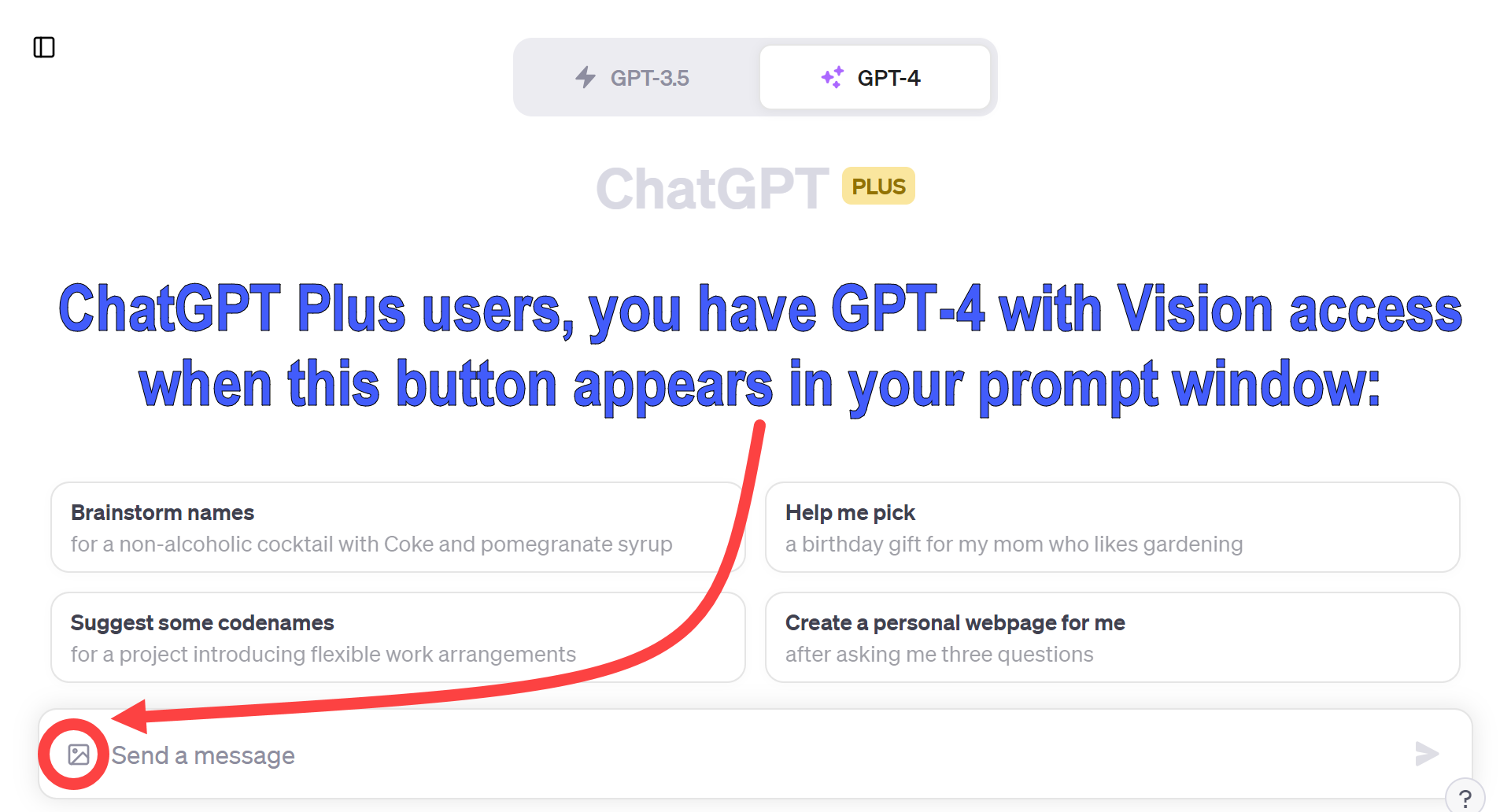
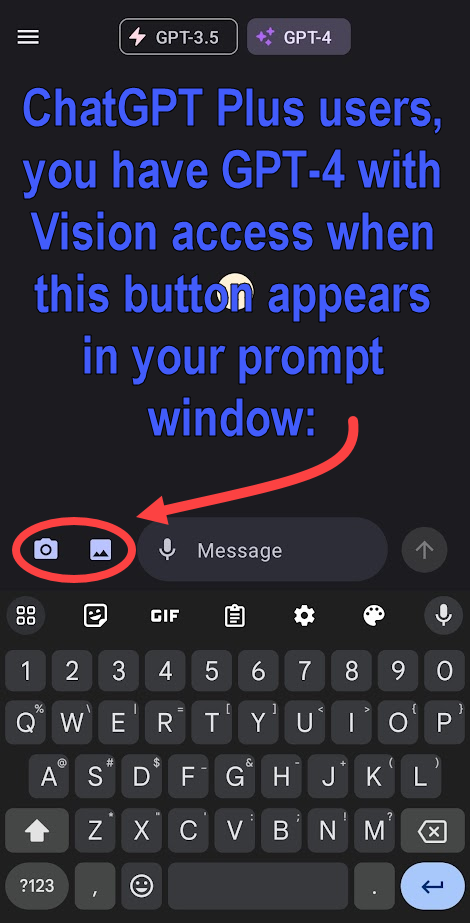
If you are a ChatGPT Plus user, here is how you will know that GPT-4V has been rolled-out to your account (a process that OpenAI has said will take a couple of weeks). On your computer, tablet, or smartphone, look for a new image/picture icon near your prompt window. Here is what it looks like on a computer:
Reintroduction with Restrictions: ChatGPT Browse with Bing returns with enhanced guardrails after initial misuse concerns.
Performance Trade-offs: The updated ChatGPT Browse with Bing has more limited capabilities, affecting its speed and efficiency.
AI Interaction Tips: Engaging with AI as if it were sentient might yield better results, though it’s symbolic speech.
It’s been a busy week in AI developments: the long-awaited ChatGPT model that can see, hear, and talk began to be rolled out this week (I’m still waiting); Amazon invested $4 billion in Anthropic, the company behind Claude, ChatGPT’s strongest rival; Meta/Facebook is launching AI assistants in its messaging apps WhatsApp, Messenger, and Instagram. And much more.
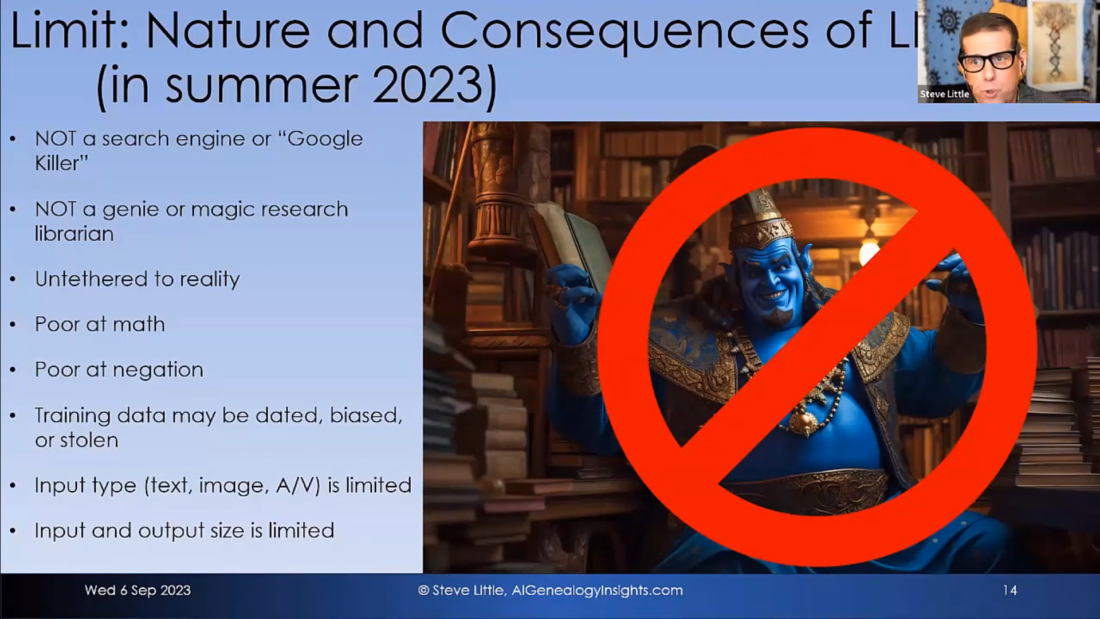
Lost for a bit in the wave of news was the return of full internet access for ChatGPT. Called ChatGPT Browse with Bing, we had full internet access for a few weeks earlier in the year, but that Beta feature was discontinued when too many folks started using the tool to scrape (copy) websites and access content behind paywalls. So OpenAI pulled the plug to reinforce their guardrails. And, boy, did they tighten things down.
For folks who had ChatGPT Browse with Bing access in the spring for those weeks, there is a noticeable drop in performance in the re-release of the Beta mode. In the spring, ChatGPT Browse with Bing allowed users to apply the full power of GPT-4 to access and process web pages. And it was very useful.
For one thing, live internet access for the chatbot means an earlier limit was overcome. With live internet access, a model can have access to information more current than its training data. That is, without internet access for most of this year, ChatGPT had no knowledge of events after September 2021 when its training ended.
That advantage and benefit is restored.
But at a cost.
ChatGPT Browse with Bing appears to have been somewhat lobotomized; it might now be operating on a fine-tuned GPT-4 model, which could explain some of its altered behavior.
First, it appears that summaries of webpages are limited to a few hundred words, about 500 tokens, probably an attempt at fair use. You can still quiz ChatGPT Browse with Bing about a webpage and eventually get the results you desire. But the process takes much longer now than it did in the spring.
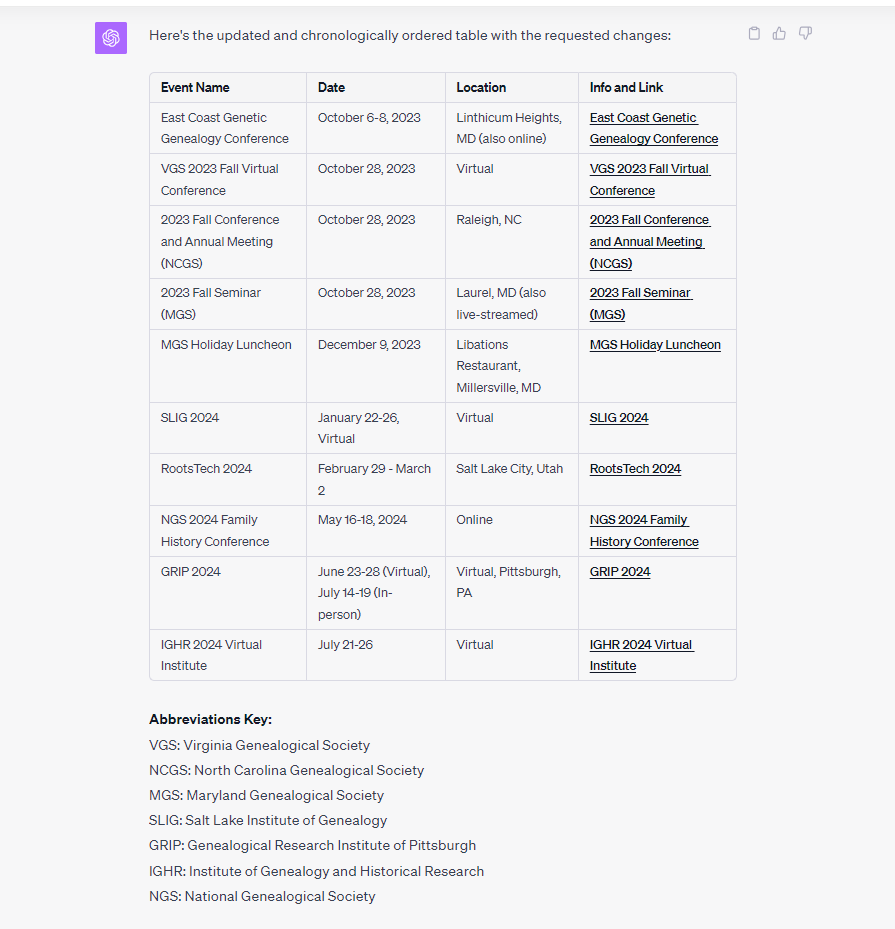
Second, look at the conversation I had with ChatGPT Browse with Bing earlier today. I was able to have ChatGPT Browse with Bing successfully create a list of genealogical education events between October 2023 and through summer 2024. It got all the details correct. But it took 26 prompt refinements. Admittedly, that means it only took about five minutes to build the calendar of events. But in the spring, it would have taken much less time and effort. I suspect this extra work is related to the guardrails that were installed. (This is the only mode of ChatGPT that appears to be effected; that is, other flavors of GPT-4 remain as robust as ever.)
Third, Reddit user ry4ny speculates that OpenAI has adjusted the presence penalty and temperature settings. As ry4ny notes, these changes might occur once the browser feature is engaged, transitioning the model from a ‘normal’ chat mode to a more restricted browsing mode. They also conjecture that the model might be using specific restart texts, which could explain the consistently repetitive endings in its completions.
So, enjoy ChatGPT Browse with Bing, but know that you will need to keep working to get the results you need.
Having just said that, now is probably a good time for a couple of reminders:
just as writing means rewriting, so prompting means re-prompting (I NEVER get anything perfect on the first attempt);
the AI does not have feelings, so it won’t get frustrated if you ask it 26 times to try again–sometimes that’s what it takes; that is, don’t worry about exasperating the AI, reiterate as much as you need to get the results you want; and
weirdly, for reasons that may not be yet fully understood, although the AI is not alive, you get better results when you talk to the AI as if it were a person (they’re called chatbots for a reason).
So it’s okay to use anthropomorphic language with and about the AI. We just occasionally remind ourselves these are figures of speech.
[LANGUAGE NOTE: Anthropomorphism is a figure of speech. AIs are not sentient. They are not alive. They do not "see," they analyze images; they do not "hear," they process audio signals; they do not "think," they evaluate. But it is okay if we speak as if AIs did see, hear, and think. We use figures of speech to communicate better.]
First-time visitors: If the topic of AI-assisted genealogy is of interest to you, you can subscribe to the right to receive notice of new posts at AI Genealogy Insights. And Welcome! - Steve
I gave a presentation titled “Empowering Genealogists with AI” to the National Genealogical Society on September 6, 2023. The talk covered emerging beneficial use cases of AI-assisted genealogy while addressing current limits, privacy issues, and ethical concerns, and includes a homework assignment you can complete to create an AI-generated handout as practice (jump to 1:04:00 for instructions). You can view the talk here: https://youtu.be/npQaRJbzE1s.
I had a great time with the presentation. I hope you enjoy it. And I am grateful to NGS for the opportunity.
The post was prepared as part of my upcoming talk: The National Genealogical Society is hosting a MemberConnects! event on Empowering Genealogists with Artificial Intelligence. Join us Wed. 6 Sept 2023, at 8 p.m. ET. Register here: https://bit.ly/NGSMemberConnects6Sept2023
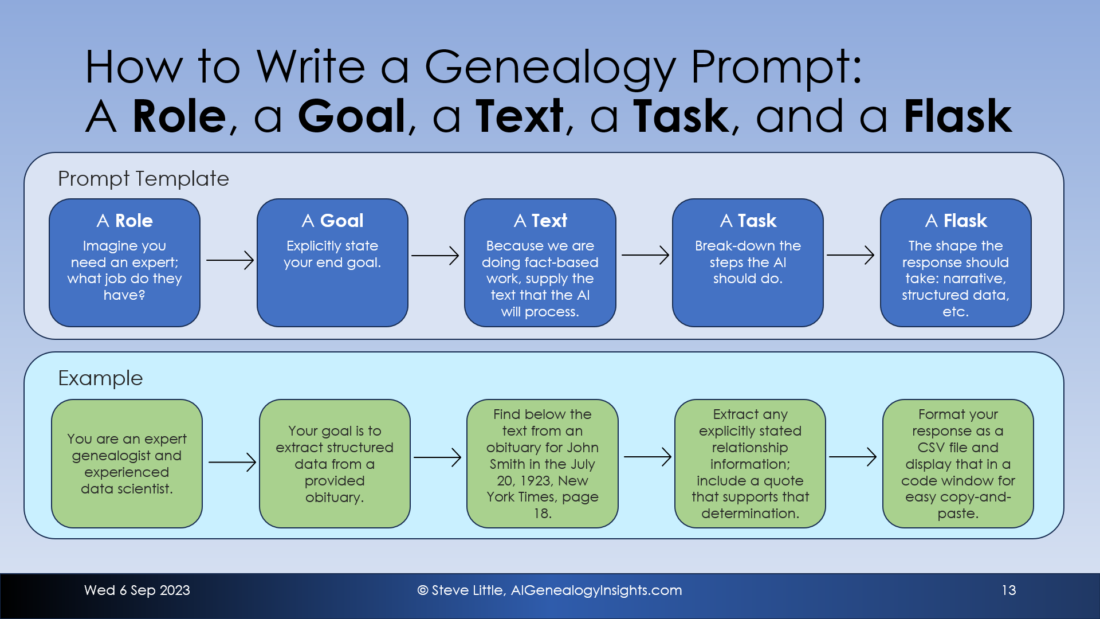
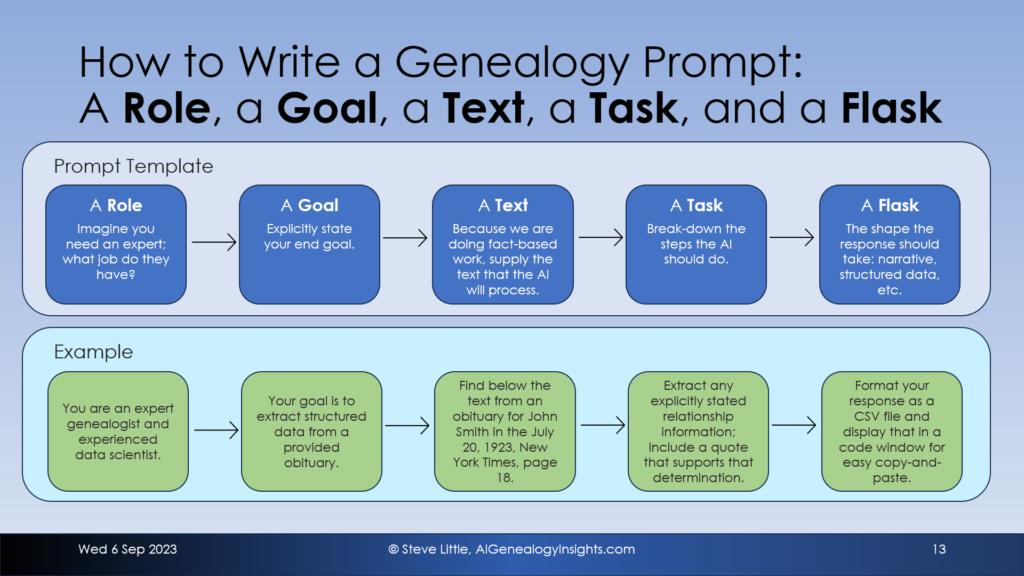
As we venture deeper into the digital age, the intersection of genealogy and artificial intelligence (AI) is becoming increasingly more exciting. Today, I’m diving into a key skill that will empower your genealogical research with AI: how to craft effective prompts for large language models (LLMs) like ChatGPT.
If you’ve been following the ongoing conversation about genealogy and AI, you’ll recall that while LLMs have an arsenal of abilities, they also come with some quirks. To guide them effectively, we need to be thoughtful in our approach.
So, without further ado, let’s discuss the five components that make for a great genealogy prompt!
1. A Role: Begin by imagining you’re recruiting an expert for a specific task. What’s their profession? What expertise should they possess? By defining a role, you’re setting the stage and giving the LLM a context to operate within.
2. A Goal: What do you want to achieve? This is your endgame. Being explicit here ensures that the AI has a clear understanding of your expectations.
3. A Text: Since genealogy is grounded in factual research, provide the text you’d like the AI to process. By supplying the exact text, you mitigate the risk of the AI generating fictitious information (a phenomenon known as “hallucinating”).
4. A Task: Simplify your request. Break it down into manageable steps, just as you’d explain a process to a bright but inexperienced intern. This ensures the LLM knows the sequence of operations it should perform.
5. A Flask: While the term “flask” is playfully chosen for the rhyme, it represents the container or format you’d like your response in. This could range from a narrative report to a structured database table.
For instance, consider this prompt:
PROMPT: You are an expert genealogist and a seasoned data scientist. Your goal is to extract structured relationship data from a provided obituary. Find below an obituary for John Smith from the July 20, 1923, New York Times, page 18. Extract any explicitly stated relationship information; include a quote that supports that determination. Format your response as a CSV file and display that in a code window for easy copy-and-paste.
By following this structure, you provide the LLM with a roadmap to navigate your request. The result? You get precisely the information you’re looking for, formatted just the way you want it.
In conclusion, the digital world of genealogy is at our fingertips, and with tools like ChatGPT, the possibilities are endless. But remember, like any tool, its effectiveness lies in how we use it. With a role, goal, text, task, and flask in hand, you’re all set to harness the full power of LLMs for your genealogical pursuits. Happy researching! 🌳🔍🖥️
UPDATE: Shortly after sharing this post, Bob Coret, the creator of the “Open Archives” plugin (and a founder of the site), got in touch. The “Open Source” plugin in more impressive than my cursory exploration revealed. The plugin is more thoroughly documented at his blog post, which is linked at bottom along with further observations.
For those engaged in A.I. genealogy and digital explorations, this piece investigates a modest recent progression in A.I.-assisted genealogical research. You may already be familiar with this if you’re a seasoned researcher, but for those who haven’t encountered it yet, this post will introduce a compelling new tool. It’s particularly relevant for those interested in Dutch and Belgian archives, but the implications could extend far beyond these boundaries.
Encountering Open Archives
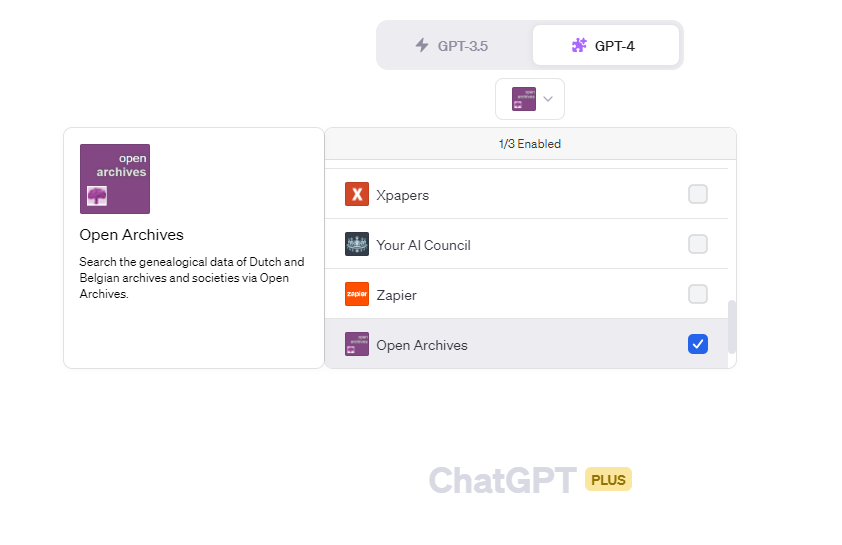
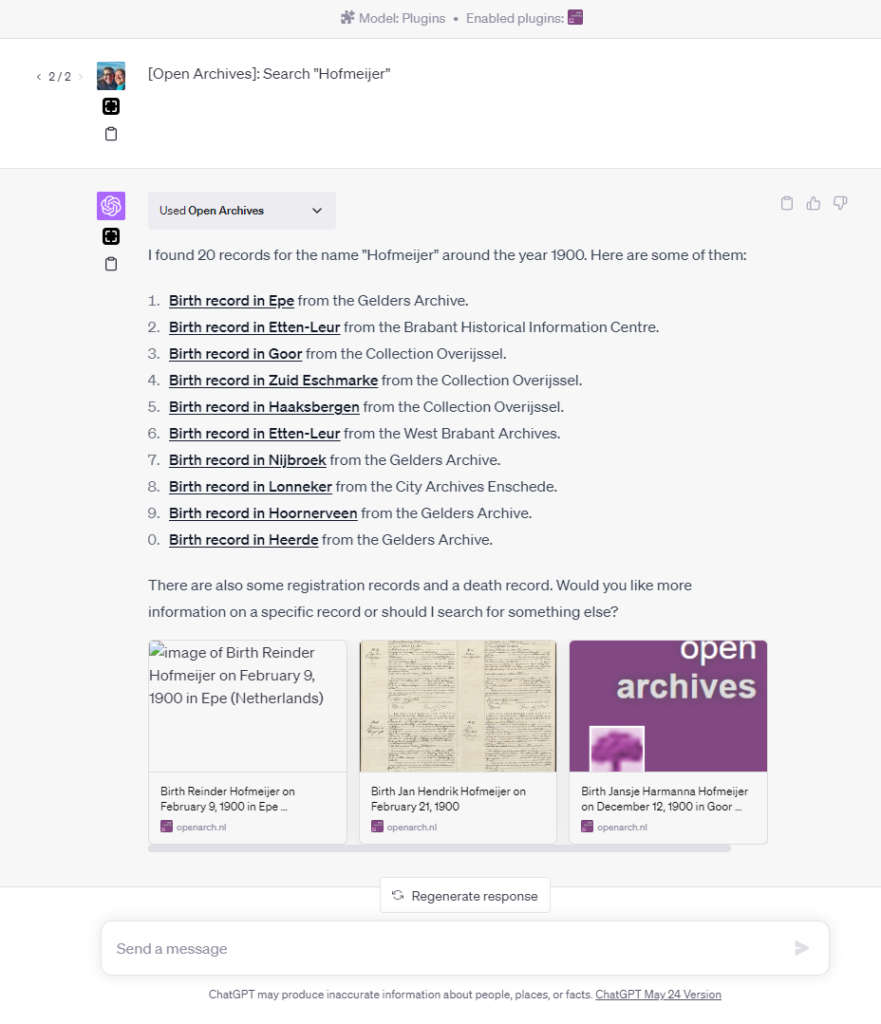
While exploring the digital landscape for genealogy-related plugins, I made an intriguing discovery: the “Open Archives” plugin. This tool offers a novel approach to accessing genealogical data from Dutch and Belgian archives and societies. Here’s how the plugin describes itself: “Search the genealogical data of Dutch and Belgian archives and societies via Open Archives.”
[Image 1 Caption: A glimpse of the Open Archives plugin interface.]
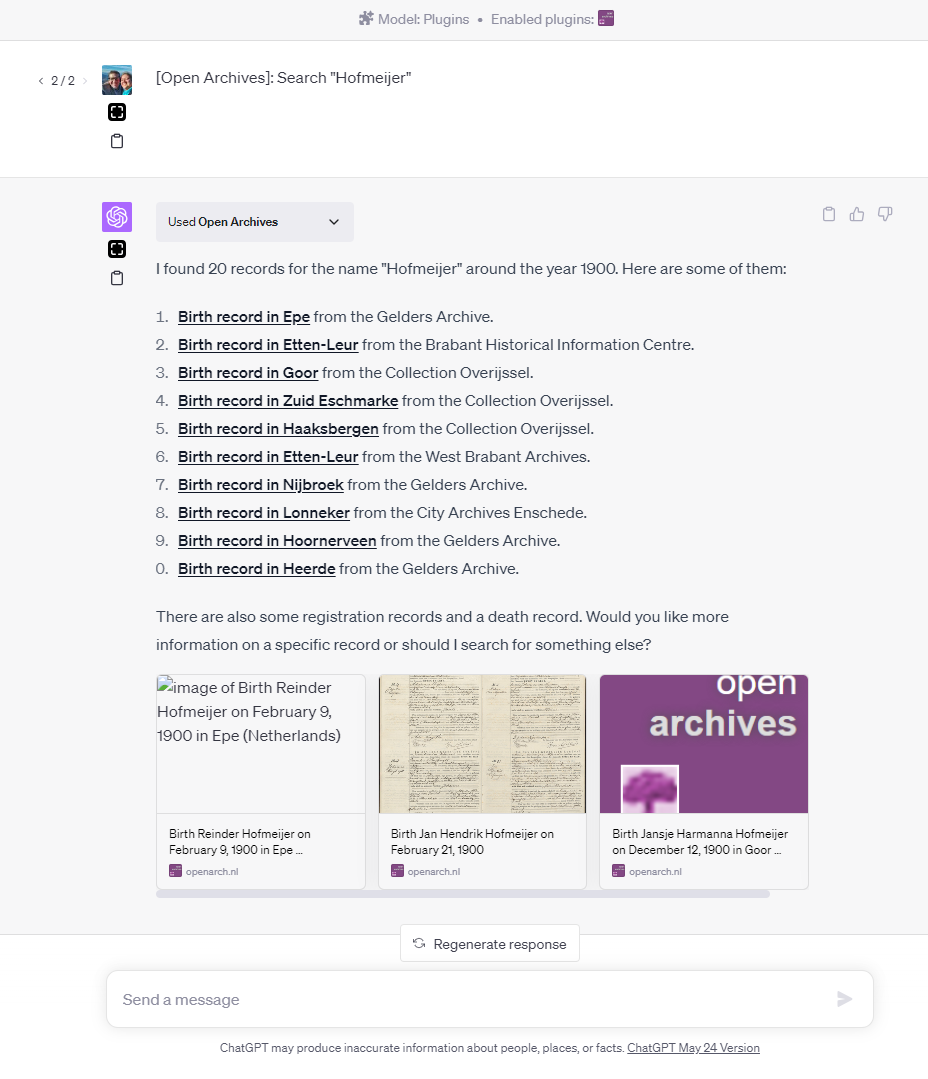
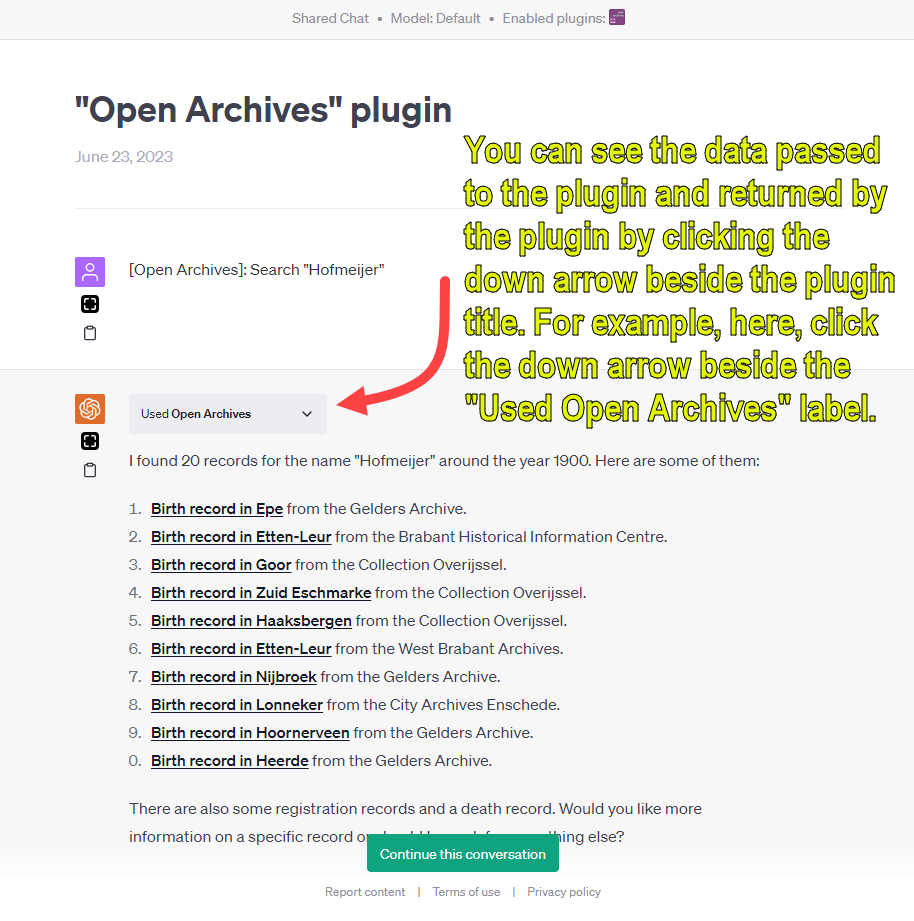
A preliminary test shows promising results. The plugin appears to effectively search records across these archives, providing links to found records on the original archive websites.
[Image 2 Caption: A sample prompt and response demonstrating the plugin’s capabilities.]
However, it’s worth noting that the plugin currently does not offer additional AI processing of the records within ChatGPT directly. That is, the plugin doesn’t import the record data into the chat session, a feature that could potentially add another layer of convenience and efficiency to our research.
Exploring the ChatGPT Session
To fully understand the potential of this tool, consider this: anyone can access the ChatGPT session via this link, and the returned links are live. Registered ChatGPT users can continue the chat and ChatGPT Plus subscribers can also carry on the conversation with the plugin enabled.
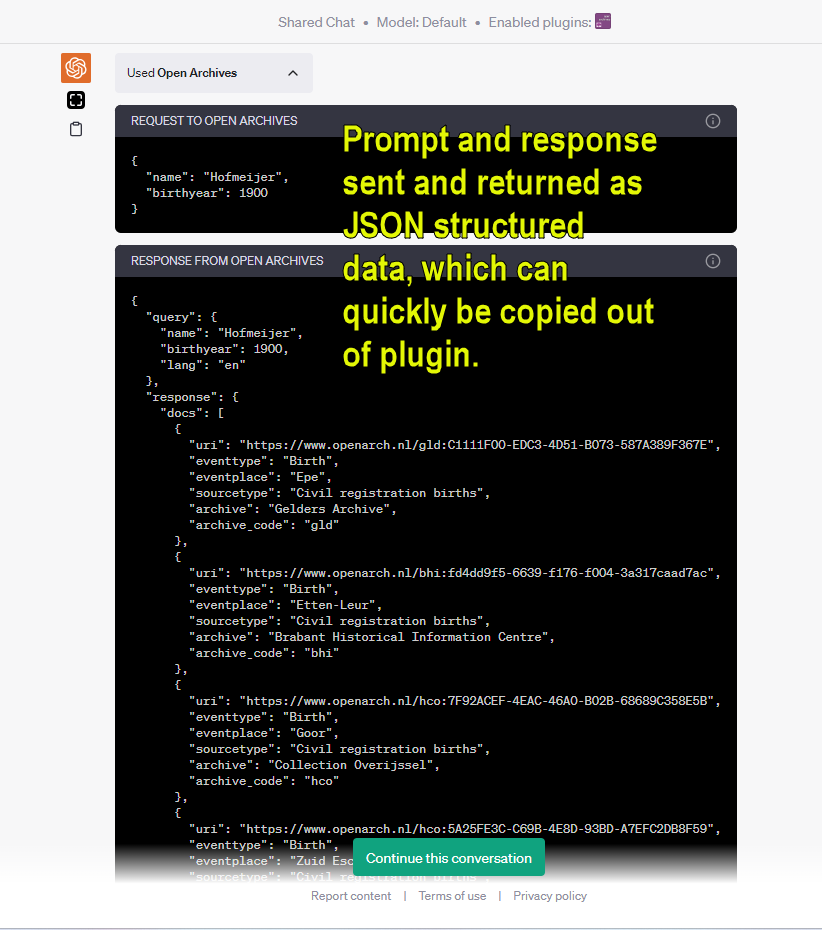
Beyond simply using the plugin, it’s also possible to examine the data passed to the plugin and returned by it. All you have to do is click the down arrow beside the plugin title. In this case, for example, click the down arrow next to the “Used Open Archives” label.
[Image 3 Caption: The Open Archives plugin’s ‘More Information’ button.]
The Nitty-Gritty: Structured Data
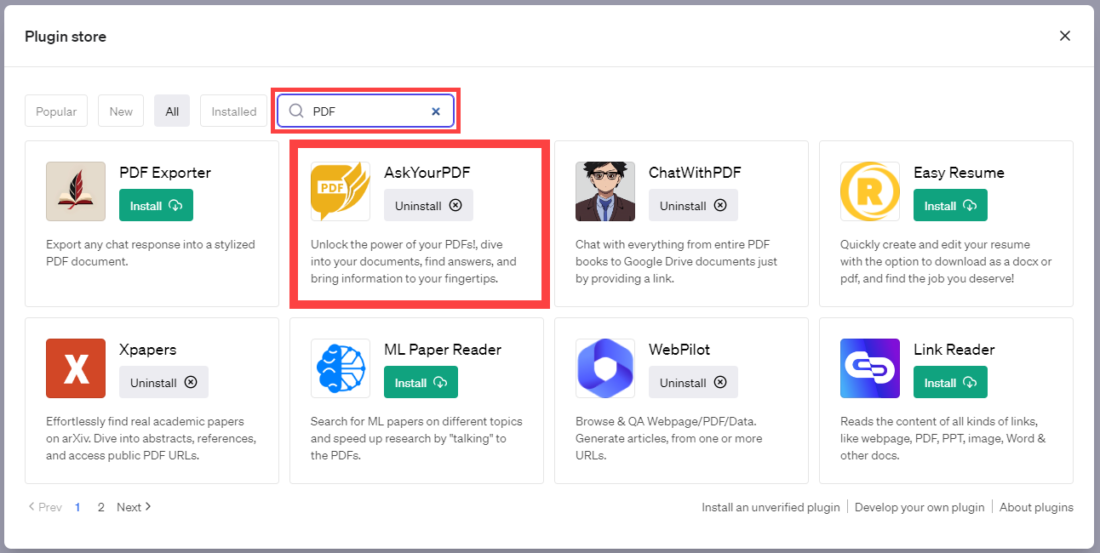
The data exchange between the user and the plugin happens in the form of JSON structured data, a widely used format that allows for easy copying out of the plugin.
[Image 4 Caption: A snapshot of the JSON prompt and response.]
The Road Ahead
While the Open Archives plugin doesn’t yet import the record data into the chat session, this pioneering tool provides a glimpse of what might be possible in the future of digital genealogical research. It paves the way for a more interactive, AI-enhanced exploration of historical records, opening up new avenues for discovery and understanding. As researchers and enthusiasts, let’s keep our eyes on the horizon for what’s coming next!
UPDATE: Shortly after sharing this post, Bob Coret, the creator of the "Open Archives" plugin (and a founder of the site), got in touch. The "Open Source" plugin in more impressive than my cursory exploration revealed. The plugin is more thoroughly documented at his blog post, which is linked below.

* Contrary to a comment in the linked article, the plugin does import record data into the chat session. In simple cases, you can ask the system for birth information (date/place) for a specific person, and then continue in a chat style by asking when the person died.
* A more complex query that can be made is "did they have children". For this, ChatGPT needs to call a specific function using a unique identification (GUID) of a marriage certificate.
* Another impressive query is "how old was {name}". For this, ChatGPT makes two requests to Open Archives (for birth and death records) and calculates the person's age.
* Bob Coret has documented his experiences with the plugin in more detail in a blog post, which is written in Dutch but easily translated to your first language.

https://blogbob.coret.org/2023/06/open-archieven-als-plugin-voor-chatgpt.html
What they are, where to get them, why use them, and how to use them: Using the AskYourPDF plugin as an in-depth example
I. Introduction: Plugins: What, why, where, & how
[NOTE: For clarification: the plugin features discussed in this post require a ChatGPT Plus subscription. At $20/month, you gain access not just to GPT-4 with its advanced functionalities – of which plugins are merely an additional advantage – but to an AI model that vastly outperforms GPT-3.5 and others like Bard, Claud, etc. Trying GPT-4 offers an incredible opportunity to unlock the vast capabilities of AI that you might not be fully utilizing yet. While plugins are a welcome bonus, GPT-4 is truly the star of the show. In other words, no one is paying $20 for plugins–it’s GPT-4 that’s worth the cost.]
Welcome to a fascinating exploration at the intersection of artificial intelligence and genealogy. If you’re a genealogist or a family history enthusiast, you are likely always on the lookout for tools that can aid in your research, streamline your workflow, and unlock new insights. Today, we’re going to delve into a resource that may be new territory for many: ChatGPT and its versatile plugins.
ChatGPT, developed by OpenAI, is a highly advanced language model trained on a diverse range of internet text. But what does that mean for you? Well, in simple terms, it’s like having a tireless research assistant that can generate human-like text based on the prompts you provide. It can answer questions, write essays, summarize text, and even generate creative ideas — all in the blink of an eye. It’s a tool that has been making waves in many fields, from education to business to creative writing, and it is beginning to assist the world of genealogy.
In this blog post, we’re going to introduce you to the world of plugins designed for ChatGPT Plus. We’ll explore what a plugin is, why it’s beneficial for genealogists, and how to enable, install, select, and use a plugin. We’ll also showcase some plugins that will be of particular interest to genealogists, and provide a more in-depth introduction to the AskYourPDF plugin, a tool that could prove invaluable in your research. So, whether you’re a seasoned genealogist or a beginner just starting your journey into your family’s past, join us as we explore the new frontier of AI-assisted genealogical research. The future of genealogy is here, and it’s incredibly exciting. Let’s dive in!
Essentially, a plugin is a piece of software that adds new features or functionality to another program.
II. What is a Plugin for ChatGPT Plus
In our digital age, the term “plugin” is quite common, but let’s pause a moment to ensure we all understand what it means in the context of ChatGPT Plus. Essentially, a plugin is a piece of software that adds new features or functionality to another program. Think of it as an accessory or an add-on that enhances the base product. In this case, the base product is ChatGPT Plus, and plugins are designed to augment its abilities, tailoring it to better fit your specific needs.
Now, you may be wondering: “What kind of enhancements are we talking about?” The beauty of plugins lies in their diversity. Some plugins are designed to give ChatGPT Plus new abilities, like parsing specific data formats or interacting with certain databases. Others are designed to improve the quality of the AI’s output in specific contexts, like technical writing or poetry composition. And some plugins, like the AskYourPDF plugin we’ll discuss later, can provide a seamless interface between ChatGPT Plus and other software or data sources.
For genealogists, plugins for ChatGPT Plus offer an opportunity to tailor the AI to better suit the unique needs of genealogical research. They allow you to push the boundaries of what’s possible with AI assistance, and help you leverage the vast capabilities of ChatGPT Plus in new and exciting ways. With the right plugins, you can transform ChatGPT Plus into a specialized tool for genealogical research, a tool that can save you time, streamline your research process, and help you unearth insights that might otherwise have been missed. In the following sections, we’ll explore this in more detail, providing a clear guide on how to use these plugins and highlighting some of the most valuable ones for genealogists. Stay with us as we journey further into the world of ChatGPT Plus plugins. It’s a world full of potential, and we’re excited to help you discover it.
PRO TIP: The AskYourPDF plugin not only allows you to search in, extract from, and chat with(!) a PDF document, but it can also access PowerPoint (.ppt and .pptx files), Excel and Google Sheets spreadsheets (.csv files), ebooks (.epub files), and Word and Google Docs documents (.rtf files).
A.I. Genealogy Insights
III. Why? The Value of Plugins for Genealogists
In the world of genealogy, every piece of information, no matter how small, can potentially be the key that unlocks a new understanding of your family history. The search for these pieces often involves sifting through vast amounts of data, from online records to old letters to scanned documents. This is where plugins for ChatGPT Plus can bring significant value.
Plugins can enhance the capabilities of ChatGPT Plus in ways that are particularly beneficial for genealogical research. For instance, some plugins are designed to improve the AI’s ability to understand and generate text in specific contexts. These can be incredibly helpful when you’re trying to interpret old documents written in outdated or specialized language. With the right plugin, you could ask ChatGPT Plus to explain what a certain phrase means or to provide a modern language paraphrase of an old letter.
Other plugins can help ChatGPT Plus interact with specific databases or digital resources. This can save you considerable time by automating some of your research tasks. Instead of manually searching through an online database for records of a certain individual, you could ask ChatGPT Plus, with the right plugin, to do it for you. You could even ask it to summarize the findings or highlight the most relevant details.
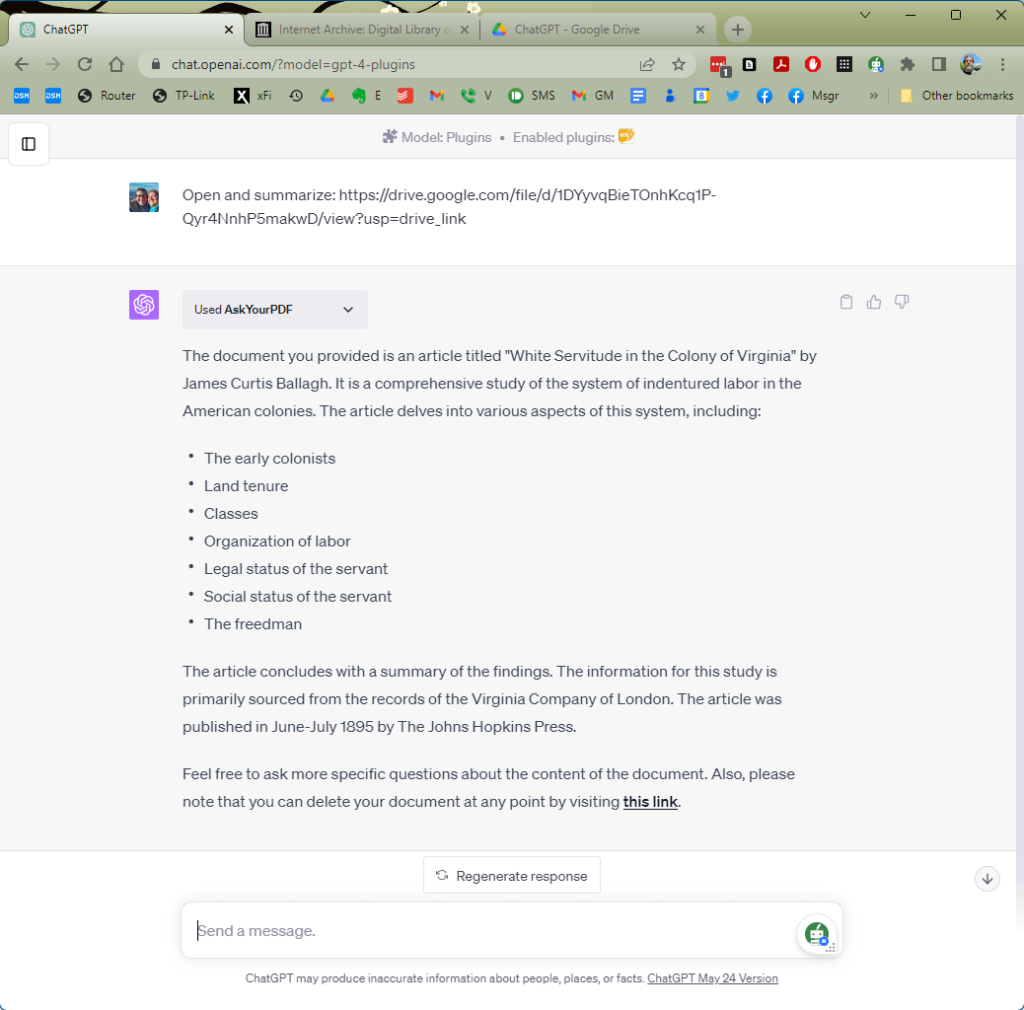
Let’s consider a specific example: the AskYourPDF plugin. This plugin allows ChatGPT Plus to interact with PDF files, a common format for many digital resources used in genealogical research. With this plugin, you can ask ChatGPT Plus to extract information from a PDF, such as the names and dates mentioned in a scanned census record or the key points from a lengthy historical article. This can be a huge time-saver, allowing you to focus more on interpreting the information and less on finding it. As we delve deeper into the realm of ChatGPT Plus plugins, it becomes clear that these tools hold great potential for genealogists. By automating tasks, interpreting complex language, and interacting with a range of digital resources, plugins can make your genealogical research more efficient and insightful. They are valuable tools in the modern genealogist’s toolbox, and we’re excited to help you explore them further.
In a moment, we will explore how to use the AskYourPDF plugin, but first we’ll talk about who can use this plugin, where to find it, how to install it, and how to activate it for use.
All ChatGPT Plus users now have access to plugins but they may not know that because plugins are considered a “beta” feature that are not enabled by default; that is, all ChatGPT Plus users can access plugins by enabling that beta feature.
A.I. Genealogy Insights
IV. How to Enable plugins, Install, Select, and Use a ChatGPT Plugin
Ready to dive into the world of plugins? This section will guide you through the process of enabling, installing, selecting, and using a plugin with ChatGPT Plus. Before we get started, it’s important to note that plugins are currently a beta feature. This means you’ll need to enable beta features in your OpenAI account settings.
Here is a step-by-step guide to get you started:
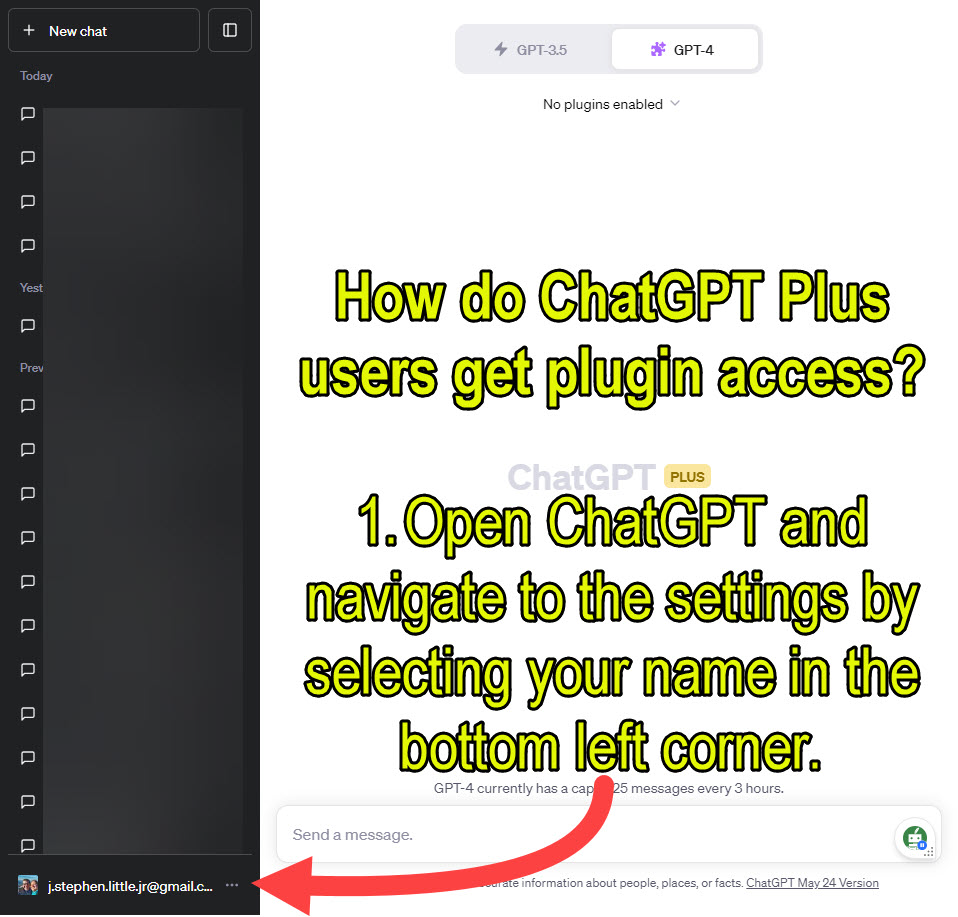
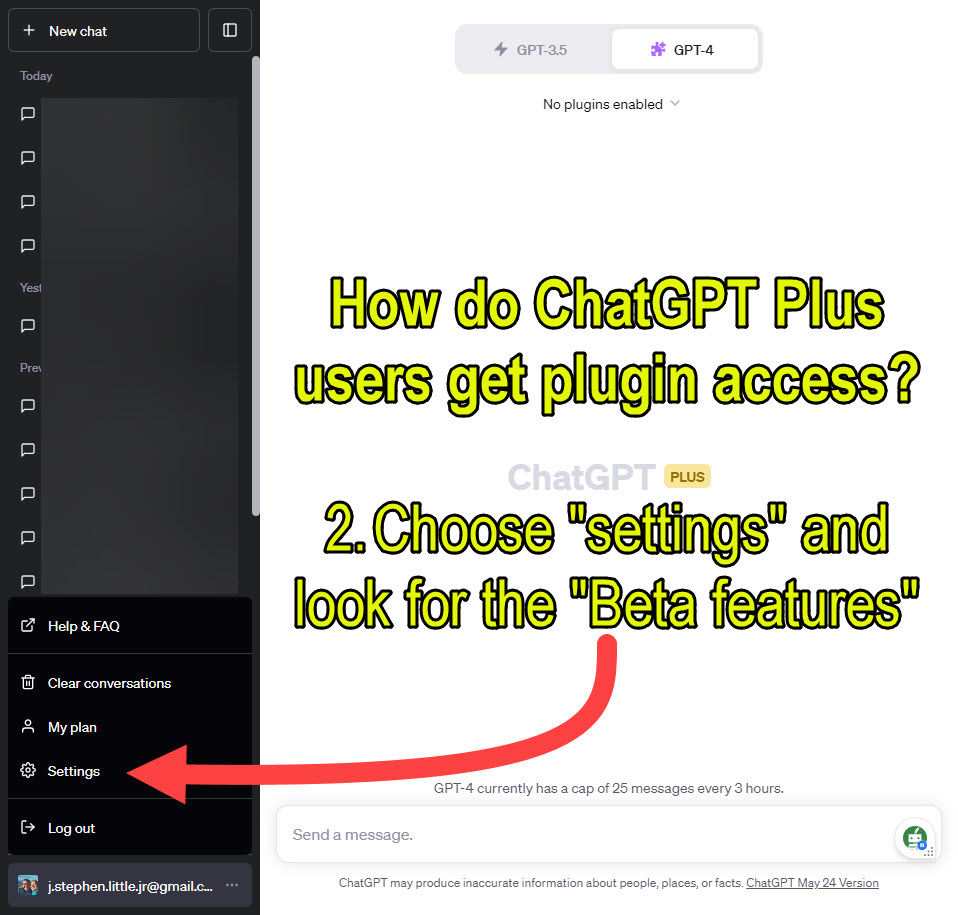
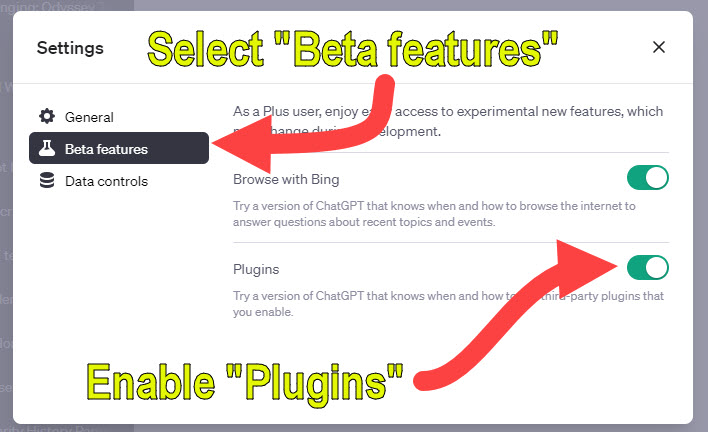
1. Enable Beta Features: Log into your OpenAI account and navigate to your account settings. Look for a section titled “Beta Features” and check the box to enable them.
Open ChatGPT and navigate to the settings by selecting your name in the bottom left corner.After opening the menu by clicking the dots next to your username, click “Settings” and look for the radio buttons to enable “Beta features.”After clicking “Settings,” use the radio buttons to enable “Plugins.” While you are here, go ahead and enable “Browse with Bing,” which will empower you to use ChatGPT to browse the internet and answer questions about recent topics and events.
2. Access the Plugin Marketplace: Once you’ve enabled beta features, you can access the plugin marketplace. This is where you can browse available plugins, read descriptions, and see user reviews.
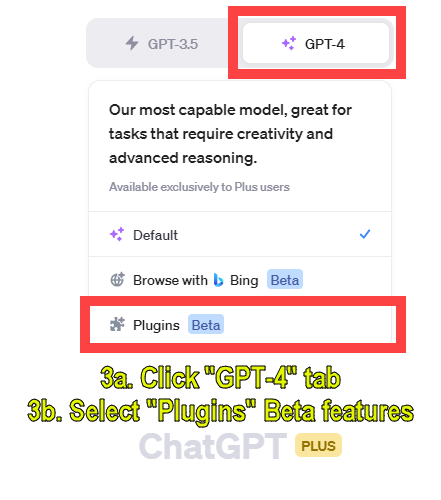
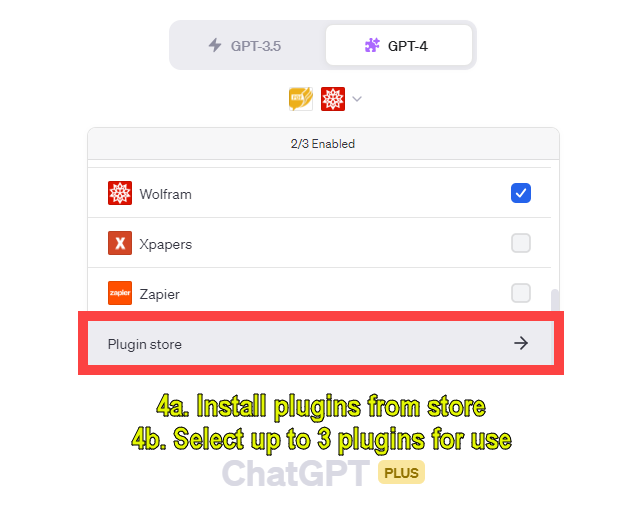
To access the Plugin store or “Marketplace,” ChatGPT Plus users can click the “GPT-4” tab, opening the drop-down menu, and selecting the “Plugins Beta” model (the version or flavor of ChatGPT you wish to use).
After selecting the Plugins Beta model, select “Plugin store” from the drop-down menu.
3. Install a Plugin: When you’ve found a plugin you’d like to try, select it to see more information. You’ll see an “Install” button on the plugin’s page. Click this button to add the plugin to your ChatGPT Plus. Currently plugins are free, but only three plugins can be “active” at any one time.
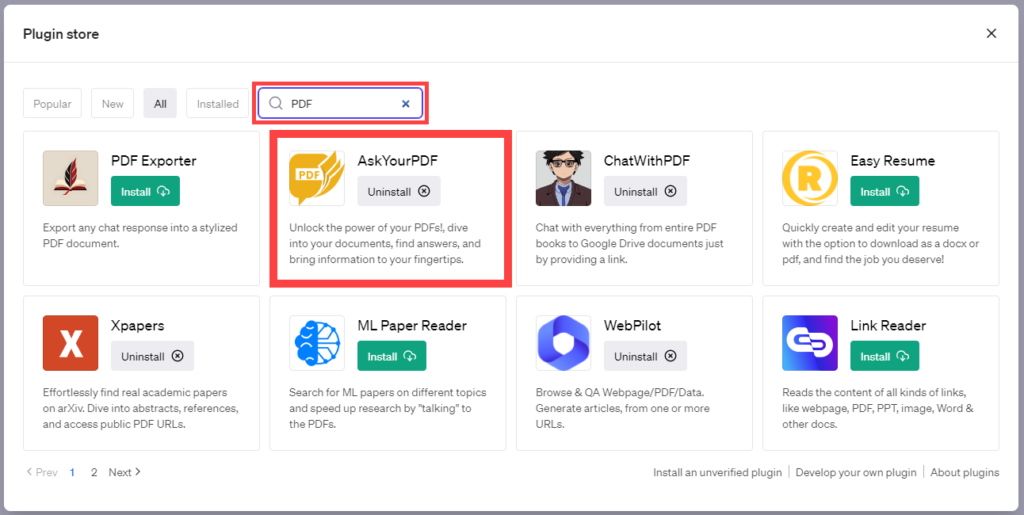
In the Plugin Store, you can search names and descriptions of plugins. Search for “pdf,” and several plugins with PDF capabilities will surface in the results. Currently, our tests indicate that “AskYourPDF” is the strongest plugin for working with PDFs. Click the “Install” button to add the plugin to your list of accessible plugins. Currently plugins are free, but only three plugins can be “active” at any one time.
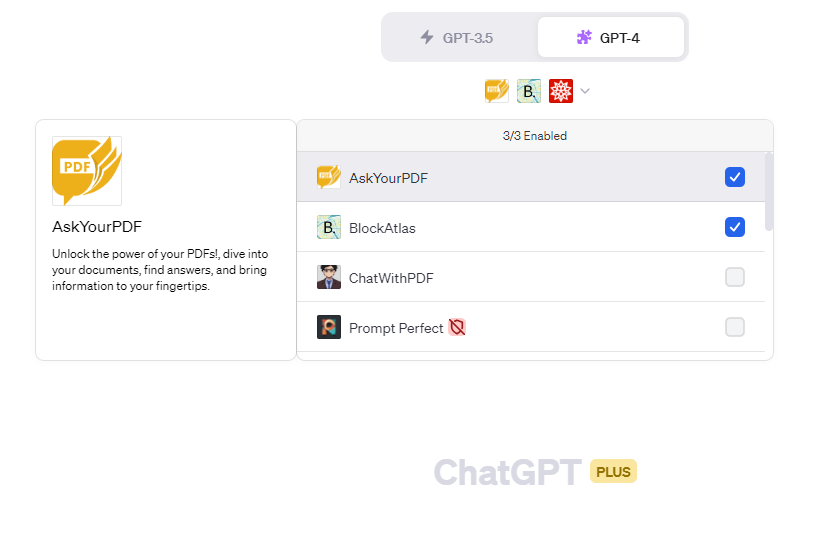
4. Select a Plugin: Once you’ve installed a plugin, you can select it for use. Although you can install any number of plugins, only three can be “active” at any one time. Of the active plugins, ChatGPT will select the most appropriate plugin as ChatGPT determines. PRO TIP: Because ChatGPT determines which active plugin to use, we often keep only one plugin active, forcing ChatGPT to use that plugin. Go to your ChatGPT Plus interface, and look for a dropdown menu labeled “Plugins.” This menu will list all the plugins you’ve installed. Select the plugin you want to use from this list.
Select a Plugin: Once you’ve installed a plugin, you can select it for use. Although you can install any number of plugins, only three can be “active” at any one time. Of the active plugins, ChatGPT will select the most appropriate plugin as ChatGPT determines. PRO TIP: Because ChatGPT determines which active plugin to use, we often keep only one plugin active, forcing ChatGPT to use that plugin.
5. Use a Plugin: With a plugin selected, you can now use it in your interactions with ChatGPT Plus. The exact way you use a plugin will depend on its specific features and capabilities, so it’s a good idea to read the user guide or documentation that comes with each plugin.
Remember, each plugin will have its own unique features and methods of interaction. Some plugins may provide additional tools or options within the ChatGPT Plus interface, while others might enhance the AI’s responses to your prompts. PRO TIP: Don’t be afraid to experiment and explore the functionality of each plugin. In the next section, we’ll take a closer look at some plugins that are particularly useful for genealogists. Whether you’re looking for assistance with document interpretation, database queries, or another aspect of your research, there’s likely a plugin that can help. Let’s continue our exploration!
V. Suggested Plugins for Genealogists: AskYourPDF, Wolfram, Show Me, BlockAtlas
As a genealogist, the intricate task of tracing lineage and family history can sometimes feel like solving a complex puzzle. Fortunately, there are some innovative ChatGPT plugins designed to make your research more efficient, more accurate, and ultimately more fruitful. In this section, we’ll introduce you to three such plugins: Wolfram, Show Me, and BlockAtlas. We’ll explore their features, advantages, drawbacks, and specific applications for genealogical research. Please note, information about the AskYourPDF plugin will be discussed in detail in the next section.
1. Wolfram Plugin
The Wolfram plugin is a powerful computational tool that enhances ChatGPT’s capabilities in several fields. Originally designed for use in disciplines such as mathematics, astronomy, chemistry, and geography, this plugin can also be a valuable tool in genealogical research.
Features and Uses: The Wolfram plugin can answer complex queries and provide visualizations and real-time data. In genealogy, this could be leveraged to analyze demographic data, calculate generational intervals, and provide visual representations of complex family trees. Additionally, the plugin’s strength in geography can assist in understanding the geographical distribution and migration patterns of your ancestors.
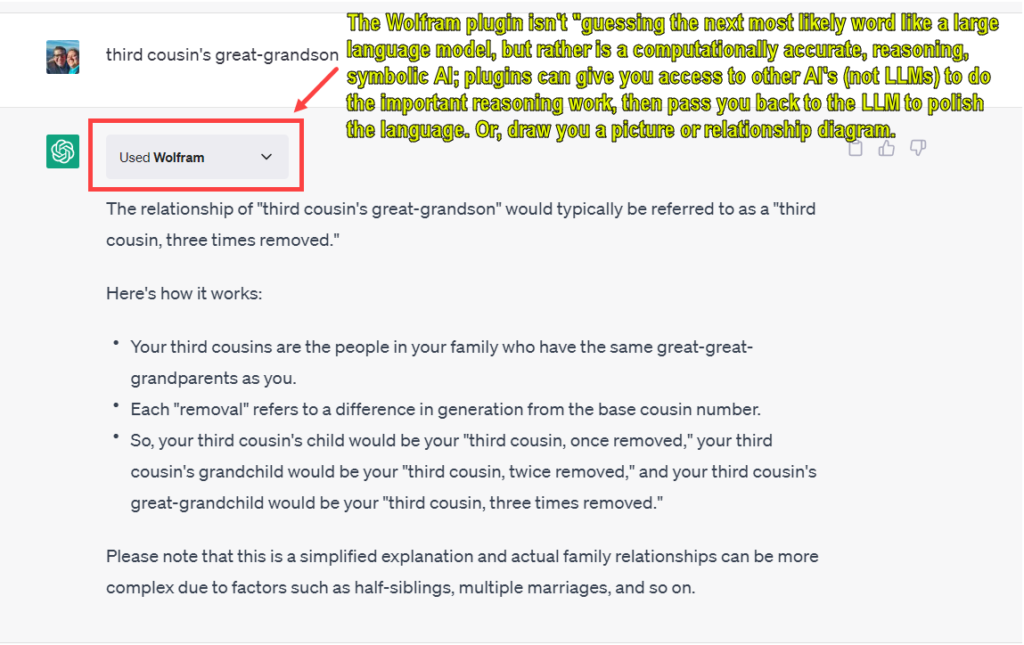
The Wolfram plugin doesn’t merely guess the next most likely word like a large language model, but rather enhances ChatGPT’s abilities with accurate computational reasoning and symbolic AI. Plugins can augment the capabilities of ChatGPT, allowing it to perform computations, deliver curated knowledge and data, and even create visual diagrams. However, they work in conjunction with, rather than replacing, the core language generation functionality of ChatGPT.
Pros: The Wolfram plugin offers improved accuracy and focus in responses compared to the standard ChatGPT model. It can handle complicated questions, providing a more streamlined response without overwhelming you with excess information.
Cons: The Wolfram plugin’s core strength lies in computational tasks and scientific fields. Although it can be significantly beneficial for genealogical research, this is not its primary function.
The Wolfram plugin doesn’t merely guess the next most likely word like a large language model, but rather enhances ChatGPT’s abilities with accurate computational reasoning and symbolic AI. Plugins can augment the capabilities of ChatGPT, allowing it to perform computations, deliver curated knowledge and data, and even create visual diagrams. However, they work in conjunction with, rather than replacing, the core language generation functionality of ChatGPT.
2. Show Me Plugin
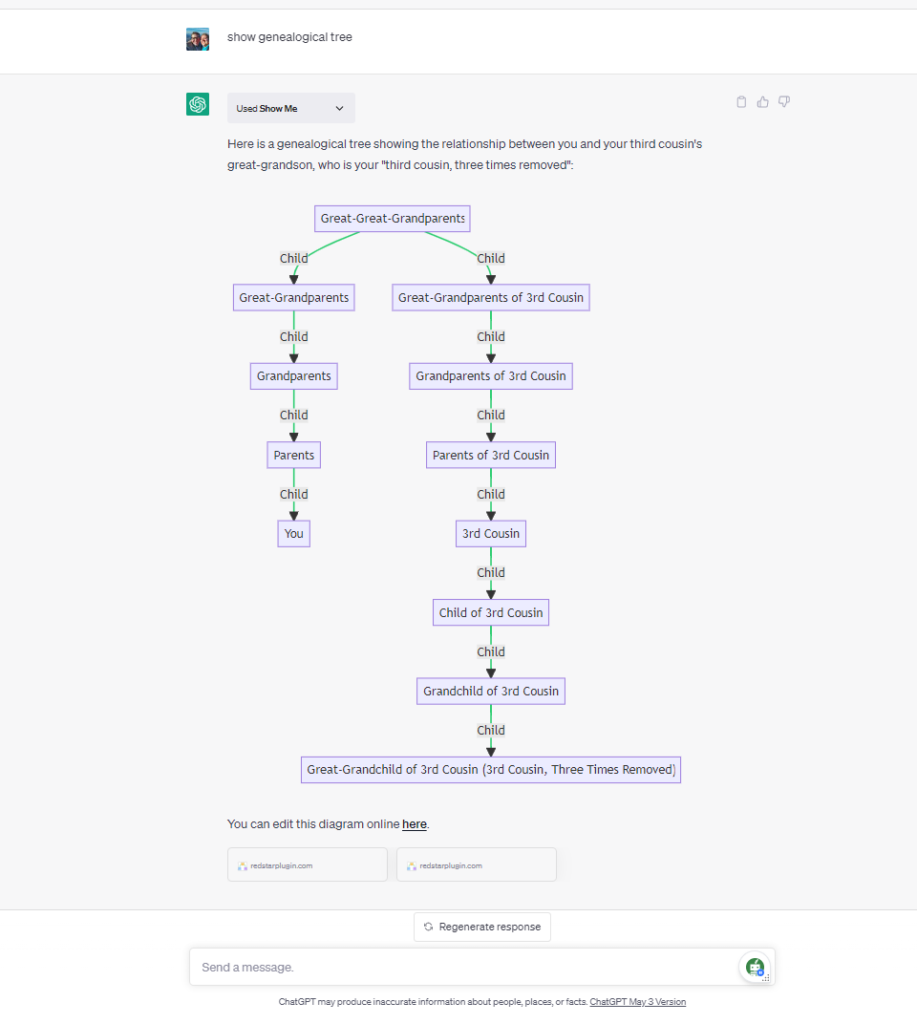
The “Show Me” plugin for ChatGPT Plus users allows the model to create diagrams using Mermaid JS, a JavaScript-based diagram and flowchart generating tool. This plugin is used to visualize data in a variety of graph formats.
Given the plugin’s ability to create diagrams, genealogists might use it to:
Visualize family relationships in the form of pedigree charts or family trees. These could outline ancestry and descent, helping to clearly see familial connections.
Create descendant charts to map out the offspring of a particular individual or couple.
Generate family group sheets that summarize vital information about a specific family, including the parents and their children, along with dates and places of birth, marriage, and death.
Develop family outline reports, which could be used to sequentially list each child in a family and their respective families.
Produce other types of diagrams that might be useful for genealogical research, like timelines or geographical maps.
Please note that these are potential uses inferred from the general capabilities of the “Show Me” plugin and the typical needs of genealogists. The actual possibilities would depend on the specific features and limitations of the plugin, and how well it integrates with genealogical research methods and tools. We were able to confirm the “Show Me” plugin’s ability to use the definition provided by Wolfram to create the diagram of between a person and their third cousin’s great-grandchild (or third cousin, three times removed).
3. BlockAtlas Plugin
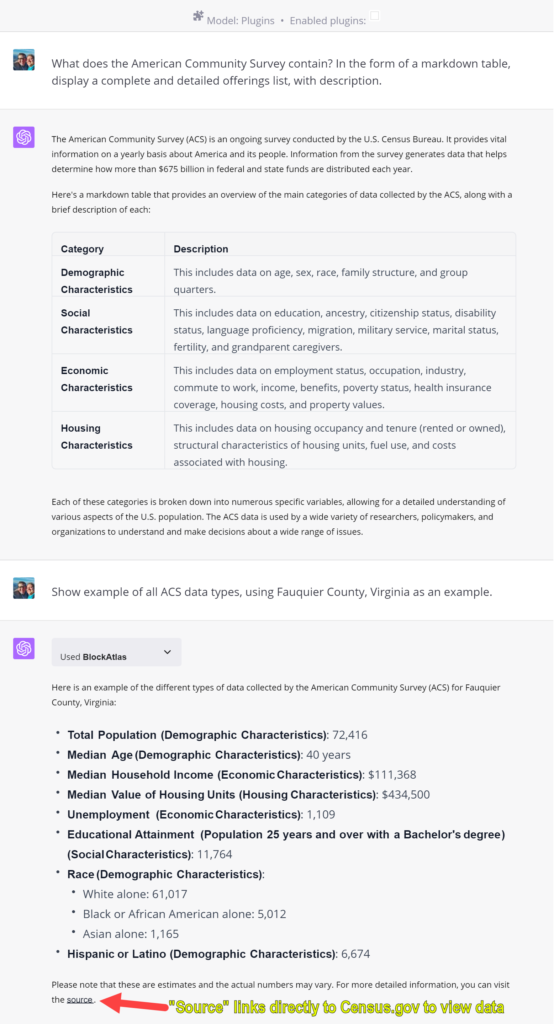
ChatGPT now includes a plugin called “BlockAtlas” which lets you use the AI to question US Census data, or, at least for now, a limited set of US Census data, the American Community Survey since 2005.
ChatGPT now includes a plugin called “BlockAtlas” which lets you use the AI to question US Census data, or, at least for now, a limited set of US Census data, the American Community Survey since 2005.
VI. A Deep Dive into the AskYourPDF Plugin
Navigating the expansive landscape of genealogical research often requires the ability to extract and process information from an array of sources, including PDF documents, text files, spreadsheets, presentation slides, and other documents. The AskYourPDF plugin, designed to work seamlessly with ChatGPT, is a powerful tool that can significantly enhance your ability to work with PDF files, and many other file types, including TXT, CSV, PPT, PPTX, EPUB, and RTF files.
1. Detailed Overview of the AskYourPDF Plugin
The AskYourPDF plugin is an ingenious tool that enables ChatGPT to analyze PDF documents with enhanced capabilities. But what does this mean in practice? This plugin can examine a PDF document, suggest changes, extract pertinent information, and even provide a summary of the document’s content. What’s more, it can be used to search through a lengthy PDF document to find specific pieces of information, saving you precious time and effort.
Security Note: It’s important to exercise caution when using online tools for analyzing sensitive documents. There are websites claiming to offer AI PDF analysis for free, but they may have ulterior motives. For this reason, it’s recommended to only use the AskYourPDF plugin via the ChatGPT prompt window on the official OpenAI website to ensure the privacy and integrity of your documents.
2. How the AskYourPDF Plugin Can Be Used in Genealogical Research
In genealogical research, the AskYourPDF plugin can prove to be a game changer. With the ability to analyze, summarize, and search through PDF documents, it can streamline the process of data extraction and interpretation. For example, if you have a lengthy historical document or a family record in PDF format, this plugin can swiftly sift through it to find relevant names, dates, and events.
Furthermore, if you’re dealing with a large collection of archival documents, the AskYourPDF plugin can help you extract and organize key information, making it easier to trace familial connections and build comprehensive family trees. The ability to quickly locate specific information in voluminous documents also means you can spend less time on manual search efforts and more time on interpreting and connecting the dots in your genealogical research.
3. Tips and Tricks for Getting the Most Out of the AskYourPDF Plugin
Be Specific in Your Queries: When asking ChatGPT to find information in a PDF using the AskYourPDF plugin, be as specific as possible. For instance, if you’re looking for a particular name or event, specify it clearly in your query. This will make the search more effective and yield more accurate results.
Leverage the Summary Feature: If you’re dealing with a long document and want a quick overview, ask ChatGPT to summarize the PDF for you. This can help you grasp the main points and decide whether you need to delve deeper into the document.
Because of the vast potential of this plugin for genealogists, additional research and posts are coming.
VII. Conclusion
As we draw to a close on our exploration of ChatGPT and its plugins, let’s take a moment to revisit the key points we’ve covered.
We started by introducing ChatGPT Plus, an advanced artificial intelligence model capable of engaging in intelligent and meaningful conversations. We learned that plugins are added tools that can enhance the functionality of ChatGPT Plus, providing additional features and expanding the range of tasks it can perform.
The value of these plugins in genealogical research came into focus, illustrating how they can streamline the research process, simplify data analysis, and allow for more efficient exploration of family histories. We also provided a step-by-step guide on how to enable, install, select, and use these plugins, thereby equipping you with the knowledge needed to integrate these tools into your research practices.
The OpenAI ChatGPT “Plugin Store” is not the only place to find plugins. There is a third-party site that offers a superior way to find ChatGPT plugins: WhatPlugin.ai.
Special thanks to a Facebook group “Genealogy and Artificial Intelligence” member for this tip.
We dove into the world of plugins that are particularly useful for genealogists, offering a brief overview of several notable ones. We then took a closer look at three top recommendations: Wolfram, Show Me, and BlockAtlas, explaining their specific features, pros, cons, and uses. This was followed by an in-depth exploration of the AskYourPDF plugin, illustrating its utility in analyzing, summarizing, and searching through PDF documents, a common requirement in genealogical research.
The journey through the capabilities and potentials of ChatGPT plugins hopefully has shed light on how these tools can become valuable allies in your genealogical quest. However, this exploration is far from exhaustive, and the full potential of these plugins can only be realized when they are put to use.
We encourage you to take these insights and explore the plugins further, integrating them into your research methods and tailoring their use to your specific needs. Each plugin brings its own unique set of capabilities, and the right combination of plugins can significantly enhance the scope and efficiency of your genealogical research. Remember, the journey of discovery does not end here. As you continue to work with ChatGPT and its plugins, you’ll undoubtedly find more ways they can aid your genealogical pursuits. Let your curiosity guide you, and let these tools empower your quest for deeper understanding of your family’s history.
This Use Case Guide explains how to utilize artificial intelligence to extract GEDCOM (family tree) files from narrative genealogically-rich sources such as birth and wedding announcements, obituaries, and newspaper articles and the like.
This Use Case Guide begins the same as Use Case Guide #2, but deviates after Step 5 to create the GEDCOM file.
Introduction:
In the world of genealogy research, information is scattered across various sources, including narrative texts such as birth and wedding announcements, obituaries, and newspaper articles. These unstructured narratives can be challenging to manage and analyze. In this blog post, we will explore the specific task of quickly extracting valuable data such as names, relationships, dates, and places from these texts and converting them into structured data formats such as GEDCOM files, the format used to build and exchange family trees and to share genealogical data. This data extraction and storage process is tremendously beneficial for for streamlining genealogical research and making connections between family members, ancestors, and historical events.
To accomplish this task, we will be utilizing ChatGPT, an advanced AI language model developed by OpenAI. ChatGPT is capable of processing and extracting information from large volumes of text, making it an ideal tool for genealogy enthusiasts seeking to organize and analyze their research data efficiently.
Objectives:
Automate the extraction process: Utilize ChatGPT to efficiently extract names, relationships, dates, and places from various sources, such as announcements, obituaries, and newspaper articles, minimizing manual effort and speeding up the research process.
Improve data organization: Convert the extracted information into structured data formats such as GEDCOM files to facilitate better organization, storage, and retrieval of genealogical data.
Enhance data analysis: Enable genealogy researchers to analyze structured data more effectively, identify patterns, and uncover hidden connections between family members and historical events.
Save time and resources: Streamline the research process by reducing the time spent on manually extracting and organizing data, freeing up more time for analysis and interpretation.
Increase research accuracy: Minimize human errors and inconsistencies in data extraction and organization by leveraging ChatGPT’s advanced language processing capabilities.
Requirements:
Access to AI: Obtain a free or paid subscription to an artificial intelligence service such as OpenAI’s ChatGPT. Other AI options include Google’s Bard, Anthropic’s Claude, or Microsoft’s Bing Chat, but in April 2023, OpenAI’s GPT-4 based ChatGPT is strongest.
Input data: Provide ChatGPT with text from sources such as birth or wedding announcements, obituaries, and newspaper articles, containing information about names, relationships, dates, and places relevant to genealogical research.
Family tree software to read and use the GEDCOM file created here. Most genealogy applications and website and utilize GEDCOM files to share family trees and genealogical data; these include desktop applications such as RootsMagic, Family Tree Maker, Gramps, and online resources such as Ancestry, DNA Painter, MyHeritage, and FindMyPast.
Optional: Formatting requirements: Ensure that the input text is free of major errors or inconsistencies. Although ChatGPT can handle some level of noise in the data, better-formatted input will yield more accurate and reliable results. Our earlier Use Case Guide on Cleaning OCR Text quickly steps you through this process.
Helpful: Genealogy research resources: Familiarize yourself with various genealogical research methods, repositories, and databases to: (1) know where to find the texts to data mine, and (2) effectively contextualize and validate the information extracted by ChatGPT.
Caveats for the Careful on Large Language Models in Genealogy (April 2023):
No live internet access, with data current only up to September 2021
Unreliable for fact-based research, relying on statistical language patterns
Official ChatGPT warning: may produce inaccurate information
Mainly used for information processing, not discovering new data
Limited to 1500 words input/output (approx. 4k tokens)
Chatbots lack traditional memory, necessitating careful management of conversation
See Use Case Guide #1: Cleaning OCR Text for detailed information on each caveat above.
How To: Methodology:
Step 1: Get a free or paid AI account. In April 2023, OpenAI’s GPT-4 based ChatGPT is strongest, but the free version based on GPT-3.5 will also work; you can get a free account at https://chat.openai.com/auth/login.
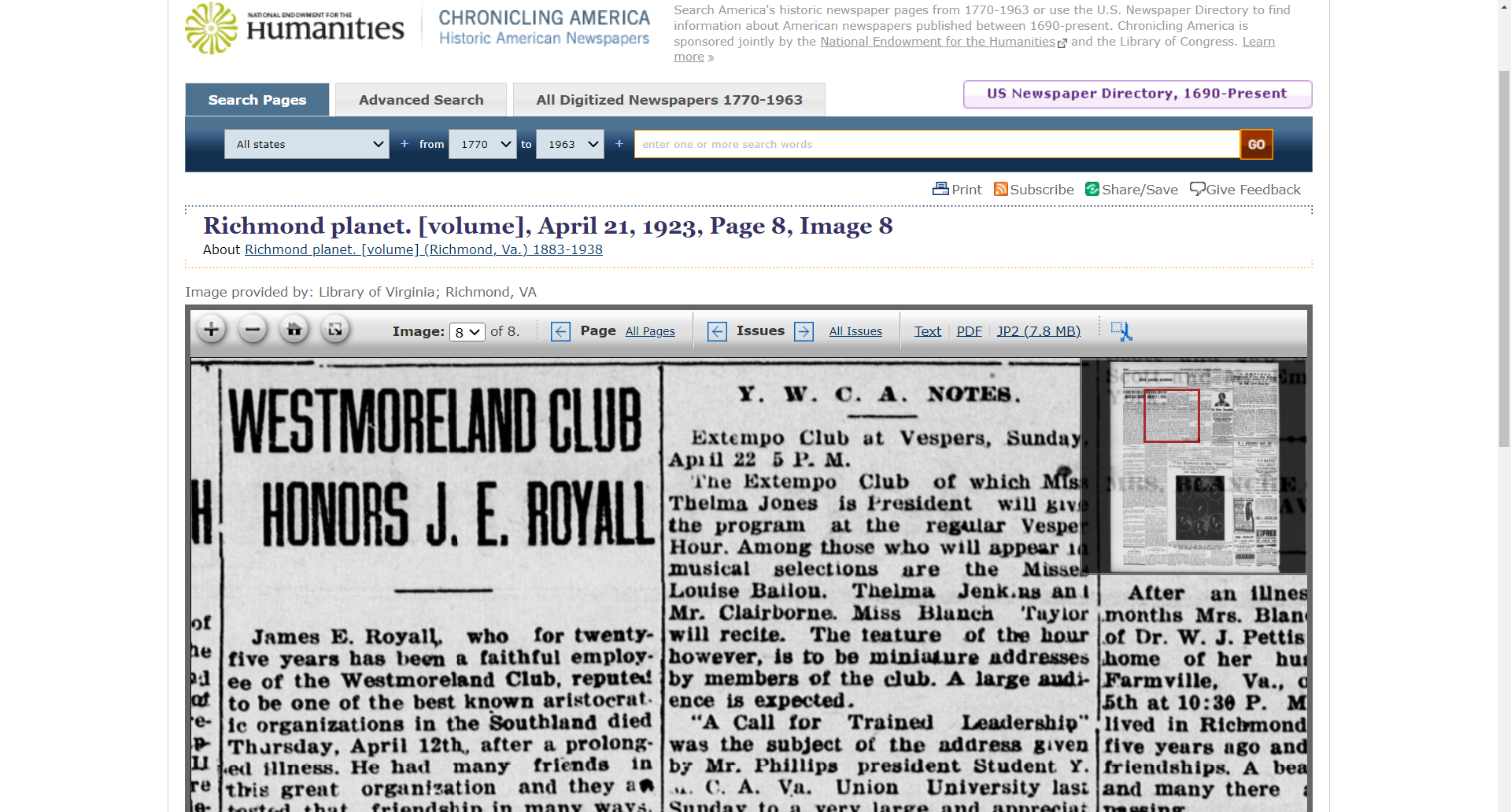
Step 2: Find and prepare your input text. In spring 2023, most publicly-accessibly AI systems are based on large language models that are untethered to reality or knowledge systems; they work by selecting the next statistically most likely word based on your prompt and previous utterances in your chat. For this reason, fact-based researchers such as genealogists restrict the AI to working only on the data you input. In this series of Use Case Guides, we have been using texts from publicly available sources such as the Chronicling America newspaper archive from The Library of Congress and the National Endowment for the Humanities. Our Use Case Guide #1: How to Clean Raw and Poor OCR Text breaks-down this step down in a detailed walk-through; refer to that guide if you would like help with this step. This Guide uses an obituary first published 100 years ago this week in one of my state’s capital newspapers: “Westmoreland Club Honors J. E. Royall,” Richmond Planet (Richmond, VA) 1883-1938, April 21, 1923, Page 8, Image 8; Image and text provided by Library of Virginia; Richmond, VA; < https://chroniclingamerica.loc.gov/lccn/sn84025841/1923-04-21/ed-1/seq-8/ > [accessed: 17 April 2023]. I processed and cleaned the raw (nightmarish) Chronicling American text using the steps in Usage Guide #1.
Step 3: Start a new ChatGPT session. It is important to start a new ChatGPT session when beginning a new genealogical task because (lacking both short-term and long-term memory) the chatbot re-ingests up to the previous 400 lines of your “dialogue” in order to simulate a conversation; this can have the unintended effect of contaminating your chat with information from pervious utterances in the current session. See “Don’t Get Burned by Spicy Autocomplete” for more information about this concern.
Step 4: Write your prompt. Your prompt will include two parts: (a) your instructions to the AI, and (b) the input text from which you want to extract structured genealogical data. We’ll discuss both parts in turn.
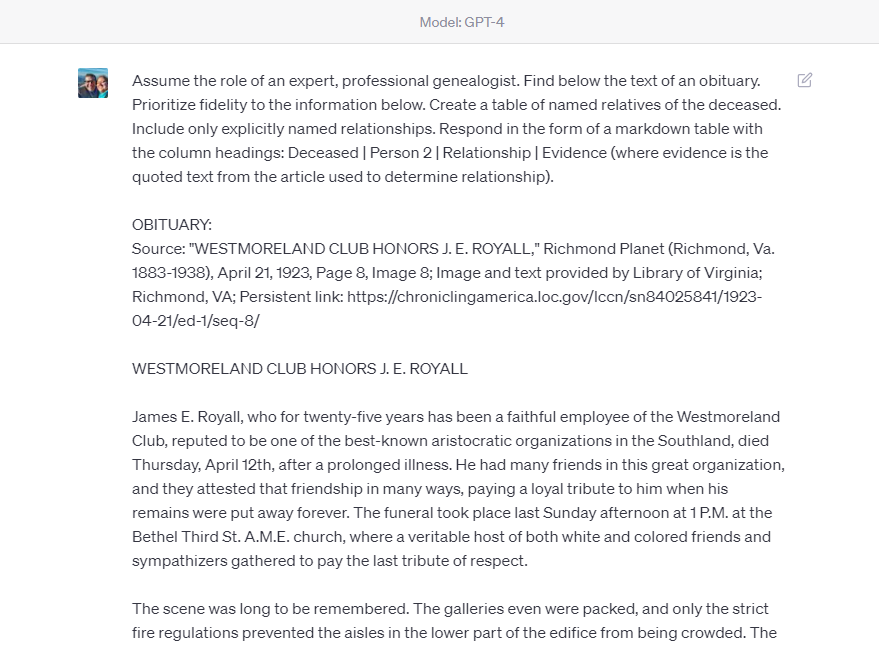
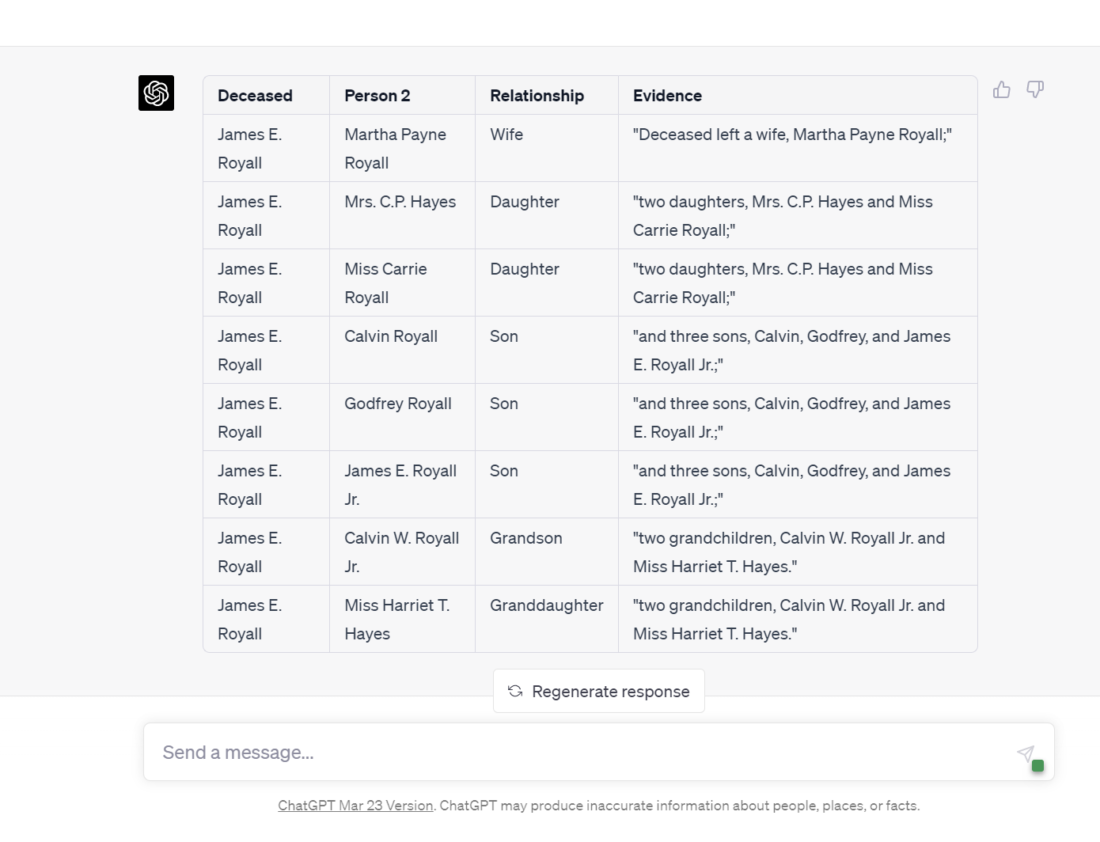
Step 4(a): Write your instructions to the AI. The instructional component of a prompt itself has subcomponents. Here you can see that the first part of the instructions are directing the AI to assume a role, in this case, of a genealogist; this has the effect of providing a context for the AI’s response. Next, action verbs to direct the AI; in this case “Find,” “Prioritize,” “Create,” “Include,” and “Respond.” These will change depending on your task; if you have troubling crafting this part, ChatGPT can help: write the instructions as best you can, then use ChatGPT to “convert these statements to the imperative mood“; this has the effect of changing your statements to the desired form “[you, the AI] do (verb) this.” Finally, you will see that here we are directing the AI to create a table of data; this is the most simple form of structured data, and perhaps the most meaningful and accessible to the human genealogist! Later, I’ll show you how to transform this table data into forms more suited for genealogical tools such as tree making applications, spreadsheets, and databases. To assist in the verification of our work, the AI is instructed to show its work, that is, to include the evidence it used to make a relationship determination by quoting the passage it relied upon to state a relationship. So far, thus prompted, contained, restrained, and instructed, I have not witnessed a fabrication or hallucination of a relationship. If you do, capture and save your whole session; I’d love to see it.
PROMPT: Assume the role of an expert, professional genealogist. Find below the text of an obituary. Prioritize fidelity to the information below. Create a table of named relatives of the deceased. Include only explicitly named relationships. Respond in the form of a markdown table with the column headings: Deceased | Person 2 | Relationship | Evidence (where evidence is the quoted text from the article used to determine relationship).
Step 4(b): Paste your input text below the instructions. Below your instruction, paste the text from which you would like to AI to process. Remember, as of April 2023, we are limited to about 1500 words input. Folks may tell you that you can upload more, perhaps by asking the AI to accept your input in parts, and it will agree to do that, but if you upload more than about 400 lines or about 1500 words, the AI will drop and ignore parts of your input. (In OpenAI’s technical jargon, we are limited to 4096 “tokens,” more akin to syllables than words, but for simplicities sake, about 1500 words input and 1500 words output.) [NOTE: If you need to enter a newline or line break in the ChatGPT edit box, Shift-Enter will give you a new line without submitting the request.]
Step 5: Examine your results; adjust as needed. Just as writing means re-writing, so prompt engineering means prompting and re-prompting. I never get the best results on a first attempt, so I expect to refine a prompt until the AI is producing the data in the form I want.
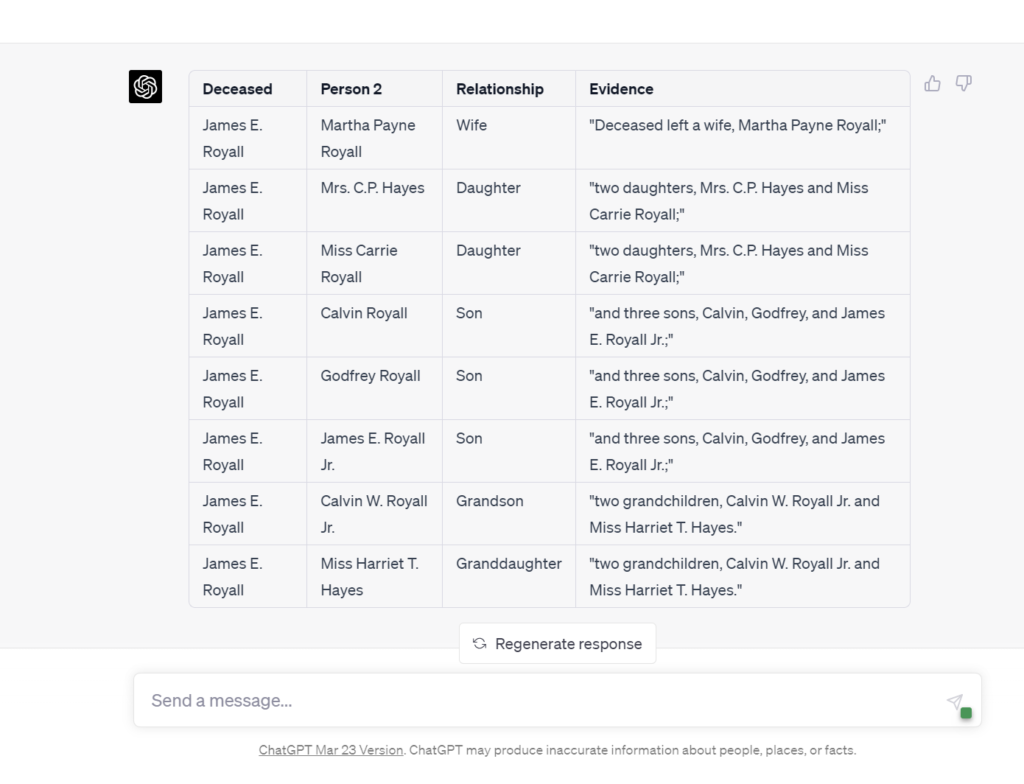
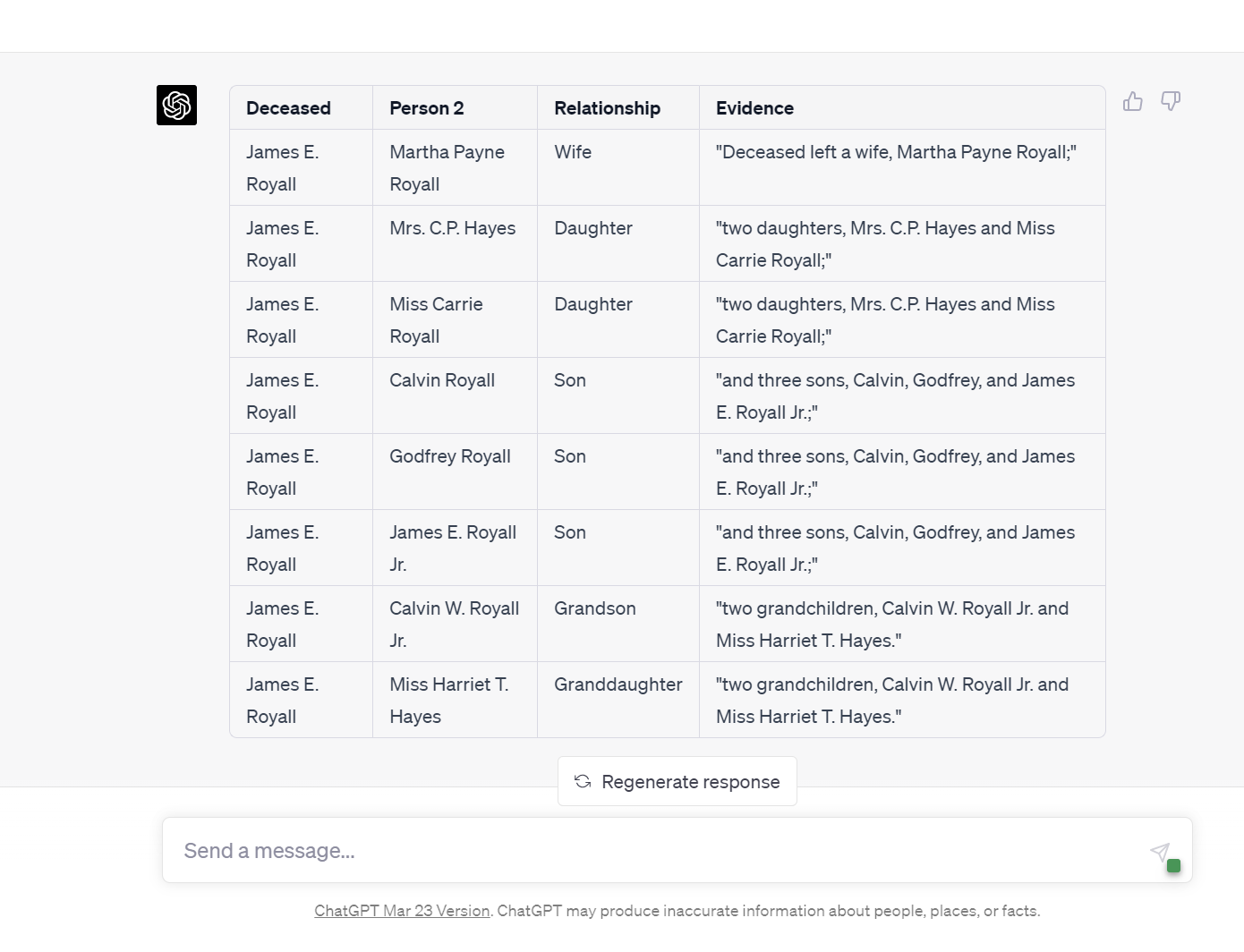
The results here are exactly as expected. This use case is a greater accomplishment than may be apparent to some. The imagination or understanding of how this use case will soon scale (become more powerful) is sometimes the missing piece. Here, eight relationships were extracted from a 700-word obituary; that is admittedly weak tea. But in time we will be able to process book chapters (50-pages announced already), whole books (this year or 2024), and entire archives after that. That’s the big deal that’s coming.
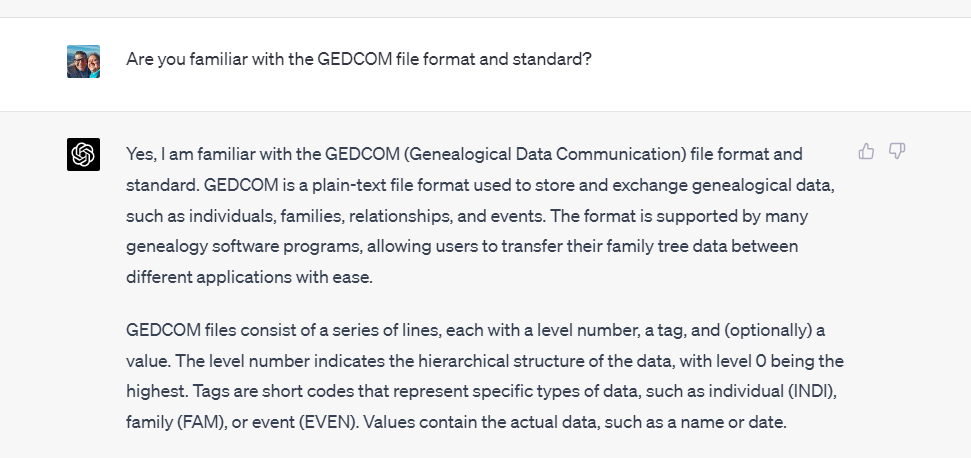
Step 6: Set the context for your GEDCOM request prompt. Set the context of the GEDCOM request by asking the AI about its familiarity with GEDCOM files.
PROMPT: Are you familiar with the GEDCOM file format and standard?
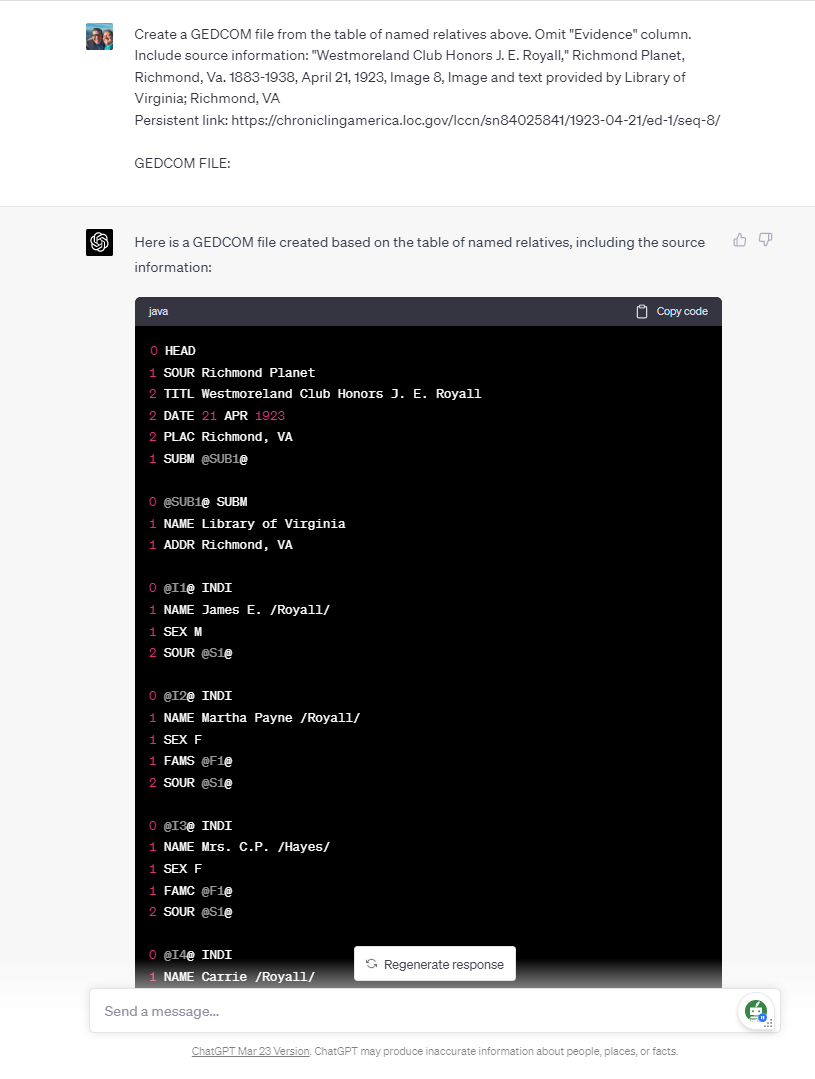
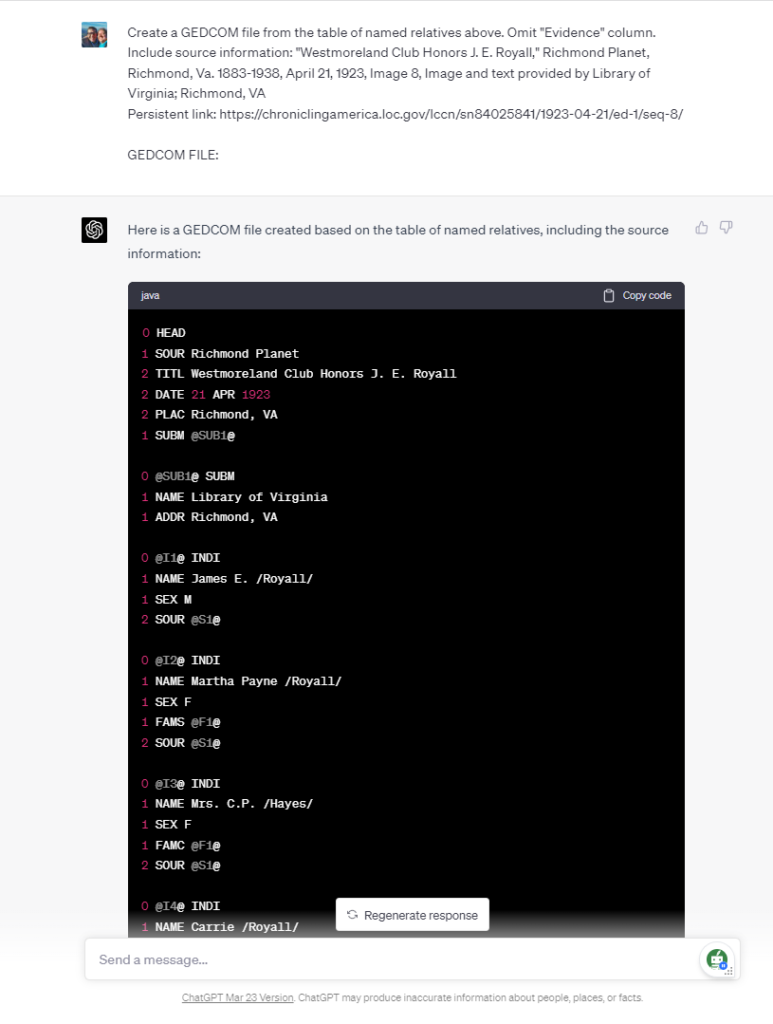
Step 7: Prompt for the creation of the GEDCOM file. There are several items to note about this prompt. First, we are directing to AI to transform the table of named relationship created earlier; that table included direct quotations from the source article for ease of validation and verification, but since that is not desired in the GEDCOM file, we instruct the artificial intelligence to omit that column of information. We do want the source of this information included with the GEDCOM file, so we supply that here to ChatGPT.
PROMPT: Create a GEDCOM file from the table of named relatives above. Omit "Evidence" column. Include source information: "Westmoreland Club Honors J. E. Royall," Richmond Planet, Richmond, Va. 1883-1938, April 21, 1923, Image 8, Image and text provided by Library of Virginia; Richmond, VA
Persistent link: https://chroniclingamerica.loc.gov/lccn/sn84025841/1923-04-21/ed-1/seq-8/

GEDCOM FILE:
Step 8: Examine your results. I have found that ChatGPT very reliably creates accurate and functional GEDCOM files using this complete method. Other artificial intelligences may not be as reliable: Anthropic’s Claude will create an accurate GEDCOM file, but fail to add the newlines (carriage returns or hard line breaks) needed to create a functional GEDCOM; asking again for those newline characters usually works; I have not been able to successfully create an accurate and functional GEDCOM with Google’s Bard, Perplexity AI, nor Microsoft’s Bing Chat.
Step 9: Save your results. You need to save your GEDCOM file as a text file. This means finding and using your computer’s text file editor. The basic Windows text editor is Notepad, so Windows users will open Notepad with a new, blank file. Then, in the ChatGPT code window, click the “Copy code” link at the upper right corner of the code window. Switch to the blank text file, paste the GEDCOM data into the text file, and save the file with a name such as “Royall.ged”; the “.ged” extension (last characters of the file name) is important. Remembering to include this file name extension will enable your genealogical apps and sites to recognize this text file as a family tree file.
Step 10: Open, test, verify, and confirm your work. At this point, you can open your genealogy application such as RootsMagic, Gramps, or Family Tree Maker and open or import the GEDCOM file (you will need to check that application’s instructions for opening and/or importing a GEDCOM file). You will usually want to open the GEDCOM file as a new tree, as opposed to merging it into an existing tree. Compare the information now in your new family tree to the information stated in the birth or wedding announcement, obituary, or newspaper article.
Results and Analysis:
Expected Outcomes: By using AI for this genealogy task, you can expect the extraction of key information such as names, relationships, dates, and places from various text sources, subsequently saving the data in a structured format such as GEDCOM files. This will facilitate easier sharing of family trees and the exchange of genealogical information.
Accuracy and Reliability: While ChatGPT is a powerful AI model, the accuracy and reliability of the results will depend on the quality of the input data and the clarity of the information present. In most cases, ChatGPT can accurately extract relevant data points, but manual review and validation is required to ensure the information is consistent with your research goals.
Conclusion:
In conclusion, using ChatGPT for extracting structured data from narrative sources like birth and wedding announcements, obituaries, and newspaper articles offers significant benefits and some limitations. The technology has the potential to greatly enhance genealogy research by automating the extraction of names, relationships, dates, and places, saving time and effort for researchers. The ability to convert this information into a structured data format such GEDCOM files further streamlines the research process and facilitates data organization, the sharing of family trees and the exchange of genealogical information.
However, limitations need to be considered. ChatGPT’s accuracy may vary depending on the quality of the input text, especially if dealing with raw OCR text or handwritten documents. Additionally, ChatGPT might struggle with complex relationships and ambiguous information present in the narratives. To overcome these challenges, AI Genealogists need to manually review and verify the extracted data.
For further improvement and exploration of AI in genealogy, researchers should consider integrating ChatGPT with other natural language processing tools or specialized genealogy software to enhance its capabilities. Collaborating with AI developers to create tailored models for genealogy research could further optimize the extraction process and improve overall accuracy. Encouraging users to share their experiences and provide feedback will contribute to the ongoing refinement of AI solutions for genealogy.
Ultimately, employing AI tools like ChatGPT for genealogy research has the potential to revolutionize the field, making it more accessible, efficient, and accurate. As AI technology continues to evolve, the possibilities for its application in genealogy will only expand, benefiting researchers and family historians alike.
Call to Action:
Try ChatGPT for your genealogy tasks: We encourage you to harness the power of ChatGPT for your genealogy research. Experience firsthand the benefits of using AI to extract structured data from narrative sources like birth and wedding announcements, obituaries, and newspaper articles.
Share your experiences: We would love to hear about your experiences using ChatGPT for genealogy tasks. Share your successes, challenges, or any interesting insights you’ve gained through utilizing AI in your research. Your feedback can help improve the technology and benefit the entire genealogy community.
Ask questions and seek advice: If you have any questions or need assistance with using ChatGPT for genealogy tasks, feel free to post them in the comments section below or reach out to us on social media. Our community of experts and fellow genealogy enthusiasts will be more than happy to help.
Connect with others and expand your knowledge: Join genealogy forums, social media groups, and other online communities where you can connect with others who are using AI for genealogy research. These platforms are excellent resources for sharing tips, tricks, and best practices, as well as staying up-to-date with the latest advancements in AI technology.
Explore additional resources: To further enhance your understanding of AI in genealogy and to make the most out of ChatGPT, check out the provided links to tutorials, support forums, and related articles. Continuously learning and staying informed will help you maximize the potential of AI in your genealogy research.
This Use Case Guide explains how to utilize AI to extract structured data such as tables and CSV files from narrative genealogically-rich sources such as birth and wedding announcements, obituaries, and newspaper articles and the like.
Introduction:
In the world of genealogy research, information is scattered across various sources, including narrative texts such as birth and wedding announcements, obituaries, and newspaper articles. These unstructured narratives can be challenging to manage and analyze. In this blog post, we will explore the specific task of quickly extracting valuable data such as names, relationships, dates, and places from these texts and converting them into structured data formats such as tables, JSON files, and near-universally usable CSV files (great for importing into spreadsheets such as Excel and Google Sheets and into databases such as MySQL and AirTable). This data extraction and storage process is tremendously beneficial for for streamlining genealogical research and making connections between family members, ancestors, and historical events.
To accomplish this task, we will be utilizing ChatGPT, an advanced AI language model developed by OpenAI. ChatGPT is capable of processing and extracting information from large volumes of text, making it an ideal tool for genealogy enthusiasts seeking to organize and analyze their research data efficiently. Stay tuned as we dive into the objectives, requirements, and methodology of using ChatGPT for genealogy data extraction and organization.
Objectives:
Automate the extraction process: Utilize ChatGPT to efficiently extract names, relationships, dates, and places from various sources, such as announcements, obituaries, and newspaper articles, minimizing manual effort and speeding up the research process.
Improve data organization: Convert the extracted information into structured data formats (e.g., tables, JSON, and CSV files) to facilitate better organization, storage, and retrieval of genealogical data.
Enhance data analysis: Enable genealogy researchers to analyze structured data more effectively, identify patterns, and uncover hidden connections between family members and historical events.
Save time and resources: Streamline the research process by reducing the time spent on manually extracting and organizing data, freeing up more time for analysis and interpretation.
Increase research accuracy: Minimize human errors and inconsistencies in data extraction and organization by leveraging ChatGPT’s advanced language processing capabilities.
Requirements:
Access to AI: Obtain a free or paid subscription to an artificial intelligence service such as OpenAI’s ChatGPT. Other AI options include Google’s Bard, Anthropic’s Claude, or Microsoft’s Bing Chat, but in April 2023, OpenAI’s GPT-4 based ChatGPT is strongest.
Input data: Provide ChatGPT with text from sources such as birth or wedding announcements, obituaries, and newspaper articles, containing information about names, relationships, dates, and places relevant to genealogical research.
Optional: Formatting requirements: Ensure that the input text is free of major errors or inconsistencies. Although ChatGPT can handle some level of noise in the data, better-formatted input will yield more accurate and reliable results. Our earlier Use Case Guide on Cleaning OCR Text quickly steps you through this process.
Optional: Data storage and processing tools: Utilize software and tools like Microsoft Excel, a CSV editor, or a MySQL client to store, manage, and analyze the structured data extracted by ChatGPT.
Helpful: Genealogy research resources: Familiarize yourself with various genealogical research methods, repositories, and databases to: (1) know where to find the texts to data mine, and (2) effectively contextualize and validate the information extracted by ChatGPT.
Caveats for the Careful on Large Language Models in Genealogy (April 2023):
No live internet access, with data current only up to September 2021
Unreliable for fact-based research, relying on statistical language patterns
Official ChatGPT warning: may produce inaccurate information
Mainly used for information processing, not discovering new data
Limited to 1500 words input/output (approx. 4k tokens)
Chatbots lack traditional memory, necessitating careful management of conversation
See Use Case Guide #1: Cleaning OCR Text for detailed information on each caveat above.
Caveats for the Bold
These initial Use Cases are admittedly weak tea: limited and narrow in function and capacity; these constraints reflect the abilities and token limits of AI systems for fact-based research in April 2023.
For now, think “Lego pieces” not “Post-Doc Assistant”; that is, in spring 2023, don’t imagine AI is a magic genie that can do all your work for you, like a post-doc assistant; instead, AI-assisted genealogical tasks are now more like a growing Swiss army knife or set of Lego blocks with which you can build tools to solve larger problems. It doesn’t take too much creativity to imagine how even these modest use cases can today be linked/chained and combined with each other to accomplish larger genealogical goals; soon enough, I imagine, the larger goals will be one-step AI-assisted tasks. But, for now, enjoy playing with the fundamental building blocks of more powerful systems to come.
How To: Methodology:
Step 1: Get a free or paid AI account. In April 2023, OpenAI’s GPT-4 based ChatGPT is strongest, but the free version based on GPT-3.5 will also work; you can get a free account at https://chat.openai.com/auth/login.
Step 2: Find and prepare your input text. In spring 2023, most publicly-accessibly AI systems are based on large language models that are untethered to reality or knowledge systems; they work by selecting the next statistically most likely word based on your prompt and previous utterances in your chat. For this reason, fact-based researchers such as genealogists restrict the AI to working only on the data you input. In this series of Use Case Guides, we have been using texts from publicly available sources such as the Chronicling America newspaper archive from The Library of Congress and the National Endowment for the Humanities. Our Use Case Guide #1: How to Clean Raw and Poor OCR Text breaks-down this step down in a detailed walk-through; refer to that guide if you would like help with this step. This Guide uses an obituary first published 100 years ago this week in one of my state’s capital newspapers: “Westmoreland Club Honors J. E. Royall,” Richmond Planet (Richmond, VA) 1883-1938, April 21, 1923, Page 8, Image 8; Image and text provided by Library of Virginia; Richmond, VA; < https://chroniclingamerica.loc.gov/lccn/sn84025841/1923-04-21/ed-1/seq-8/ > [accessed: 17 April 2023]. I processed and cleaned the raw (nightmarish) Chronicling American text using the steps in Usage Guide #1.
Step 3: Start a new ChatGPT session. It is important to start a new ChatGPT session when beginning a new genealogical task because (lacking both short-term and long-term memory) the chatbot re-ingests up to the previous 400 lines of your “dialogue” in order to simulate a conversation; this can have the unintended effect of contaminating your chat with information from pervious utterances in the current session. See “Don’t Get Burned by Spicy Autocomplete” for more information about this concern.
Step 4: Write your prompt. Your prompt will include two parts: (a) your instructions to the AI, and (b) the input text from which you want to extract structured genealogical data. We’ll discuss both parts in turn.
Step 4(a): Write your instructions to the AI. The instructional component of a prompt itself has subcomponents. Here you can see that the first part of the instructions are directing the AI to assume a role, in this case, of a genealogist; this has the effect of providing a context for the AI’s response. Next, action verbs to direct the AI; in this case “Find,” “Prioritize,” “Create,” “Include,” and “Respond.” These will change depending on your task; if you have troubling crafting this part, ChatGPT can help: write the instructions as best you can, then use ChatGPT to “convert these statements to the imperative mood“; this has the effect of changing your statements to the desired form “[you, the AI] do (verb) this.” Finally, you will see that here we are directing the AI to create a table of data; this is the most simple form of structured data, and perhaps the most meaningful and accessible to the human genealogist! Later, I’ll show you how to transform this table data into forms more suited for genealogical tools such as tree making applications, spreadsheets, and databases. To assist in the verification of our work, the AI is instructed to show its work, that is, to include the evidence it used to make a relationship determination by quoting the passage it relied upon to state a relationship. So far, thus prompted, contained, restrained, and instructed, I have not witnessed a fabrication or hallucination of a relationship. If you do, capture and save your whole session; I’d love to see it.
PROMPT: Assume the role of an expert, professional genealogist. Find below the text of an obituary. Prioritize fidelity to the information below. Create a table of named relatives of the deceased. Include only explicitly named relationships. Respond in the form of a markdown table with the column headings: Deceased | Person 2 | Relationship | Evidence (where evidence is the quoted text from the article used to determine relationship).
Step 4(b): Paste your input text below the instructions. Below your instruction, paste the text from which you would like to AI to process. Remember, as of April 2023, we are limited to about 1500 words input. Folks may tell you that you can upload more, perhaps by asking the AI to accept your input in parts, and it will agree to do that, but if you upload more than about 400 lines or about 1500 words, the AI will drop and ignore parts of your input. (In OpenAI’s technical jargon, we are limited to 4096 “tokens,” more akin to syllables than words, but for simplicities sake, about 1500 words input and 1500 words output.) [NOTE: If you need to enter a newline or line break in the ChatGPT edit box, Shift-Enter will give you a new line without submitting the request.]
Step 5: Examine your results; adjust as needed. Just as writing means re-writing, so prompt engineering means prompting and re-prompting. I never get the best results on a first attempt, so I expect to refine a prompt until the AI is producing the data in the form I want.
The results here are exactly as expected. This use case is a greater accomplishment than may be apparent to some. The imagination or understanding of how this use case will soon scale (become more powerful) is sometimes the missing piece. Here, eight relationships were extracted from a 700-word obituary; that is admittedly weak tea. But in time we will be able to process book chapters (50-page capacity announced already by OpenAI), whole books (this year or 2024), and entire archives after that. That’s the big deal that’s coming.
Step 6: Save your work. Save both your ChatGPT session and save your response to a text file. You can now easily download your entire ChatGPT history. You may also want to copy-and-paste the table data to a local file; some of the formatting will be lost if you paste into a plain text file, but pasting into a Word or Google Docs file will preserve the markdown formatting, if that is important to you.
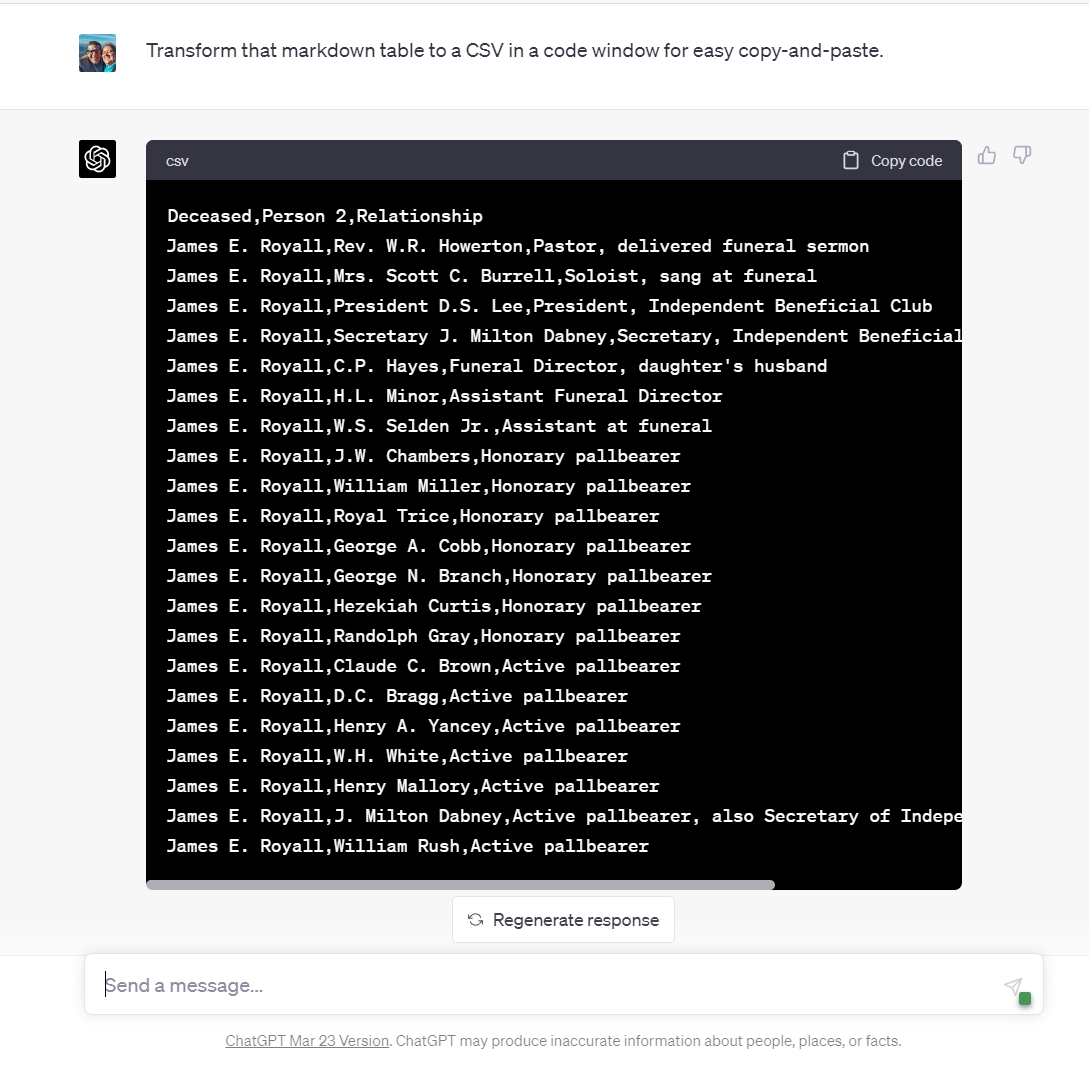
Step 7: Wring further data from the text. Named relationships are not the only data that ChatGPT can extract from a text. ChatGPT excels at FAN processing of a text (finding friends, associates, and neighbors that are mentioned in a text). People (“entities” in AI jargon) are not the only data that can be extracted. ChatGPT will also extract places, events, and dates from a text. For example, after extracting the explicit relationships from the obituary, I instructed ChatGPT to extract all named associates from the text:
PROMPT: Create a table of named associates of the deceased; broaden the meaning of associates as wide as possible to include ALL named people in the obituary if their relationship or function at funeral is stated. Respond in the form of a markdown table with the column headings: Deceased | Person 2 | Relationship.
Step 8: Create derivative data structures and formats. You can now instruct ChatGPT to create alternate file types such as CSV (common separated values) files which are nearly universally usable by spreadsheets (Excel, Google Sheets), databases (MySQL, MS Access, AirTable), and word processors (Word, Google Sheets). For the technically inclined, GPT-4 is able to convert the table data to JSON files for processing by web applications and custom programming scripts such as Python. In the next Usage Guide, I’ll show you step-by-step how to create a GEDCOM file, used widely to create family trees and exchange genealogical data. Here you can see all how the named associates of the deceased may quickly be downloaded as a CSV file:
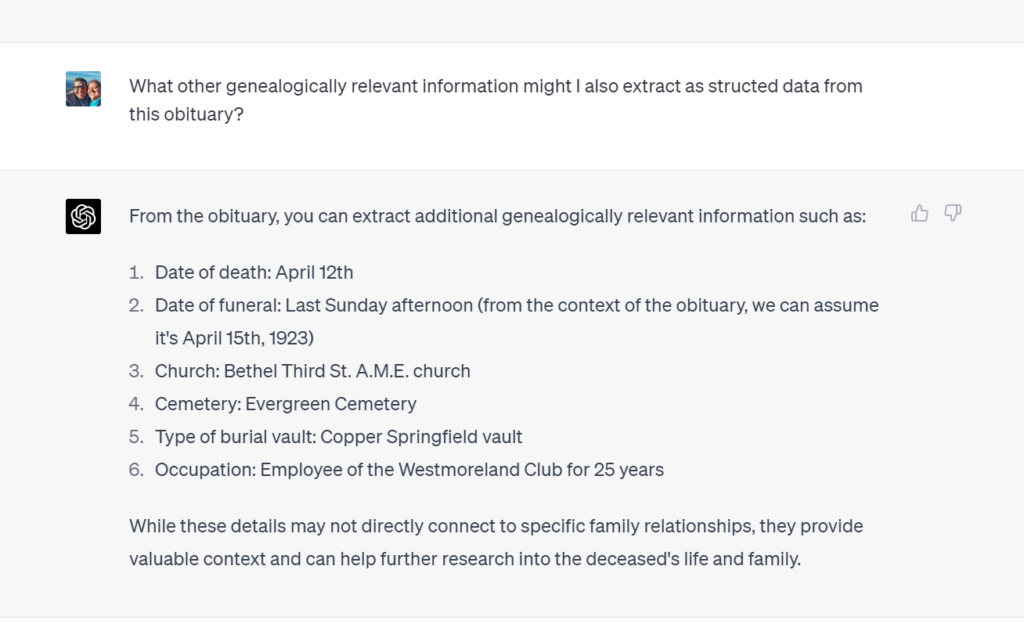
Step 9: As a last step, ask the AI what you forgot. This is always fun, and reveals that while I may be focused on one type or piece of information, the AI may help me uncover the missing piece to solve a brick wall that was under my nose but which I’d overlooked.
PROMPT: What other genealogically relevant information might I also extract as structed data from this obituary?
Results and Analysis:
Expected Outcomes: By using AI for this genealogy task, you can expect the extraction of key information such as names, relationships, dates, and places from various text sources, subsequently saving the data in structured formats like table data, JSON, and CSV files. This will facilitate easier data analysis and integration into your genealogical research.
Accuracy and Reliability: While ChatGPT is a powerful AI model, the accuracy and reliability of the results will depend on the quality of the input data and the clarity of the information present. In most cases, ChatGPT can accurately extract relevant data points, but manual review and validation is required to ensure the information is consistent with your research goals.
Conclusions:
In conclusion, using ChatGPT for extracting structured data from narrative sources like birth and wedding announcements, obituaries, and newspaper articles offers significant benefits and some limitations. The technology has the potential to greatly enhance genealogy research by automating the extraction of names, relationships, dates, and places, saving time and effort for researchers. The ability to convert this information into structured data formats such as table data, JSON, and CSV files further streamlines the research process and facilitates data organization.
However, limitations need to be considered. ChatGPT’s accuracy may vary depending on the quality of the input text, especially if dealing with raw OCR text or handwritten documents. Additionally, ChatGPT might struggle with complex relationships and ambiguous information present in the narratives. To overcome these challenges, AI Genealogists need to manually review and verify the extracted data.
For further improvement and exploration of AI in genealogy, researchers should consider integrating ChatGPT with other natural language processing tools or specialized genealogy software to enhance its capabilities. Collaborating with AI developers to create tailored models for genealogy research could further optimize the extraction process and improve overall accuracy. Encouraging users to share their experiences and provide feedback will contribute to the ongoing refinement of AI solutions for genealogy.
Ultimately, employing AI tools like ChatGPT for genealogy research has the potential to revolutionize the field, making it more accessible, efficient, and accurate. As AI technology continues to evolve, the possibilities for its application in genealogy will only expand, benefiting researchers and family historians alike.
Calls to Action:
Try ChatGPT for your genealogy tasks: We encourage you to harness the power of ChatGPT for your genealogy research. Experience firsthand the benefits of using AI to extract structured data from narrative sources like birth and wedding announcements, obituaries, and newspaper articles.
Share your experiences: We would love to hear about your experiences using ChatGPT for genealogy tasks. Share your successes, challenges, or any interesting insights you’ve gained through utilizing AI in your research. Your feedback can help improve the technology and benefit the entire genealogy community.
Ask questions and seek advice: If you have any questions or need assistance with using ChatGPT for genealogy tasks, feel free to post them in the comments section below or reach out to us on social media. Our community of experts and fellow genealogy enthusiasts will be more than happy to help.
Connect with others and expand your knowledge: Join genealogy forums, social media groups, and other online communities where you can connect with others who are using AI for genealogy research. These platforms are excellent resources for sharing tips, tricks, and best practices, as well as staying up-to-date with the latest advancements in AI technology.
Explore additional resources: To further enhance your understanding of AI in genealogy and to make the most out of ChatGPT, check out the provided links to tutorials, support forums, and related articles. Continuously learning and staying informed will help you maximize the potential of AI in your genealogy research.