I’m Steve Little. I run this site, co-host The Family History AI Show podcast with Mark Thompson, and teach courses through The Family History AI Academy. I serve as AI Program Director for the National Genealogical Society and helped found the Coalition for Responsible AI in Genealogy.
But none of that explains where I come from—or why I care about this work.
Roots
I trace my ancestry to Ashe County, North Carolina, where all 32 of my 3rd-great-grandparents had settled by 1820—many even earlier. Sixty of my most recent ancestors were born, lived, and died in that one Appalachian county. The surnames among them: Little, Lawrence, Bower, Houck, Adams, Bare, Burkett, Curtis, Fox, Gabey, Goodman, Greene, Grogan, Halsey, Johnston, Koontz, McMillan, Osborn, Parker, Perkins, Poe, Sheets, Strunk, Taylor, Wagoner, Witherspoon.
As a friend once remarked, “That’s deep roots.”
My parents left Ashe in the mid-1960s—the first of my direct ancestors to leave in 140 years. Sometimes they say they escaped. Other times they say they were exiled. Both are in jest. The only people who love Ashe County more than the people who live there are the people who have left.
I inherited my love of genealogy from my aunt, Monte Ann Little DeBoard, an educator who spent her summers haunting county courthouses, archival libraries, and family reunions. About thirty years ago, I started helping her by digitizing her research in an early version of Family Tree Maker. Fifteen years ago, I got serious about my own research. In 2017, I took my first DNA test and began the analysis to confirm my aunt’s work. I found almost no errors. I now manage about two dozen DNA kits for friends and family.
The Bridge
My path to AI genealogy wasn’t obvious at the time, but it makes sense looking back.
My academic training was in computational linguistics—natural language processing, the field that became the foundation of today’s large language models. My first career, about fifteen years, was building information systems in libraries: university libraries, law libraries, state archival libraries. I learned how institutions organize knowledge and how researchers find what they need.
My second career, another fifteen years, has been as a Methodist pastor in Fauquier County, Virginia. Ministry taught me something no technical training could: every family is messy, and yet the sacred shows up in the messes—not least of all your own. That insight shapes how I approach genealogy. We’re not just collecting names and dates. We’re trying to understand the people who made us.
When ChatGPT arrived in late 2022, I recognized what it was: a language model built on the computational linguistics I’d studied decades earlier, now powerful enough to be genuinely useful—and genuinely dangerous—for genealogical research. I’d spent years in libraries, years in pastoral care, years doing genealogy. Suddenly all of it was relevant to one question: What can AI actually do for family historians, and what can’t it do?
That’s what this site explores.
The Personal Stuff
I’m a husband and a dad. I live in Virginia, less than 50 miles from where my surname immigrant ancestor, Abraham Little, first landed near Fredericksburg in the mid-1680s as a boy—an indentured servant, having boarded or been placed upon a ship in England.
Beyond genealogy, I’m a birder, a chess player, a film enthusiast, an avid reader, and a regex script hacker (a geeky name for sophisticated find-and-replace searches).
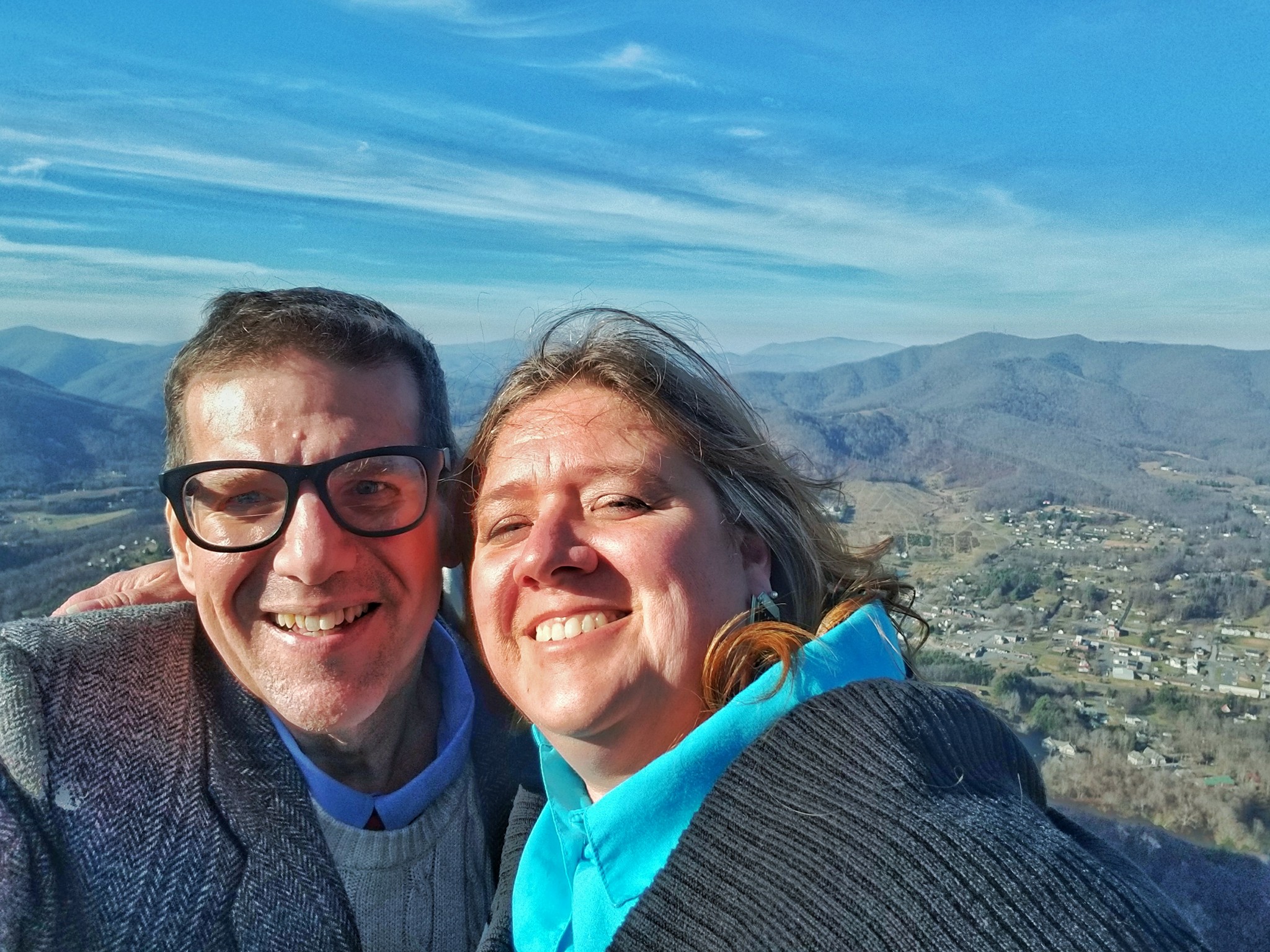
Steve and Shawn Little overlooking ancestral homeland of Ashe County, North Carolina
What to Explore Next
Listen to the podcast: The Family History AI Show — Mark Thompson and I cover the latest AI tools and developments each week, with practical advice for genealogists.
Take a course: The Family History AI Academy — Structured learning for genealogists ready to build real AI skills.
Read my family history blog: Ashe Ancestors — Where I write about my own research, particularly my Appalachian roots.
Browse the prompts: Prompts — Open-source AI prompts I’ve developed for genealogical work.
Explore the blog: Blog — News, tutorials, experiments, and commentary on AI and genealogy.
Think We Might Be Cousins?
If you’re researching Ashe County families or we share DNA, I’d love to hear from you.
DNA & Genetic Genealogy:
- GEDmatch: XT360531C1
- 23andMe: Profile
- FTDNA: Kit #B355835 (Y-DNA 111 markers, Big Y) — Haplogroups: Paternal R-BY15250, Maternal U4b2
- MyHeritage: Profile
Family Trees:
- Ancestry: JSLittle1967
- WikiTree: Little-11094
- Find-a-Grave: Profile
Social:
- Facebook: stephen.little
- X/Twitter: JStephenLittle
- LinkedIn: revstevelittle
- Bluesky: digitalarchivst
- Threads: @digitalarchivist
- GitHub: DigitalArchivst
Questions? Contact me.