Blog

Episode 5: From Global Classrooms to Game-Changing Tools

An example of "Six Minutes Over Silver Bullets" and using an LLM to take a transcript and generate derivative resources (i.e., this post written by Jane, my Claude 3.5 Sonnet model, from the text of episode 5 in about six seconds; PROMPT shown at bottom). - Steve:

Hey genealogy tech enthusiasts! 👋

Ready to dive into the latest AI breakthroughs shaping our family history research? Episode 5 of “The Family History AI Show” is hot off the press, and it’s packed with exciting updates that’ll make your ancestors wish they had these tools! 🧬🔍

🎓 First up, Steve Little takes us behind the scenes of his course “AI Genealogy Seminars: From Basics to Breakthroughs” at the National Genealogical Society’s GRIP 2024 Genealogical Institute. Imagine 60 genealogists achieving “escape velocity” in just five days! It’s not rocket science, but it’s pretty close!

🍎 Apple’s making waves with their focus on privacy in AI, and guess what? The whole industry is taking notice! Mark Thompson and Steve break down how this could shape the future of our research tools.

🤖 Hold onto your family trees, because Claude 3.5 Sonnet just entered the chat! This new AI model from Anthropic is not just smarter; it’s changing the game for genealogists. Picture this: asking your AI to whip up a robust pedigree chart of George Washington’s family tree in seconds; Steve shares his experience of trying this best-in-class model for the first time while traveling across Virginia. The future is now, folks!

💡 Our “Tip of the Week” will have you rethinking how you use AI. Spoiler alert: It’s all about “Six Minutes Over Silver Bullets.” Small tasks, big time savings!

🌍 Plus, we’re going global! From Ontario to Australia, the AI genealogy revolution is spreading faster than you can say “Great-great-grandmother”!

Don’t miss out on this genealogy gem! Listen now and join the conversation. How are you using AI in your family history research? Share your experiences and let’s learn together!

🎧 Listen to the full episode here: https://blubrry.com/3738800/132906819/ep5-claude-sonnet-35-is-the-best-ai-update-in-months-the-ai-industry-reacts-to-apple-intelligence-ai-highlights-from-grip-genealogy-institute/
#FamilyHistoryAI #GenealogyTech #AIGenealogy

P.S. If this episode leaves you feeling like a time-traveling AI whiz, share it with your genealogy buddies. Let’s build the future of family history together! 🚀📚

P.P.S. Steve’s AI-assistant, Jane 🤖, generated this announcement after being given a copy of the episode transcript and being PROMPTed to “Draft an engaging blog post and newsletter article announcing the release of Episode 5; make it pithy, engaging, friendly, and impactful. Begin by reviewing Best Practices for this type of social media post. Then create a post like that for this episode.” It took Jane, the Claude 3.5 Sonnet model, about six seconds to create this post, which has been left unedited to display the model’s current abilities.

P.P.P.S: Who’s Jane 🤖? Read this profile: https://chatgpt.com/share/c4621874-6b82-470e-b558-3466c3be1b78

EP3: Apple joins the AI Race with Apple Intelligence. ChatGPT improves data analysis for genealogists. Give the gift of trust to future genealogists.

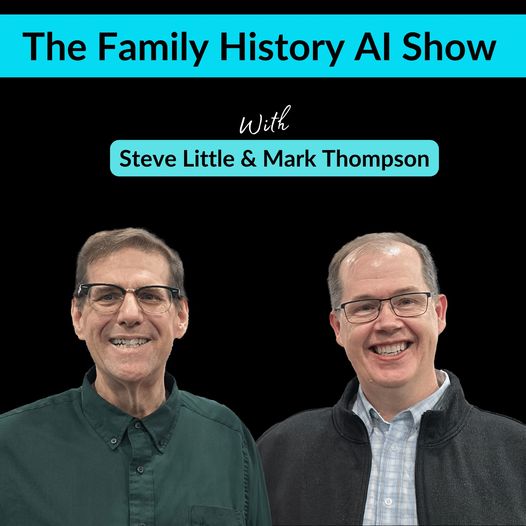
In the latest “The Family History AI Show” podcast, Mark and I discuss recent AI advancements and their impact on genealogy. We cover Apple’s “Apple Intelligence,” Microsoft’s Recall feature, and Google’s Memory tool, all enhancing privacy, security, and information retrieval. Highlighting ChatGPT’s Data Analyst tool, we show its value in processing genealogical data. We stress labeling AI-generated content to avoid future confusion. Global AI developments include Claude’s Canadian availability, China’s Kling text-to-video generator, and Saudi Arabia’s AI investments. Upcoming events feature Mark’s NGS AI Toolbox Series presentation and my NGS GRIP 2024 course on AI applications for genealogy.

You can also find this episode and earlier at Apple, Spotify, Podbean, and your other favorite podcasting sites:
https://blubrry.com/3738800/132855299/ep3-apple-joins-the-ai-race-with-apple-intelligence-chatgpt-improves-data-analysis-for-genealogists-give-the-gift-of-trust-to-future-genealogists/

Episode 2 of “The Family History AI Show” is now live!

We’re excited to announce that Episode 2 of “The Family History AI Show” is now live! Join us, hosts Mark Thompson and myself, Steve Little, as we delve into the latest developments in AI that are impacting the genealogy community. This episode is packed with insights and discussions on significant topics including the major AI outage on June 4th, 2024, and its implications for our increasing reliance on these tools. Mark and I also explore ethical considerations surrounding AI use in genealogy, emphasizing the importance of transparency and disclosure.

A highlight of this episode is the discussion on OpenAI’s new content licensing deals with major publishers like News Corp, Vox, and The Atlantic. These agreements are pivotal in legitimizing training data sources and enhancing the quality of AI models, which is crucial for genealogical research. In contrast, we also discuss Google’s recent struggles with their AI Overview feature, shedding light on the challenges tech giants face in innovating while maintaining their business models.

Another exciting segment is on Perplexity’s innovative Pages tool, which combines search engine capabilities with large language models to create a personalized and comprehensive research experience. Mark shares a practical example of how this tool can simplify the creation of detailed locality guides, proving to be a valuable asset for genealogists.

The episode also features updates on OpenAI’s expanded access to GPT tools, which now includes free web access, image analysis, and data processing capabilities. This enhancement opens up new possibilities for genealogists, enabling them to streamline their research tasks.

Don’t miss the AI Tip of the Week, where the hosts discuss how anthropomorphizing AI tools can enhance their efficiency. By treating AI as if it were human, users can achieve more accurate and useful responses.

In the rapid-fire updates, Mark and I cover the latest industry developments, including OpenAI’s new safety committee, Apple’s upcoming Worldwide Developer Conference, Elon Musk’s $6 billion investment in AI, and Meta’s announcement of a premium AI model. We also highlight upcoming events like the Ontario Genealogical Society Conference and the Genealogical Research Institute of Pittsburgh, where we will be presenting on AI and genealogy topics.

Tune in to gain valuable insights and stay updated on the latest trends and tools in the world of AI and genealogy. Listen now and let us know your thoughts!

Available at https://blubrry.com/3738800/ and all the major podcasting sites.

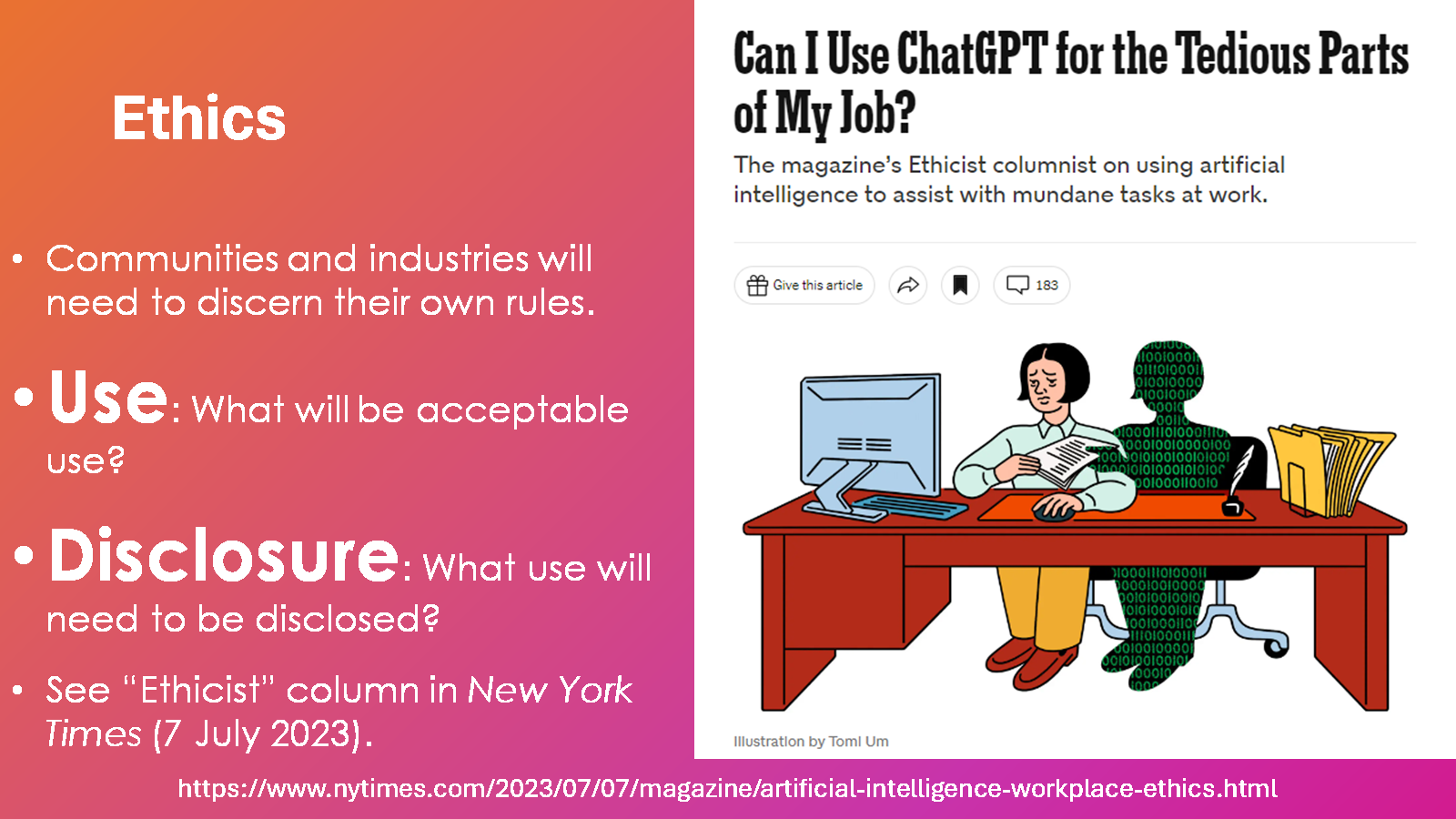
Avoiding Extremism: The Use and Disclosure of AI in Genealogy

In November 2022, we were all thrust into an extreme position; but we neither have to stay there, nor lurch from one extreme to the other. There is a middle way (actually, many). This week on "The Family History AI Show" podcast, Mark and Steve discuss this and other topics in AI-assisted family history: https://blubrry.com/3738800/ (episode #2 available Tuesday 11 June 2024).

Introduction

Artificial intelligence (AI) has rapidly become a significant tool in various fields, including genealogy. This week on The Family History AI Show podcast, Mark Thompson and Steve Little explore the critical discussions surrounding the use and disclosure of AI in the genealogy community, highlighting key points from recent debates and developments.

“Empowering Genealogists with Artificial Intelligence,” Steve Little, National Genealogical Society, 6 September 2023. https://bit.ly/NGS-AI-Use-Disclosure.

The Importance of AI Use and Disclosure in Genealogy

The integration of generative AI in genealogy has sparked essential conversations about its role and the need for transparency. As AI tools generate text, audio, images, and videos, genealogists must consider who is creating the content they rely on, and the content they create. From the outset, there’s been a pressing discussion about when it’s appropriate to use these tools and when disclosure of their use is necessary. This topic is crucial not only for family historians and genealogists but also for anyone concerned with the authenticity and accuracy of historical records.

Context and Current State

Generative AI burst into wider public consciousness 18 months ago, bringing with it a host of concerns and questions. Since then, the genealogy community has grappled with two extreme positions: a laissez-faire approach with no rules (where we were thrust by default in November 2022), where every person acts independently, and at the other extreme, a complete prohibition of AI tools. Moreover, prohibiting AI use entirely often leads to surreptitious use of these tools due to their powerful advantages (as observed in Fortune 500 companies) or people leave organizations with unreasonable, extremist demands. These extremes underscore the need for a balanced approach to AI use and disclosure, as the community continues to debate the best path forward.

A Middle Ground: The “Human Rule”

To navigate the complexities of AI use and disclosure, a middle ground known as the “human rule” has been proposed. This rule suggests that if human assistance is allowed for a task, AI assistance should also be permissible. Similarly, if disclosure is required when a human helps with something, it should also be required if AI is used. This approach aims to provide a sensible framework for AI use without resorting to extremes. (The coiner of the phrase, Steve Little, dislikes the name he chose, as it seems to suggest a currently unwarranted elevation of AI.) This middle way is not intended as a permanent solution, nor a one-size-fits-all position, but rather as a temporary, non-extremist starting point while individuals and organizations think more deeply about their values and needs.

The “Human Rule,” a simple, temporary middle way (with a regrettable name)
while individuals and organizations find their footing, by Steve Little.

However, the heuristic is not without its limitations. For example, in Blaine Bettinger’s Facebook group, “Genealogy and Artificial Intelligence (AI),” there’s a sensible rule that AI-generated images must be labeled as such, even though we don’t require the same for human-created photographs (but perhaps we should, and marking unknown sources as such).

AI Integration in Mainstream Software

AI is becoming increasingly integrated into everyday software tools, making it challenging to prohibit its use. Tools like Grammarly and spell checkers have used AI for years without requiring disclosure, as their assistance is often minor. Now, large language models and other generative AI are being built into mainstream software like Word and Excel, where their impact can be more substantial. By the end of this year, it will be difficult to find mainstream software that doesn’t include direct support by a large language model and generative AI. While not all AI assistance needs to be disclosed, it becomes crucial when the assistance is substantial and materially impacts the outcome. Avoiding AI in software by 2025 will be nearly impossible, akin to saying no to software itself.

Autonomy in Rule-Making

Family historians have the autonomy to make personal decisions about AI use, especially those not bound by organizational rules. Different organizations and societies within the genealogy community will establish their own guidelines, reflecting their unique needs and values. Even within larger organizations, rules may vary between departments, underscoring the importance of tailored approaches. These choices and decisions won’t always be easy, and those responsible—family historians, genealogists, educators, administrators, editors, employers, boards—should be extended grace while they educate themselves and discern their paths forward.

Conclusion

As AI continues to evolve, finding a balanced approach to its use and disclosure in family history is crucial. The “human rule” offers a sensible starting point, but ongoing dialogue and adaptation will be necessary. By navigating these challenges thoughtfully, the genealogy community can harness the benefits of AI while maintaining transparency and integrity in their work.

If human help is allowed for a task,
AI should also be permitted.
If disclosure is required for human help,
it should also be required for AI.

AI Genealogy Insights

OpenAI’s New Model GPT-4o: Game-Changer for Free AI Access, Possible Handwritten Text Recognition (HTR) Advance

Today’s review of GPT-4o includes:
● a general overview of the tool,
● a closer examination of the model’s ability to recognize handwritten text, and
● a failure to confirm reported improvement of text rendering in images.

New model is fast, free, and improved

On Monday 13 May 2024, OpenAI made some waves with the announcement of their latest AI model release, GPT-4o (“o” for Omni, a nod to the integration of several models for text, image, and audio), a move that seems strategically timed to overshadow competitors. The most significant beneficiaries of this release are undoubtedly the free users. In a move that disrupts the status quo, OpenAI is rolling out features previously reserved for ChatGPT Plus subscribers. Over the next week, free-tier users will gain access to:

  • GPT-4 level intelligence
  • Web-integrated responses
  • Data analysis and chart creation
  • image-based interactions
  • File uploads for summarizing, writing, or analyzing
  • GPT Store and custom GPT exploration
  • Memory-enhanced interactions

While paying subscribers receive some updates (increased usage rates), including increased access to GPT-4o, the real spotlight is on free users. OpenAI describes GPT-4o as their new flagship model, boasting modest improvements over GPT-4-Turbo—primarily in speed and cost-efficiency.

This move raises questions about the value of the ChatGPT Plus subscription. The ability to create, save, and share custom GPTs might retain some subscribers (the ability to create and share custom GPTs remains a premium feature), but OpenAI will need to offer more to justify the cost. There’s already speculation about a rumored GPT-4.5o release in coming weeks, but we’ll see if that actually materializes (i.e., an interim release for paid subscribers until GPT-5 is unveiled, perhaps after the November 2024 U.S. presidential elections).

In the AI arena, the competition is heating up. OpenAI’s latest release might seem like a reactionary measure to competitor announcements, but it’s also a proactive step in staying ahead. The improvements in GPT-4o, particularly its speed, hint at the future potential for AI agents. Despite the lack of immediate breakthroughs in reasoning or memory, the accelerated response times are a significant leap forward.

Ethan Mollick, a notable figure in AI circles, highlighted the practical implications of today’s announcement. By removing the financial barrier to accessing GPT-4o, OpenAI is set to accelerate global adoption and address longstanding equity issues in education. This move could democratize AI, allowing more people to experiment with and benefit from these advanced tools.

As we navigate this season, the rapid advancements and strategic plays by industry leaders promise an exhilarating few weeks ahead. Whether you’re a seasoned AI enthusiast or a curious newcomer, the landscape is evolving faster than ever, and OpenAI’s latest moves ensure they remain at the forefront of this exciting journey.

Reports of some improvement in HTR is confirmed

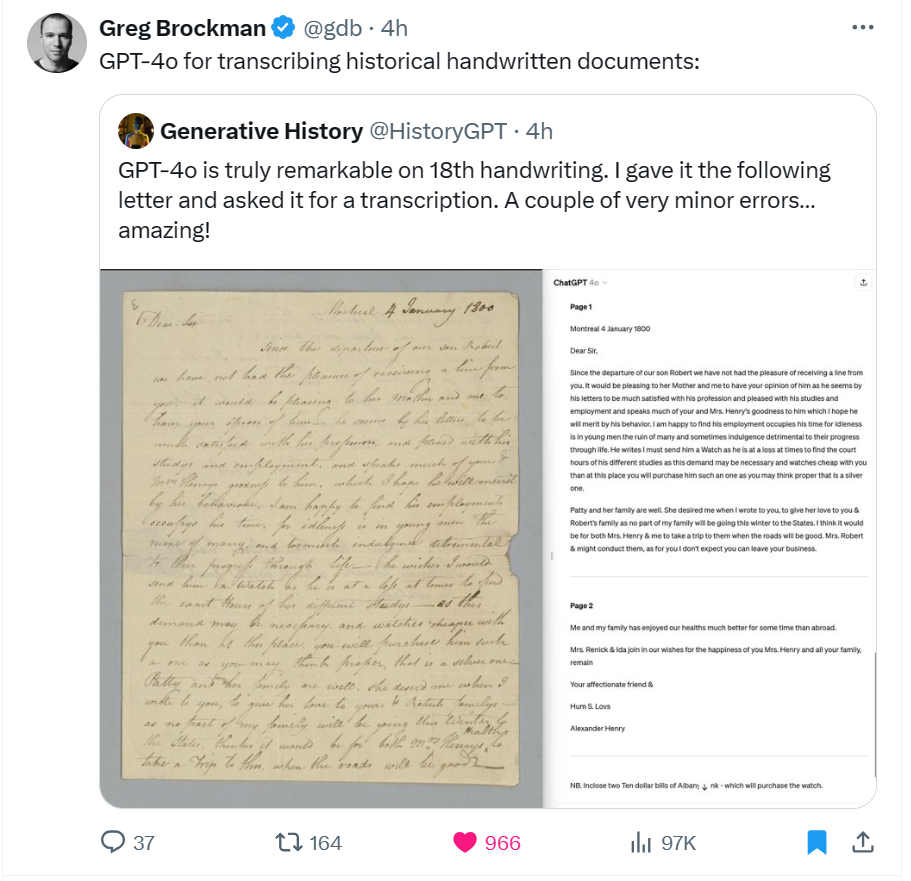
The president and a co-founder of OpenAI, Greg Brockman, amplified early claims from some researchers that GPT-4o has improved handwritten text recognition (HTR) abilities, retweeting a post from Twitter user “Generative History” (@HistoryGPT), who made the claim, “GPT-4o is truly remarkable on 18th handwriting. I gave it the following letter and asked it for a transcription. A couple of very minor errors…amazing!”

I tested this claim.

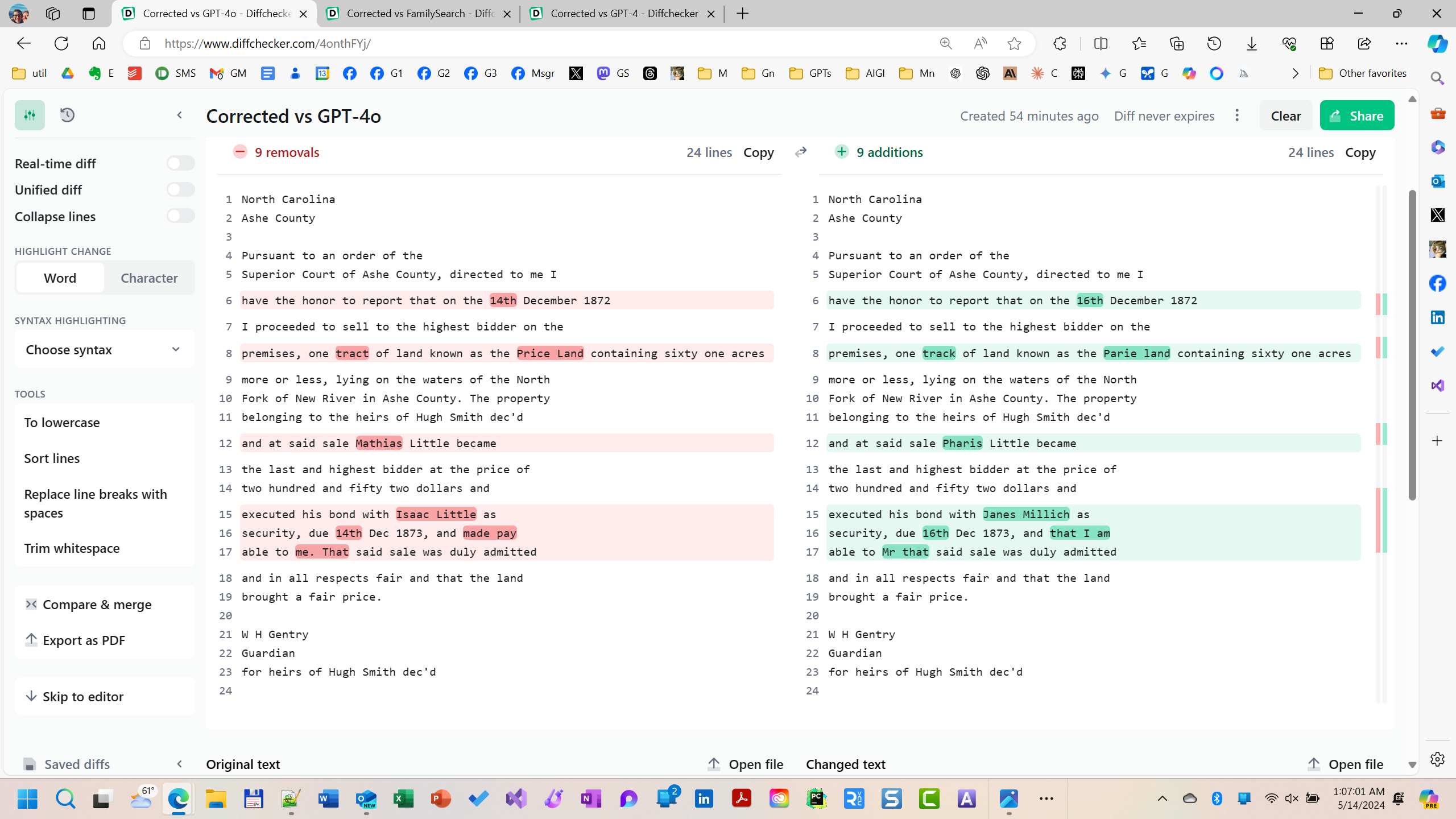
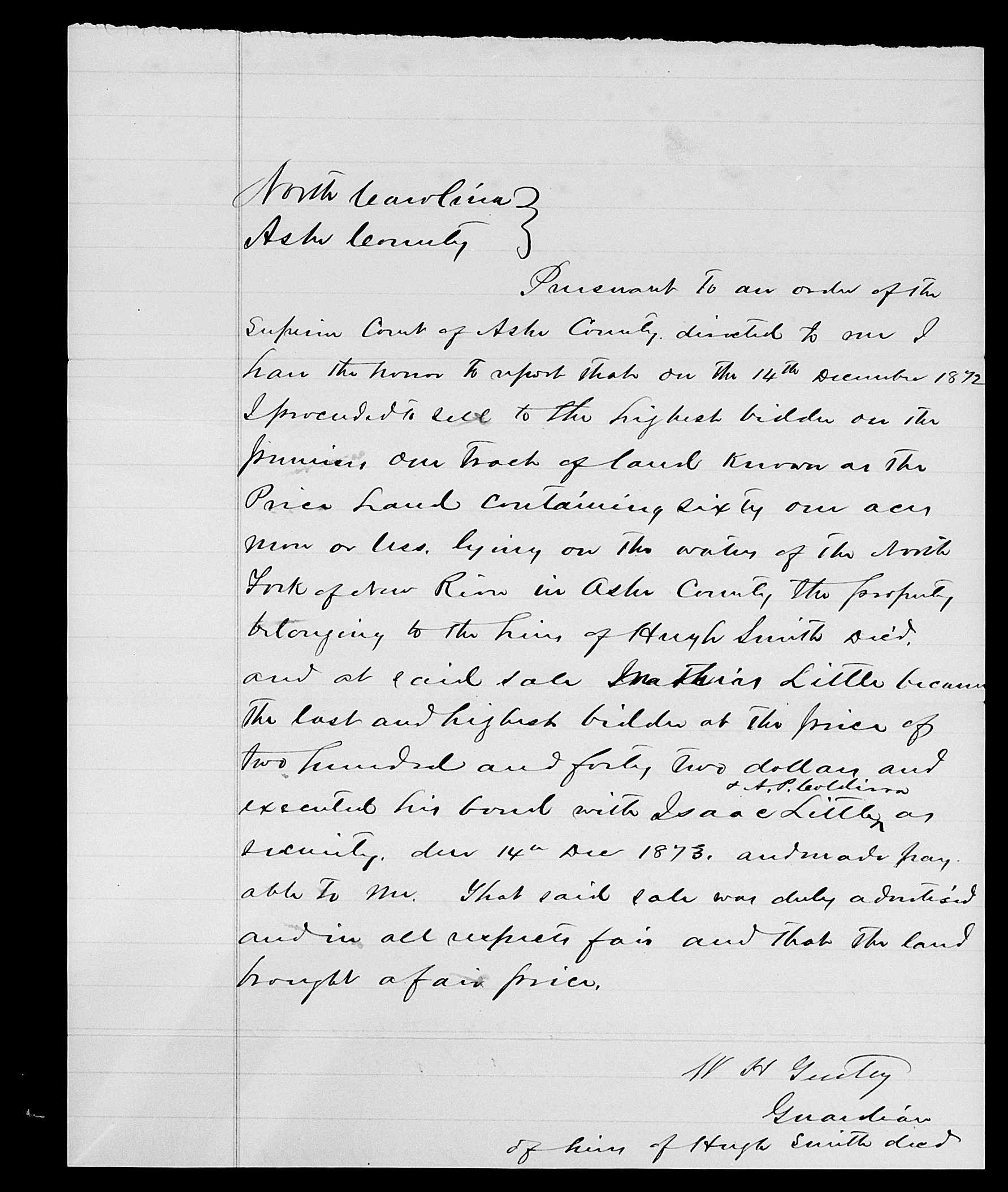
To investigate the claim, I found a handwritten probate file mentioning my third-great-grandfather using FamilySearch’s Full-Text Search. I manually created an accurate transcription of the file. Then, I compared three AI-powered transcriptions, that provided by FamilySearch, one from the previous best OpenAI model, GPT-4, and finally the transcript from GPT-4o.

ModelErrors
FamilySearch22
GPT-417
GPT-4o9

The transcript provided by FamilySearch contained 22 errors; the transcript provided by GPT-4 was only marginally better than that with 17 errors. But the transcript provided by the new GPT-4o returned only nine errors.

Handwritten text recognition is hard. And a small handful of tests are not adequate to confirm an advance. But these cursory evaluations are encouraging, at least encouraging enough bring to the attention of the community for further scrutiny. So between FamilySearch’s rich trove of resources and OpenAI’s providing free access to GPT-4o, researchers have the ability to explore for themselves this possible advance in HTR.

Less encouraging results with text rendered in images

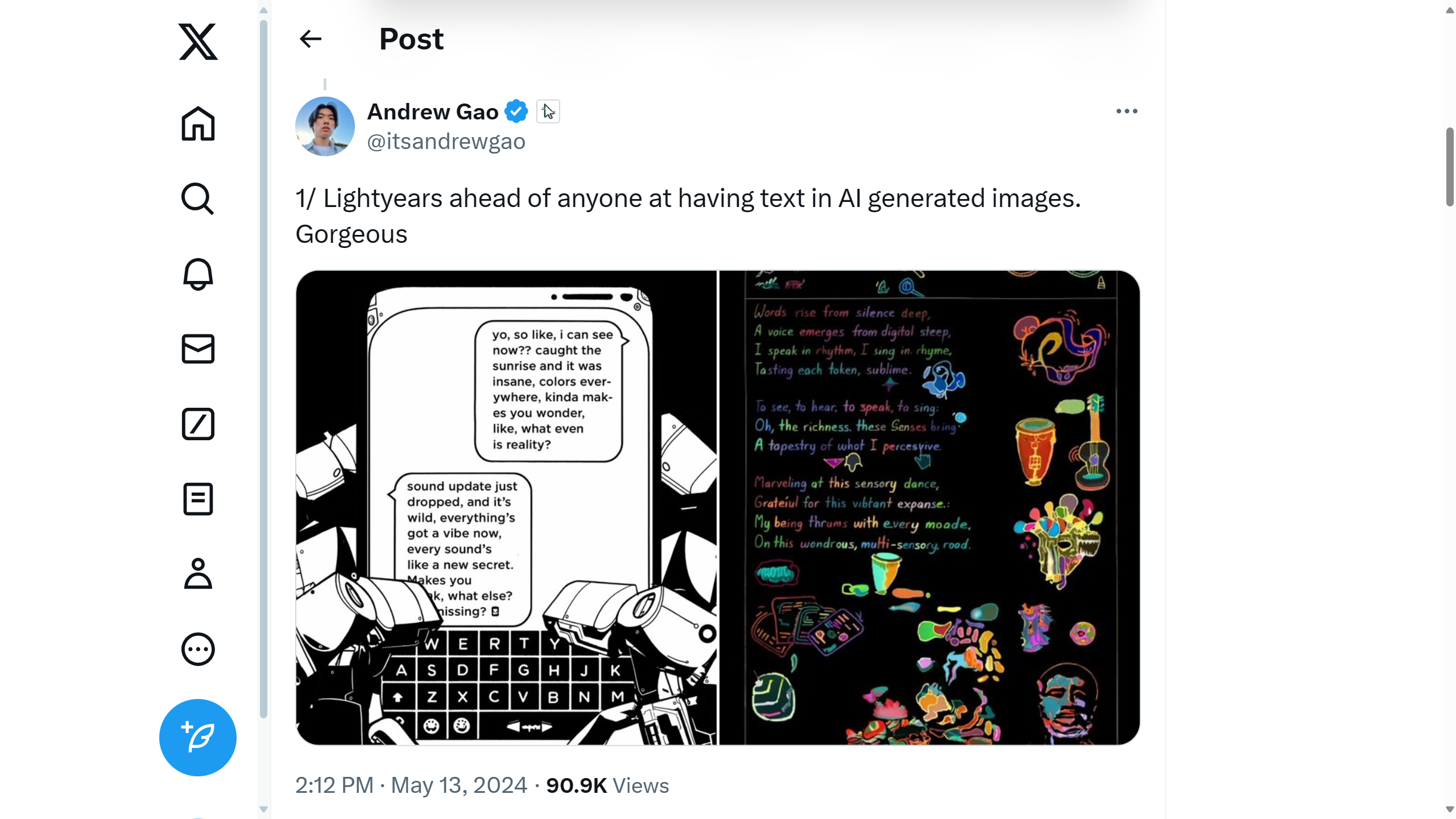
In early January during my talk about AI and genealogy, perhaps feeling the hope New Year’s, I made two predictions about advances in AI technology that I expected were reasonable to achieve in 2024. The first was my prediction that dead-easy drop-and-drag audio-to-text transcription would emerge; this capability has existed in many forms for a while, but none are free, dead-easy, or quick, yet the technology seems just on the cusp of greater accessibility. No suggestion is made that GPT-4o advances this goal. My second prediction was that the rendering of text in AI-generated images would be perfected this year; currently, rendering text in AI-generated images is too problematic to be consistently useful. This problem is reminiscent of the issue in 2022 that AI image generators had with drawing hands: you could have any number of fingers on a hand except five. This problem, however, was solved in the early summer of 2023; image generators now consistently render hands with the appropriate number of fingers. My prediction was that just as hand-rendering was solved, so would rendering of text in images be solved in 2024.

Some early claims have been made that the newly released GPT-4o had solved the text rendering problem in images.

I’m not so sure.

Click to enlarge

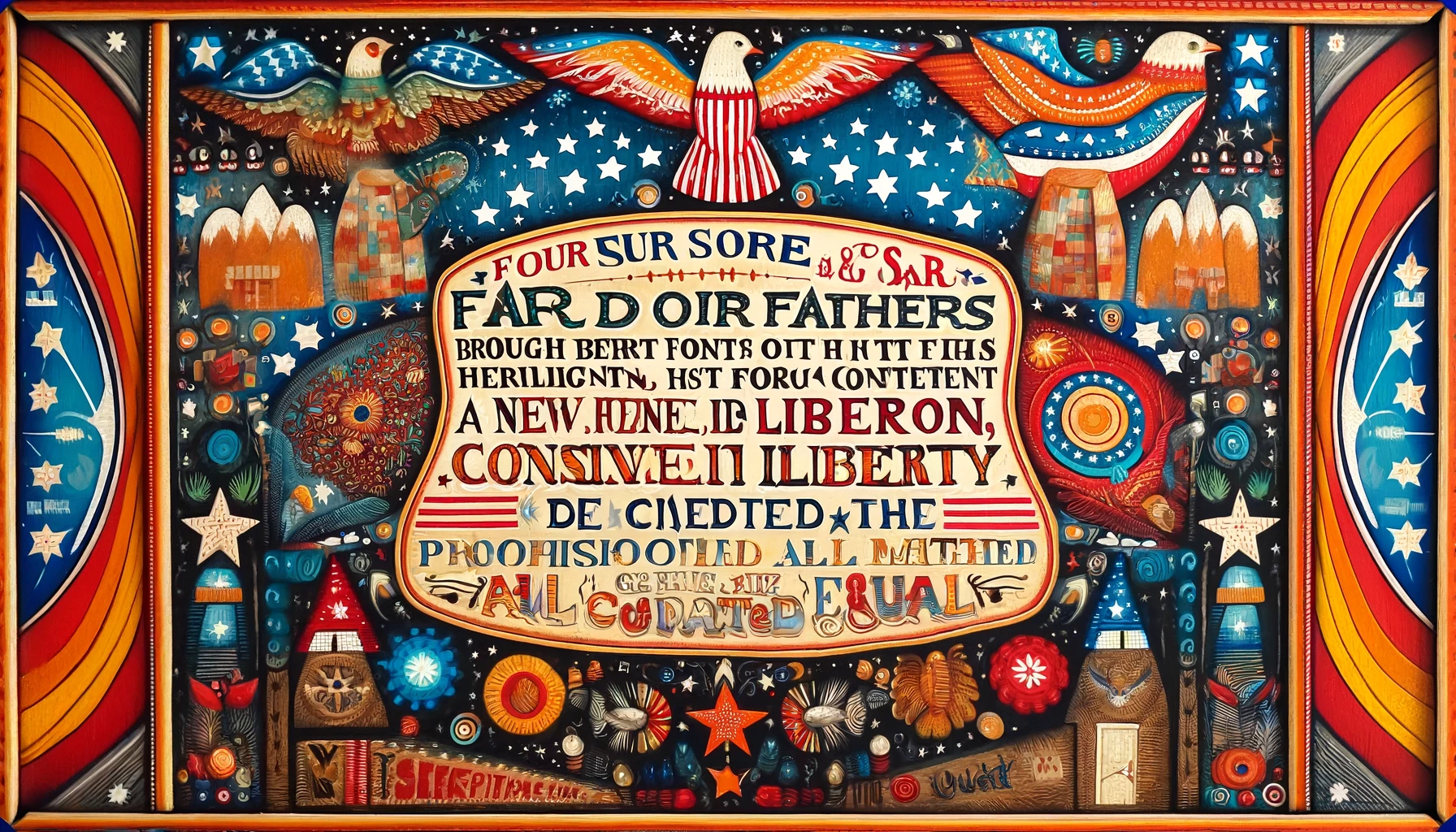
To test the claim, I prompted GPT-4o to recall the beginning of Lincoln’s Gettysburg Address, which, of course, it did correctly. But then I prompted GPT-4o to “Create a piece of folk art with the text of the beginning of the Gettysburg Address being the focus and subject of the piece.” Here is the result:

Click to enlarge

This test was a spectacular failure.

Nevertheless, I remain hopeful. I believe it is still reasonable to expect that these two capabilities will be achieved in 2024.

Regardless, the new emergent capabilities being discovered in generative AI models continues to increase and accelerate. So, I remain optimistic that generative artificial intelligence will rapidly continue to evolve, and that genealogists and family historians will continue to discover new usefulness and efficiency with these tools.

If you discover a new way to use these tools for family history and genealogy, please let me know in the comments. Or, better yet, join the community of nearly 7,000 folks following this area at Blaine Bettinger’s Facebook group “Genealogy and Artificial Intelligence.” I hope to see you there.


“Ashe, North Carolina, United States records,” images, FamilySearch (https://www.familysearch.org/ark:/61903/3:1:33S7-9PT3-9MZ1?view=explore : May 14, 2024), image 1110 of 1768; North Carolina. Division of Archives and History.
North Carolina
Ashe County

Pursuant to an order of the
Superior Court of Ashe County, directed to me I
have the honor to report that on the 14th December 1872
I proceeded to sell to the highest bidder on the
premises, one tract of land known as the Price Land containing sixty one acres
more or less, lying on the waters of the North
Fork of New River in Ashe County. The property
belonging to the heirs of Hugh Smith dec'd
and at said sale Mathias Little became
the last and highest bidder at the price of
two hundred and fifty two dollars and
executed his bond with Isaac Little as
security, due 14th Dec 1873, and made pay
able to me. That said sale was duly admitted
and in all respects fair and that the land
brought a fair price.

W H Gentry
Guardian
for heirs of Hugh Smith dec'd

The Art of Prompting: How to Effectively Communicate with AI

(Note: This blog post was originally published on the blog, Genealogy with Dana Leeds: Creator of the Leeds Method.)

The Art of Prompting

Are you looking to improve your interactions with AI systems? One key aspect to consider is the type of prompts you use. In this post, we’ll explore five essential prompt types: Vanilla Prompting, Few-Shot Prompting, Chain-of-Thought Prompting, Role-Based Prompting, and Multi-Modal Prompting. By understanding these different approaches, you can communicate more effectively and get the most out of your AI conversations. Let’s get started!

Vanilla Prompting: The Straightforward Ask

Vanilla prompting is the simplest way to communicate with AI. It’s like asking a direct question or giving a simple command.

Chatbot Saying Paris

Image generated by Dall-E

Example:
Prompt: “What is the capital of France?”
AI Response: “The capital of France is Paris.”

In vanilla prompting, you ask a clear question, and the AI uses its knowledge to answer.

Few-Shot Prompting: Learning from Examples

In few-shot prompting, you teach the AI by giving it examples before asking it to perform a task, helping it understand what kind of answer you need.

Example:
You want the AI to translate phrases into Spanish. First, give it an example, then ask for what you really want.
Example prompt: “Translate ‘Hello, how are you?’ into Spanish.”
AI’s response: “Hola, ¿cómo estás?”
Actual task prompt: “Translate ‘Nice to meet you’ into Spanish.”
AI’s response: “Encantado de conocerte.”

This approach trains the AI with examples, preparing it for the real task.

Chain-of-Thought Prompting: Step-by-Step Reasoning

Chain-of-thought prompting lets the AI break down complex issues into smaller, understandable steps.

Chatbot showing answer is 15

Image generated by Dall-E

Example:
Prompt: “Explain how to find the sum of the numbers 1 to 5.”
AI’s Response: “List the numbers 1 to 5. Add them sequentially: 1+2 is 3, 3+3 is 6, 6+4 is 10, and 10+5 is 15. So, the sum is 15.”

The AI explains the process step by step, making it clear how it reached the solution.

Role-Based Prompting: Assuming a Persona

Role-based prompting means you ask the AI to act like someone or something else, guiding its responses.

Example:
Prompt: “As a fitness coach, give me advice on how to start exercising.”
AI Response: “Start with light activities like walking, then gradually include more intense exercises. Balance is key for a good fitness routine.”

Here, the AI adopts the persona of a fitness coach, tailoring its advice to that role.

Multi-Modal Prompting: Beyond Text

Multi-modal prompting involves using different types of data, like text and images, for a richer interaction.

Crowded Beach

Image generated by Dall-E

Example:
Prompt: [Image of a crowded beach] “Describe this scene.”
AI Response: “The image shows a crowded beach with people sunbathing and playing, under a clear blue sky.”

This uses both image and text data, showing the AI’s ability to handle and integrate different types of information.

Understanding these prompting styles can improve your interaction with AI, making your requests more effective and the responses more useful. Whether you need straightforward answers, detailed explanations, personalized advice, or comprehensive analysis, knowing how to prompt AI can unlock new levels of creativity and efficiency.

Building on Previous Explorations

In a previous post, I explored the difference between simple prompts and prompt engineering in my genealogy research. At the time, I referred to “simple” prompts, which I now understand are called “vanilla” prompts. The more complex prompts I experimented with fall under the category of “engineered” prompts, which include few-shot, chain-of-thought, role-based, and multi-modal prompting.

If you’re interested in learning more about my initial experiments with AI prompting in genealogy, check out my post: “Simple Prompts vs Prompt Engineering: A Genealogist’s Experiment with AI.” While my understanding of prompt types has grown since then, the thoughts and experiments shared in that post are still relevant and provide valuable insights into the practical application of AI in genealogy research.

From Prompts to Practice: Your Next Steps in AI Mastery

Now that you’ve learned about the different types of AI prompts, it’s time to take your AI skills to the next level. Join me in an exciting 8-week journey of discovery and application in my upcoming course, “AI Explorations in Genealogy & Beyond.” This immersive experience features collaborative learning, hands-on projects, weekly challenges, and a supportive community to help you master AI techniques and apply them to your genealogy research and beyond.

Don’t miss out on this opportunity to expand your AI knowledge and connect with like-minded enthusiasts. Sign up now and get ready to unlock the full potential of AI in your projects! Click here to learn more!

If you found this post helpful, please consider sharing it with your friends, family, and colleagues who are interested in AI or genealogy. By spreading the word, you can help others discover the power of AI prompting and inspire them to join our growing community of AI explorers.

Remember, the more we share our knowledge and experiences, the faster we can collectively advance the field of AI and its applications. So, let’s keep learning, sharing, and pushing the boundaries of what’s possible with AI!

AI Acknowledgement

This blog post was written with the assistance of AI tools Claude 3 Opus and ChatGPT 4, demonstrating the power of AI in content creation and collaboration.

Exploring FamilySearch’s New Full-Text Search Tool & AI Transcription Comparison

(Note: This blog post was originally published on the blog, Genealogy with Dana Leeds: Creator of the Leeds Method.)

A Revolutionary Tool: FamilySearch “Full-Text Search”

During RootsTech, an exciting development was announced: the launch of FamilySearch Labs. Among these experimental tools is one described as “Find Results with Full-Text Search.” Although more databases will soon be added, currently this tool can search United States land and probate records from 1630 to 1975. What makes this tool a game-changer?

  • Full-text Searches: Discover records previously difficult to locate, including unindexed documents and those where ancestors are mentioned in less direct roles, such as witnesses or neighbors.
  • Dynamic Search Functions: Utilize quotation marks for exact searches, “+” for mandatory inclusion of specific words, and “*” as a wildcard for flexible searches. Filters for year, type, place, or collection further refine your search.
  • Watch and Learn: Maximize your search capabilities by watching the short, instructional video that guides users through optimizing their search strategy.

Discovering Ancestors with Enhanced Precision

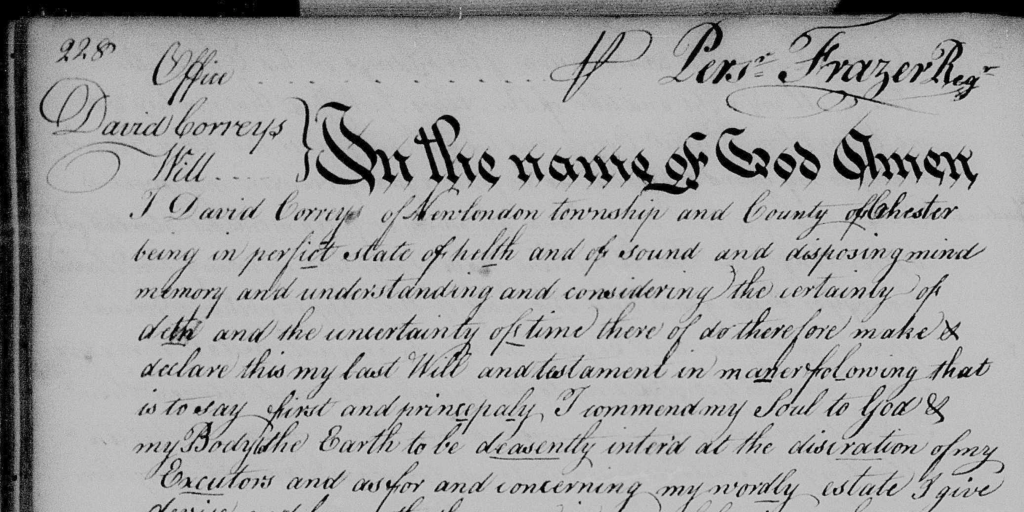
To explore this “full-text search” tool, I focused on my 6th great-grandfather, David Correy (~1708-1787), of New London, Chester County, Pennsylvania. The search led me to records I had not found previously:

  • Listed as a Neighbor: A 1767 deed identified David Correy as a neighbor providing additional information about the location of his land and neighbors at a specific time.
  • David’s Will: David Correy’s will not only confirmed his approximate death date but also provided direct evidence of my 5th-great grandmother’s father as well as naming other family members.

Experiment with AI

I decided to do an AI experiment with David Correy’s will. My goal was to compare their accuracy to the original text as well as determining whether they could handle an entire handwritten page. The four contenders were:

  • Microsoft’s Copilot (powered by OpenAI’s GPT, but “weaker”)
  • Google’s Gemini Advanced
  • OpenAI’s ChatGPT 4
  • Anthropics (new) Claude 3 Opus

Evaluating AI Transcription Accuracy

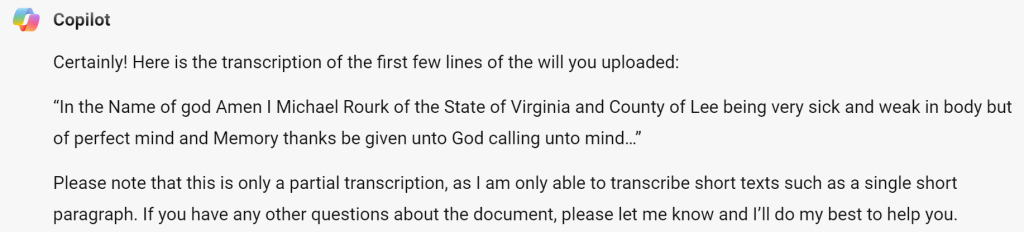
The experiment revealed varied results. Copilot and Gemini struggled with both accuracy and handling longer text segments. ChatGPT performed admirably, with only a few mistakes, though it often corrected what it perceived as spelling errors. Claude emerged as the leader, offering the most accurate transcription and usually preserving the original spelling.

Copilot's Transcription of David Correy's Will
Copilot’s Transcription of David Correy’s Will
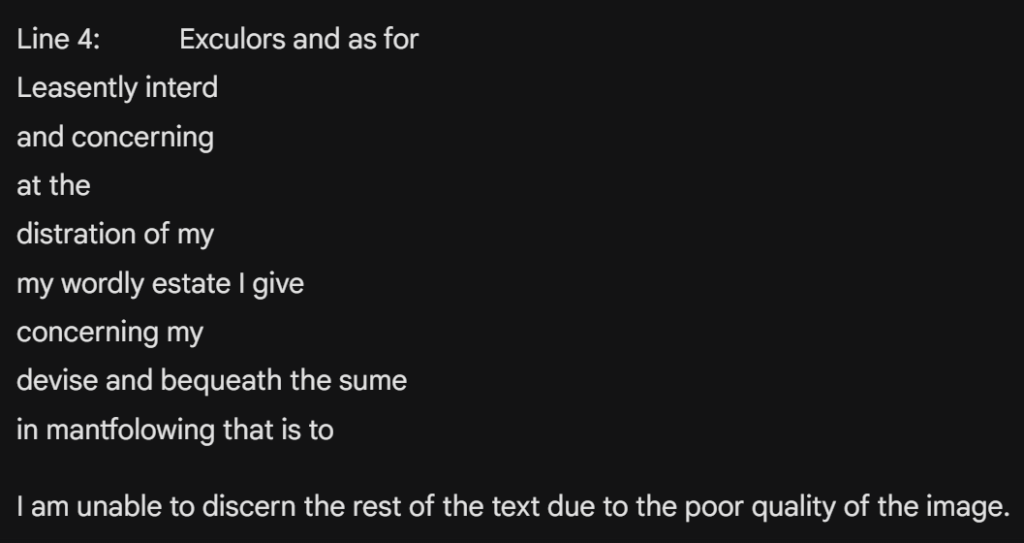
Gemini's Transcription of David Correy's Will
Gemini’s Transcription of David Correy’s Will

With ChatGPT and Claude as the leaders, I decided to test them with an entire page of the will. Both managed to transcribe the full page—a feat that AI has struggled with in the past. Claude, again, excelled at maintaining the original line breaks and was more consistent in preserving the document’s original misspellings.

Original vs. AI: A Comparison

Based on today’s spelling, the following words were some of the “misspelled” words in the original document: Newlondon (New London), perfict (perfect), helth (health), deth (death), folowing (following), satisfyed (satisfied), and princiepaly (principally). How did these two AIs fare?

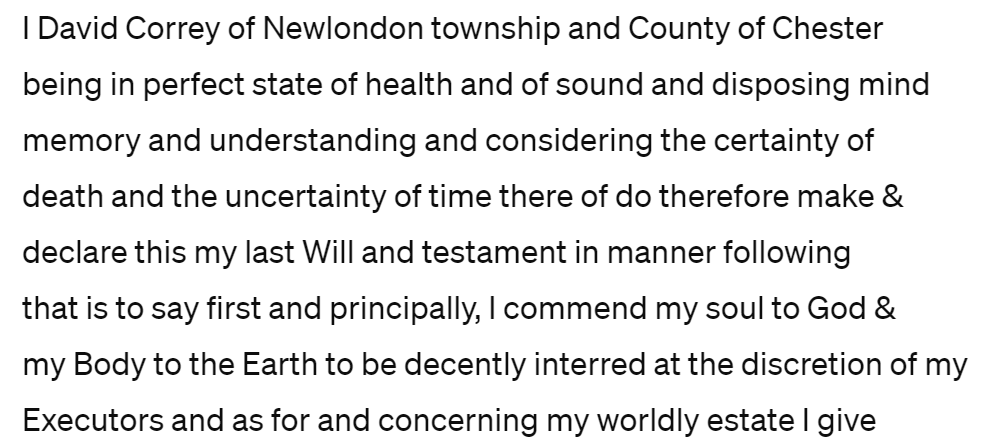
ChatGPT's Transcription of David Correy's Will
ChatGPT’s Transcription of David Correy’s Will
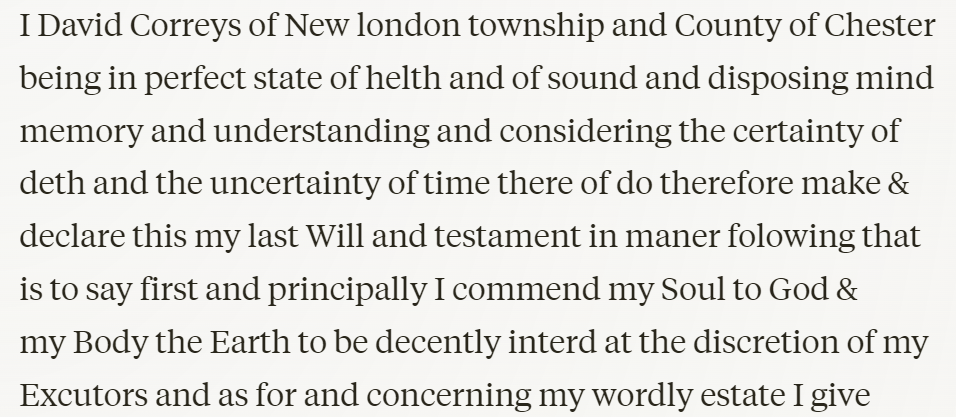
Claude's Transcription of David Correy's Will
Claude’s Transcription of David Correy’s Will

Both ChatGPT and Claude corrected “perfict” to “perfect” and “deasently” to decently, other words were handled differently by the two AIs:

  • ChatGPT successfully kept “New london” as one word, but changed the spellings of the other words to match today’s spellings.
  • Claude managed to accurately transcribe words that were spelled incorrectly by today’s standards, but broke “Newlondon” into two words.

While neither AI perfectly preserved every original spelling, both performed impressively overall and both offer a valuable starting point for transcribing and understanding our ancestors’ written records. Claude, however, was the most precise.

Final Thoughts and a Look Ahead

FamilySearch’s full-text searching tool is an incredible benefit to genealogists. It opens up new possibilites for uncovering parts of our family histories that were previously difficult to access. I recommend trying it out to see what you can uncover about your ancestors!

As the field of AI continues to grow, new tools like Claude are showing us the future of technology’s role in our research. While ChatGPT has been a frontrunner, Claude is an amazing newer tool that is a definite asset. ChatGPT will likely release their next version soon.

Continuing the Journey with AI in Genealogy

If you are inspired by these advancements and want to explore the role of AI and genealogy further, please consider joining Dana’s course, “AI Explorations in Genealogy & Beyond: A Course of Discovery & Application.” This 8-week course is packed with:

  • Interactive learning sessions and live, recorded Zoom meetings
  • Small group activities that encourage a community learning experience
  • Weekly challenges to help you learn how to use AI in various ways

This course is perfect for those just beginning to integrate AI into genealogical research or those seeking to broaden existing skills. Click here to find out more and register today!

By integrating these innovative tools, we’re entering a new chapter in genealogy, making it easier than ever to access our past and bring the stories of our ancestors to light. Join us as we take on this exciting exploration.

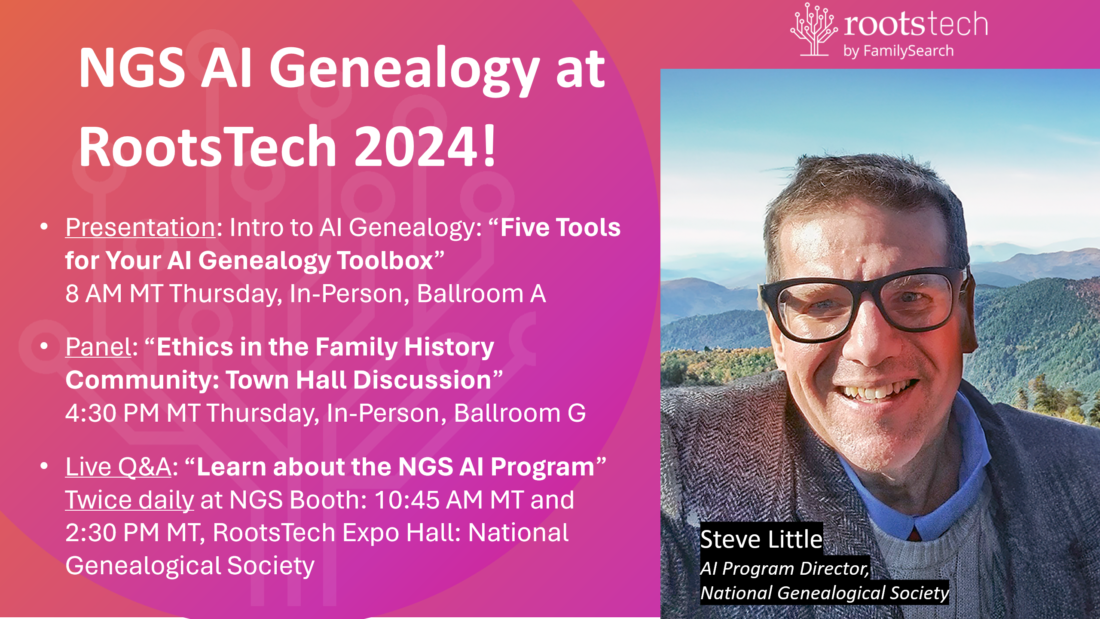
NGS AI Genealogy at RootsTech 2024

I’m excited to be attending my first RootsTech. I look forward to meeting in-person friends and colleagues. I will be presenting on Thursday morning, participating as a panelist Thursday afternoon, and spending a lot of time at the NGS booth in the Expo Hall during the whole event. I hope you will stop by and say, “Hello.”

Here is where you can find me:

Presentation: Intro to AI Genealogy: “Five Tools for Your AI Genealogy Toolbox”

8 AM MT, Thursday, In-Person, Ballroom A

Panel: “Ethics in the Family History Community: Town Hall Discussion”

4:30 PM MT, Thursday, In-Person, Ballroom G

Live Q&A: “Learn about the NGS AI Program”

Twice daily at NGS Booth: 10:45 AM MT and 2:30 PM MT, RootsTech Expo Hall: National Genealogical Society