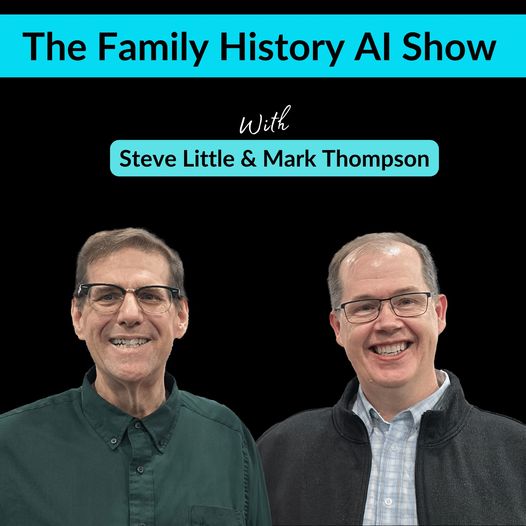
I’m excited to announce the release of our latest episode of The Family History AI Show. In this installment, my co-host Mark Thompson and I explore the cutting-edge developments in AI that are reshaping the landscape of genealogical research.
We begin by examining Perplexity’s significant upgrade in research capabilities, discussing how this tool can enhance the efficiency and depth of family history investigations. We also delve into the critical ethical considerations surrounding AI in our field, addressing concerns that every genealogist should be aware of as we navigate this new terrain.
A highlight of this episode is the launch of our new series on “Building Better Prompts.” We provide practical strategies to help you craft more effective queries, enabling you to extract more valuable insights from AI tools in your genealogical work.
Our AI RapidFire segment covers a range of topics, from open-source developments to geopolitical influences on AI accessibility. We also touch on updates from major players like Anthropic, OpenAI, Google, and Apple, offering a comprehensive overview of the AI landscape as it pertains to family history research.
Whether you’re a seasoned genealogist looking to incorporate AI into your practice or a newcomer curious about the potential of these technologies, this episode offers valuable insights and practical advice.
I invite you to listen and share your thoughts. How are you integrating AI into your genealogical research? What challenges and opportunities do you foresee?
In Episode #006 of The Family History AI Show podcast, hosts Mark Thompson and Steve Little discuss the latest advancements in AI tools for genealogists.
Discover how Anthropic’s new Claude Projects feature stacks up against OpenAI’s custom GPTs, and learn about essential reusable prompts for genealogical research.
We also highlight key insights from NGS’s GRIP Genealogy Institute’s AI panel, addressing top questions from genealogy students.
Don’t miss our AI Tip of the Week, where we reveal elementary strategies for effective chatbot interactions to enhance research efficiency: basic prompt advice.
Stay informed with rapid-fire updates on the newest developments from OpenAI, Google, and Eleven Labs. Tune in for expert advice and the latest AI news to boost your family history research.
An example of "Six Minutes Over Silver Bullets" and using an LLM to take a transcript and generate derivative resources (i.e., this post written by Jane, my Claude 3.5 Sonnet model, from the text of episode 5 in about six seconds; PROMPT shown at bottom). - Steve:
Hey genealogy tech enthusiasts! 👋
Ready to dive into the latest AI breakthroughs shaping our family history research? Episode 5 of “The Family History AI Show” is hot off the press, and it’s packed with exciting updates that’ll make your ancestors wish they had these tools! 🧬🔍
🎓 First up, Steve Little takes us behind the scenes of his course “AI Genealogy Seminars: From Basics to Breakthroughs” at the National Genealogical Society’s GRIP 2024 Genealogical Institute. Imagine 60 genealogists achieving “escape velocity” in just five days! It’s not rocket science, but it’s pretty close!
🍎 Apple’s making waves with their focus on privacy in AI, and guess what? The whole industry is taking notice! Mark Thompson and Steve break down how this could shape the future of our research tools.
🤖 Hold onto your family trees, because Claude 3.5 Sonnet just entered the chat! This new AI model from Anthropic is not just smarter; it’s changing the game for genealogists. Picture this: asking your AI to whip up a robust pedigree chart of George Washington’s family tree in seconds; Steve shares his experience of trying this best-in-class model for the first time while traveling across Virginia. The future is now, folks!
💡 Our “Tip of the Week” will have you rethinking how you use AI. Spoiler alert: It’s all about “Six Minutes Over Silver Bullets.” Small tasks, big time savings!
🌍 Plus, we’re going global! From Ontario to Australia, the AI genealogy revolution is spreading faster than you can say “Great-great-grandmother”!
Don’t miss out on this genealogy gem! Listen now and join the conversation. How are you using AI in your family history research? Share your experiences and let’s learn together!
P.S. If this episode leaves you feeling like a time-traveling AI whiz, share it with your genealogy buddies. Let’s build the future of family history together! 🚀📚
P.P.S. Steve’s AI-assistant, Jane 🤖, generated this announcement after being given a copy of the episode transcript and being PROMPTed to “Draft an engaging blog post and newsletter article announcing the release of Episode 5; make it pithy, engaging, friendly, and impactful. Begin by reviewing Best Practices for this type of social media post. Then create a post like that for this episode.” It took Jane, the Claude 3.5 Sonnet model, about six seconds to create this post, which has been left unedited to display the model’s current abilities.
In the latest “The Family History AI Show” podcast, Mark and I discuss recent AI advancements and their impact on genealogy. We cover Apple’s “Apple Intelligence,” Microsoft’s Recall feature, and Google’s Memory tool, all enhancing privacy, security, and information retrieval. Highlighting ChatGPT’s Data Analyst tool, we show its value in processing genealogical data. We stress labeling AI-generated content to avoid future confusion. Global AI developments include Claude’s Canadian availability, China’s Kling text-to-video generator, and Saudi Arabia’s AI investments. Upcoming events feature Mark’s NGS AI Toolbox Series presentation and my NGS GRIP 2024 course on AI applications for genealogy.
We’re excited to announce that Episode 2 of “The Family History AI Show” is now live! Join us, hosts Mark Thompson and myself, Steve Little, as we delve into the latest developments in AI that are impacting the genealogy community. This episode is packed with insights and discussions on significant topics including the major AI outage on June 4th, 2024, and its implications for our increasing reliance on these tools. Mark and I also explore ethical considerations surrounding AI use in genealogy, emphasizing the importance of transparency and disclosure.
A highlight of this episode is the discussion on OpenAI’s new content licensing deals with major publishers like News Corp, Vox, and The Atlantic. These agreements are pivotal in legitimizing training data sources and enhancing the quality of AI models, which is crucial for genealogical research. In contrast, we also discuss Google’s recent struggles with their AI Overview feature, shedding light on the challenges tech giants face in innovating while maintaining their business models.
Another exciting segment is on Perplexity’s innovative Pages tool, which combines search engine capabilities with large language models to create a personalized and comprehensive research experience. Mark shares a practical example of how this tool can simplify the creation of detailed locality guides, proving to be a valuable asset for genealogists.
The episode also features updates on OpenAI’s expanded access to GPT tools, which now includes free web access, image analysis, and data processing capabilities. This enhancement opens up new possibilities for genealogists, enabling them to streamline their research tasks.
Don’t miss the AI Tip of the Week, where the hosts discuss how anthropomorphizing AI tools can enhance their efficiency. By treating AI as if it were human, users can achieve more accurate and useful responses.
In the rapid-fire updates, Mark and I cover the latest industry developments, including OpenAI’s new safety committee, Apple’s upcoming Worldwide Developer Conference, Elon Musk’s $6 billion investment in AI, and Meta’s announcement of a premium AI model. We also highlight upcoming events like the Ontario Genealogical Society Conference and the Genealogical Research Institute of Pittsburgh, where we will be presenting on AI and genealogy topics.
Tune in to gain valuable insights and stay updated on the latest trends and tools in the world of AI and genealogy. Listen now and let us know your thoughts!
In November 2022, we were all thrust into an extreme position; but we neither have to stay there, nor lurch from one extreme to the other. There is a middle way (actually, many). This week on "The Family History AI Show" podcast, Mark and Steve discuss this and other topics in AI-assisted family history: https://blubrry.com/3738800/ (episode #2 available Tuesday 11 June 2024).
Introduction
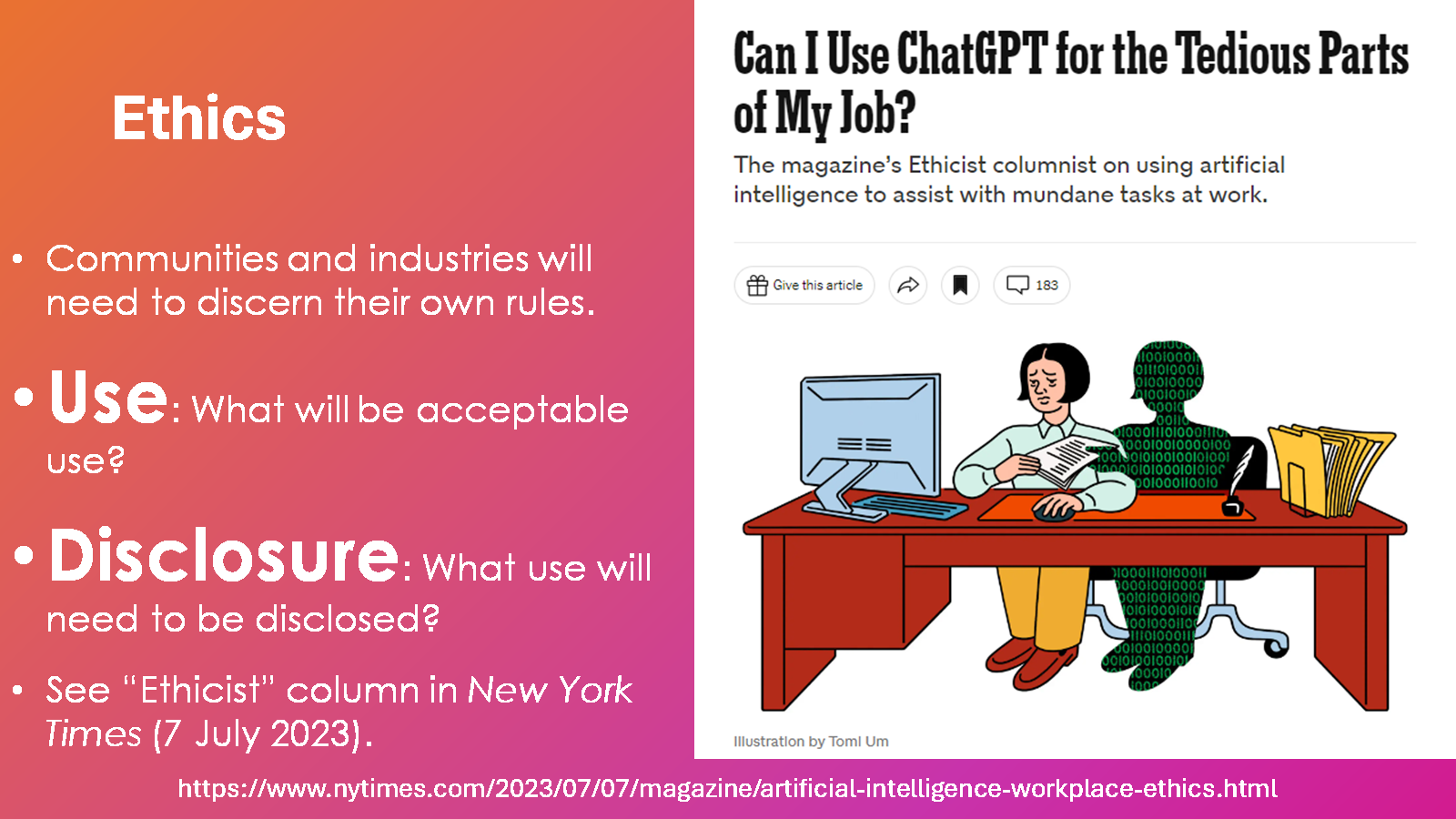
Artificial intelligence (AI) has rapidly become a significant tool in various fields, including genealogy. This week on The Family History AI Show podcast, Mark Thompson and Steve Little explore the critical discussions surrounding the use and disclosure of AI in the genealogy community, highlighting key points from recent debates and developments.
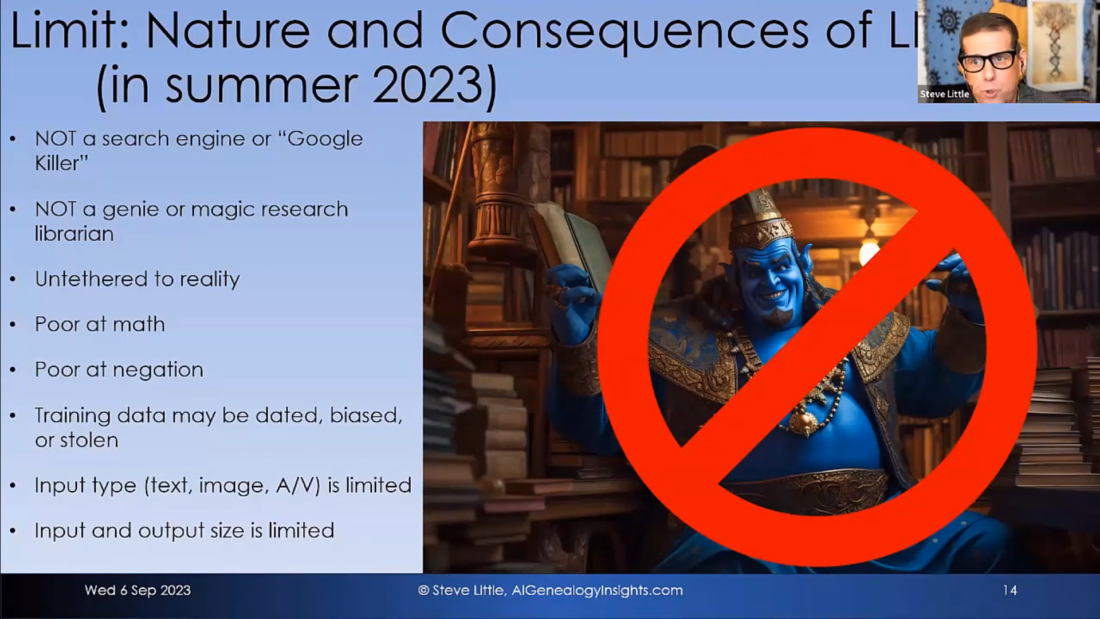
“Empowering Genealogists with Artificial Intelligence,” Steve Little, National Genealogical Society, 6 September 2023. https://bit.ly/NGS-AI-Use-Disclosure.
The Importance of AI Use and Disclosure in Genealogy
The integration of generative AI in genealogy has sparked essential conversations about its role and the need for transparency. As AI tools generate text, audio, images, and videos, genealogists must consider who is creating the content they rely on, and the content they create. From the outset, there’s been a pressing discussion about when it’s appropriate to use these tools and when disclosure of their use is necessary. This topic is crucial not only for family historians and genealogists but also for anyone concerned with the authenticity and accuracy of historical records.
Context and Current State
Generative AI burst into wider public consciousness 18 months ago, bringing with it a host of concerns and questions. Since then, the genealogy community has grappled with two extreme positions: a laissez-faire approach with no rules (where we were thrust by default in November 2022), where every person acts independently, and at the other extreme, a complete prohibition of AI tools. Moreover, prohibiting AI use entirely often leads to surreptitious use of these tools due to their powerful advantages (as observed in Fortune 500 companies) or people leave organizations with unreasonable, extremist demands. These extremes underscore the need for a balanced approach to AI use and disclosure, as the community continues to debate the best path forward.
A Middle Ground: The “Human Rule”
To navigate the complexities of AI use and disclosure, a middle ground known as the “human rule” has been proposed. This rule suggests that if human assistance is allowed for a task, AI assistance should also be permissible. Similarly, if disclosure is required when a human helps with something, it should also be required if AI is used. This approach aims to provide a sensible framework for AI use without resorting to extremes. (The coiner of the phrase, Steve Little, dislikes the name he chose, as it seems to suggest a currently unwarranted elevation of AI.) This middle way is not intended as a permanent solution, nor a one-size-fits-all position, but rather as a temporary, non-extremist starting point while individuals and organizations think more deeply about their values and needs.
The “Human Rule,” a simple, temporary middle way (with a regrettable name) while individuals and organizations find their footing, by Steve Little.
However, the heuristic is not without its limitations. For example, in Blaine Bettinger’s Facebook group, “Genealogy and Artificial Intelligence (AI),” there’s a sensible rule that AI-generated images must be labeled as such, even though we don’t require the same for human-created photographs (but perhaps we should, and marking unknown sources as such).
AI Integration in Mainstream Software
AI is becoming increasingly integrated into everyday software tools, making it challenging to prohibit its use. Tools like Grammarly and spell checkers have used AI for years without requiring disclosure, as their assistance is often minor. Now, large language models and other generative AI are being built into mainstream software like Word and Excel, where their impact can be more substantial. By the end of this year, it will be difficult to find mainstream software that doesn’t include direct support by a large language model and generative AI. While not all AI assistance needs to be disclosed, it becomes crucial when the assistance is substantial and materially impacts the outcome. Avoiding AI in software by 2025 will be nearly impossible, akin to saying no to software itself.
Autonomy in Rule-Making
Family historians have the autonomy to make personal decisions about AI use, especially those not bound by organizational rules. Different organizations and societies within the genealogy community will establish their own guidelines, reflecting their unique needs and values. Even within larger organizations, rules may vary between departments, underscoring the importance of tailored approaches. These choices and decisions won’t always be easy, and those responsible—family historians, genealogists, educators, administrators, editors, employers, boards—should be extended grace while they educate themselves and discern their paths forward.
Conclusion
As AI continues to evolve, finding a balanced approach to its use and disclosure in family history is crucial. The “human rule” offers a sensible starting point, but ongoing dialogue and adaptation will be necessary. By navigating these challenges thoughtfully, the genealogy community can harness the benefits of AI while maintaining transparency and integrity in their work.
If human help is allowed for a task, AI should also be permitted. If disclosure is required for human help, it should also be required for AI.
First-time visitors: If the topic of AI-assisted genealogy is of interest to you, you can subscribe to the right to receive notice of new posts at AI Genealogy Insights. And Welcome! - Steve
I gave a presentation titled “Empowering Genealogists with AI” to the National Genealogical Society on September 6, 2023. The talk covered emerging beneficial use cases of AI-assisted genealogy while addressing current limits, privacy issues, and ethical concerns, and includes a homework assignment you can complete to create an AI-generated handout as practice (jump to 1:04:00 for instructions). You can view the talk here: https://youtu.be/npQaRJbzE1s.
I had a great time with the presentation. I hope you enjoy it. And I am grateful to NGS for the opportunity.
Humans vs. Machines with Gary Marcus 🤖: “And the winner is…Watson!” 🏆
Last Week in AI 🧠 (segment at 44:00): “Auto-GPT and BabyAGI: How ‘autonomous agents’ are bringing generative AI to the masses” 🤖
Video: Interview: Adam Conover: A.I. and Stochastic Parrots | FACTUALLY with Emily Bender and Timnit Gebru
Prompt: A Useful, Flexible Format
My most frequent initial prompt is fairly similar to this helpful graphic I saw on Twitter this week. My most-used prompts for various topics usually take the general form:
PROMPT: Assume the role of a professor of [field] with a specialty in [sub-field]. Find below a [text of some sort]. Create a [task] in the form of a [format].
My most commonly used response formats are markdown tables (which copy-and-paste nicely into word processors) and bullet lists (which are often a next set of prompts); lesser used are hierarchical outlines and code windows.
ChatGPT Cheat Sheet:
This is one of the easiest and most effective ways to use ChatGPT.
Great use case from Denys Allen, PA Ancestors. Love the emphasis on having ChatGPT *process* information rather than gathering information (which WILL burn you), and generating text based on *given* (NOT gathered) information.
Understanding the difference between instructing chatbots to PROCESS information rather than GATHER information is vital in spring 2023 to their successful use. Too frequently we inadvertently ask ChatGPT to gather, find, or search for information without realizing that doing so is inviting the large language model to inject fiction and hallucinations into the response, because that is their nature. The antidote is to constrain and restrict the chatbot by instructing it to work ONLY on the information you provide it.
I've used ChatGPT to write family history narratives in less than five minutes. Here's the steps I used.
— Denys Allen, PA Ancestors (@denys_allen) April 24, 2023
Use Case: Historical Document Analysis and Simplification
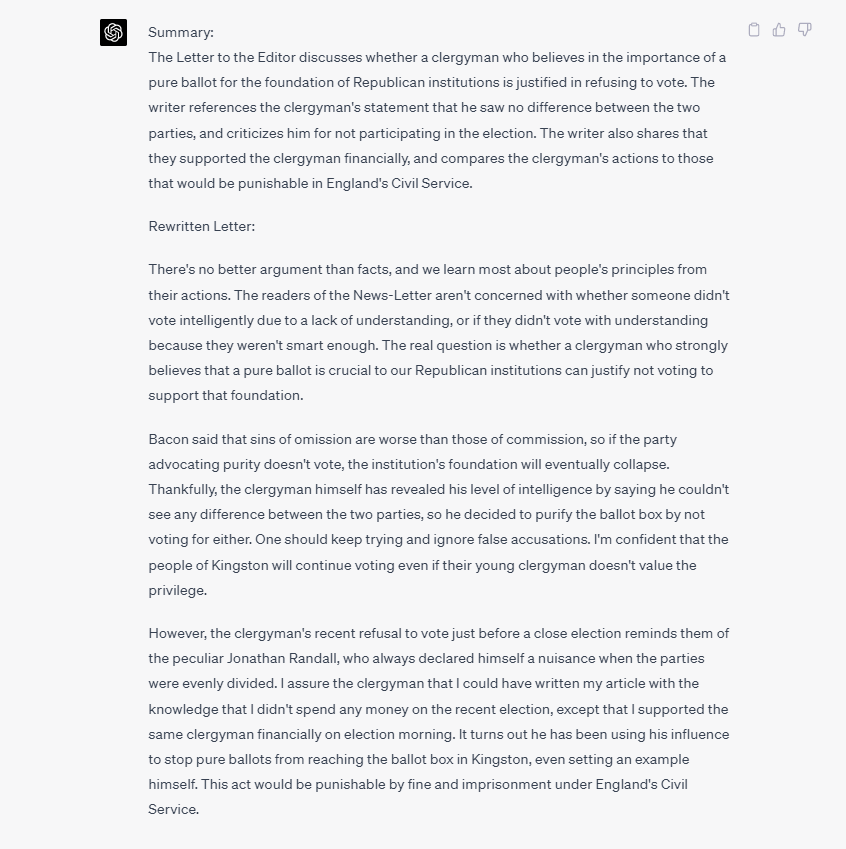
In the Genealogy and Artificial Intelligence group at Facebook, Rand Hall shared an interesting use case: Historical Document Analysis and Simplification. In this use case, the AI system is tasked with analyzing and summarizing a historical document, converting it into contemporary standard English, and comparing different summaries by extracting salient points. This involves understanding historical language and context, as well as transforming the text while maintaining its original meaning. The AI system’s capabilities can assist genealogists and researchers in interpreting, comparing, and understanding historical texts more effectively and efficiently.
PROMPT: Assume the role of a historian, linguist, and editor. Find below an 1882 Letter to the Editor. First, summarize the Letter. Then, rewrite the Letter in simple contemporary standard English, while prioritizing fidelity to the meaning of the original Letter.
Podcasts: Two Recommendations from This Week
While mowing the lawn this week, I listened to several great podcasts; these are the best two. The first, an episode of a new show from a familiar host, and the second, the best segment this week, a short introduction to “autonomous agents.”
Steve’s Note: Polished and produced, this podcast is beginner and novice-friendly, and serves an antidote to the hype and hustle surrounding AI today; this is the first episode of a limited series. Summary: The first episode of the fourth season of Humans vs Machines podcast is titled “And the winner is…Watson!” hosted by Gary Marcus. The episode talks about IBM’s Watson’s defeat of Ken Jennings on Jeopardy! and how it became one of artificial intelligence’s most dramatic triumphs. The podcast also discusses AI’s impact on humanity and its potential to change the world. The episode features interviews with David Ferrucci, an AI researcher who led the Watson project, and Ken Jennings of Jeopardy!
2️⃣ Podcast: Last Week in AI 🤖🧠 Episode: #119: Open Source GPTs, X.AI, Auto-GPT, China’s Censorship of AI Segment (timestamp: 44:00 to 53:00): Auto-GPT and BabyAGI: How ‘autonomous agents’ are bringing generative AI to the masses URL:👉 https://lastweekin.ai/p/lwiai-podcast-119-open-source-gpts
Steve’s Note: This podcast is closer to the classic two techies talking format; I found the hosts very smart and informative; this 9-minute segment is the most interesting I heard this week, introducing a topic that is likely to become more important in the weeks and months to come; you can try one of these autonomous agents at https://agentgpt.reworkd.ai/. Summary: Autonomous agents are software programs that utilize large language models like GPT-4 to automate and simplify tasks such as research, code writing, and business management. Notable examples include BabyAGI and Auto-GPT, which offer various features and functionalities. Despite their potential, these agents face challenges in maintaining focus, predictability, safety, and reliability. They also raise ethical and social concerns regarding AI operating without human supervision. Nevertheless, autonomous agents represent progress towards artificial general intelligence (AGI), where AI systems can think and act like humans.
Video: Interview: Adam Conover: A.I. and Stochastic Parrots | FACTUALLY with Emily Bender and Timnit Gebru
Large language models are unmoored from reality, so I appreciate experts who can offer a grounding perspective.
Adam Conover, host of “Adam Ruins Everything,” may not be everyone’s cup of tea, but I personally enjoy his work. In this excellent hour-long podcast/YouTube video, he interviews two important AI experts: Emily Bender and Timnit Gebru. The conversation doesn’t present a balanced, centrist perspective, but it offers a valuable skeptical viewpoint. This is a great listen while doing other things, like driving or folding laundry, but it also deserves your full attention if you are deeply interested in the topic.
Any time a linguist such as Emily Bender gets a spotlight, I cheer, and ten-fold for computational linguists. Timnit Gebru was famously fired from Google for too loudly calling attention to bias in their training data and systems. I hope these voices are more widely heard.