Building Better Prompts, Facebook’s LLM May Benefit Family History, MyHeritage Retires an AI Feature

In Episode #9 of The Family History AI Show podcast, Mark Thompson and I begin by exploring the potential benefits of Meta’s open-source approach to AI. Next, we discuss MyHeritage’s plans to retire an AI feature. Then, we review the AI image generation features added to Adobe Illustrator.

In this week’s Tip of the Week, we share valuable insights on crafting effective, hallucination-resistant genealogical AI prompts using the “Role, Task, and Format” prompting method.

The RapidFire segment covers Apple’s AI delays, Google’s impressive math achievements, Reddit’s web crawling restrictions, OpenAI’s venture into AI-based search, and Meta’s groundbreaking image recognition advancements.

In all, this episode offers a blend of practical applications and future possibilities, making it essential listening for genealogists navigating the AI revolution. Whether you’re a tech enthusiast or a family history buff, this show provides the knowledge you need to stay ahead in the rapidly changing world of AI.

https://blubrry.com/3738800/134391782/ep9-building-better-prompts-facebooks-llm-may-benefit-family-history-myheritage-retires-an-ai-feature

Busted by Bard: How Google Gemini Spilled the Tea on Google Search Monopoly

With a twist of irony, Google’s Gemini AI is here used to summarize a nearly 300-page landmark ruling against Google’s Search monopoly. This demonstration highlights Gemini’s large context window and ability to process complex legal documents, while underscoring the far-reaching implications of the antitrust case against its creator.

Among large language models, Google’s Gemini is often considered the red-headed stepchild alongside Anthropic’s Claude and OpenAI’s GPT-4. There are two areas, however, where Gemini shines. First, Gemini is the only model currently that can analyze video. Second, it has the largest short-term memory among LLMs (“context window” in AI jargon), a critical characteristic to mitigate against hallucinations.

Important news about Google on Monday 5 August 2024 gave me a chance to demonstrate what can be done with a large context window. Yesterday, a federal judge ruled (gift link to NYT article) that Google was a monopoly, finding for the U.S. Department of Justice, a development that will have consequences for us all. The judge issued a nearly 300-page ruling. I used Google’s newly released Gemini 1.5 Pro Experimental (0801) model to write a summary of the ruling as if it were a feature newspaper article. The article is below. I used a series of three prompts: the first to summarize the brief, the second to identify key quotes from the judge and the most important witnesses in the case, and the third prompt to knit the summary and key quotes into the article below. If you have court filings in your genealogical research, you may find this a helpful use case.

Here is the article that Gemini and I generated, followed by detailed instructions on how we did it.

The Default Choice: How Google’s Grip on Search Landed It in Court

by Steve Little with Gemini 1.5 Pro Experimental (0801)

“The general search engine has revolutionized how we live,” Judge Amit P. Mehta wrote in his landmark decision, recognizing the transformative power of technology that Google helped pioneer. But that very revolution, the judge concluded, had been corrupted by anticompetitive conduct, as Google used its dominance to stifle rivals and maintain an iron grip on the internet search market.

The case, a sprawling saga of algorithms, exclusive contracts, and billions of dollars in advertising revenue, pitted the U.S. Department of Justice and nearly every state Attorney General against one of the most powerful companies in the world. At the heart of the government’s argument lay a seemingly innocuous feature: the default search engine setting. While most users likely don’t give it much thought, that pre-selected choice has immense power in the digital world, steering users to specific websites and shaping the flow of information and advertising dollars.

The government alleged that Google, through a series of exclusive agreements, had effectively locked up the default position on billions of devices, creating an insurmountable barrier to entry for competitors. These contracts, struck with major players like Apple, Mozilla, Samsung, and wireless carriers, guaranteed that Google was the primary gateway to the internet for a vast majority of users.

The trial provided a rare glimpse into the complex world of internet search and the economics of the digital advertising industry. Expert witnesses painstakingly explained how search engines crawl the web to index websites, then employ sophisticated algorithms to understand user queries and rank relevant results. They also emphasized the crucial role of “scale,” or the volume of user data, in refining those algorithms and delivering a superior search experience.

Google, with its vast market share, enjoys an unparalleled scale advantage. Users enter nine times more queries on Google than on all its rivals combined, giving the company an enormous dataset to hone its algorithms and solidify its quality lead. This advantage, the government argued, had been cemented through exclusive contracts that prevent competitors from gaining the user data they need to compete effectively.

Internal Google documents revealed a strategic focus on securing and maintaining default placements, with the company willing to pay billions of dollars in revenue sharing to keep those agreements in place. The judge pointed to a telling 2011 email from a Google executive who wrote, “Our philosophy is that we are paying revenue share in return for exclusivity.” This candid statement, among many others, illustrated how Google used its financial power to cement its dominance.

The testimony of key witnesses further illuminated the anticompetitive effects of Google’s conduct. Eddy Cue, Apple’s Senior Vice President of Services, frankly admitted that there was “no price that Microsoft could ever offer [Apple]” to switch to Bing, Microsoft’s search engine. This stark assessment underscored the reality of a market where competition had been effectively extinguished, with no realistic alternative to Google’s default placement.

John Giannandrea, Apple’s Chief of Machine Learning and AI Strategy and former head of Google Search, described the challenges facing any company hoping to compete in the search market. Building a search engine from scratch requires massive investment, sophisticated engineering, and access to vast amounts of data to train algorithms. Apple, despite its immense resources, has chosen to stay on the sidelines, deterred by the financial and logistical hurdles of taking on Google.

Satya Nadella, CEO of Microsoft, provided a glimpse into the frustration of a company striving to compete against a seemingly invincible rival. Despite investing billions of dollars to improve Bing’s quality, Microsoft has been unable to overcome the “vicious cycle” of Google’s dominance. Google’s default placement drives query volume, which in turn fuels its quality advantage, making it even harder for Bing to gain traction.

Perhaps the most poignant testimony came from Sridhar Ramaswamy, a former Google executive who founded Neeva, a subscription-based search engine that aimed to challenge Google’s dominance. Despite securing substantial funding and developing a high-quality product, Neeva ultimately failed. Ramaswamy attributed the failure directly to Google’s control over default placements, stating that “the convenience of easy accessibility and tapping into…engrained default behaviors are the deciding factors when it comes to whether a search engine gets lots of usage.”

The evidence, both documentary and testimonial, led Judge Mehta to a clear conclusion: “Google is a monopolist, and it has acted as one to maintain its monopoly.” He found that the company’s exclusive distribution agreements had foreclosed competition, deprived rivals of scale, diminished incentives to innovate, and allowed Google to charge advertisers supracompetitive prices for search ads.

The judge’s ruling, a significant victory for antitrust enforcers, represents a turning point in the digital age. It sends a strong message that even tech giants are not above the law and that exclusive deals can be illegally used to stifle competition.

The case now moves into the critical remedies phase, where the court will consider what steps Google must take to address its anticompetitive conduct and restore competition to the search market. “The general search engine has revolutionized how we live,” the judge observed, but he concluded that Google had used its power to “thwart competition and maintain its monopoly.” The remedies imposed on the company will have a profound impact on the future of online search, influencing how consumers access information and interact with the internet for years to come.

How We Generated the Article

  • Downloaded 286-page PDF case brief: https://static01.nyt.com/newsgraphics/documenttools/f6ab5c368725101c/43d7c2a0-full.pdf
  • Extracted plain full-text from PDF using Adobe Acrobat
  • Began session with Gemini 1.5 Pro Experimental 0801 at Google AI Studio: https://aistudio.google.com/
  • MAGIC!: Pasted the entire full-text of the brief (526 KB, 72-thousand words!) into the System Instructions, fixing the entire brief into the context window!
    • Prefaced the brief with the simple PROMPT, “You are this BRIEF: “, then wrapped the text with XML tags, i.e., added <brief> before and </brief> after the full text
  • Generated the article through a series of prompts:
    • A. PROMPT: “You are the above BRIEF. Your goal is to assist your user in every way possible. Refactor the BRIEF as a newspaper article, introducing the BRIEF and summarizing its contents for a general readership, a readership without knowledge of the case, law, technology, or history; you are expected to educate and inform on those and other aspects and facets important in the BRIEF.”
    • B. Used the response from #A with this PROMPT: “Identify key witnesses. Explain the context of the testimony of those key witnesses. Provide exact quotations of the most salient and relevant statements by key witnesses.”
    • C. Used the response from #B with this PROMPT: “Write a feature article built around those key quotations; use your earlier article and the BRIEF itself to introduce and contextualize the case; the feature article should be about 750 words, narrative prose (avoiding lists and bullet points).”
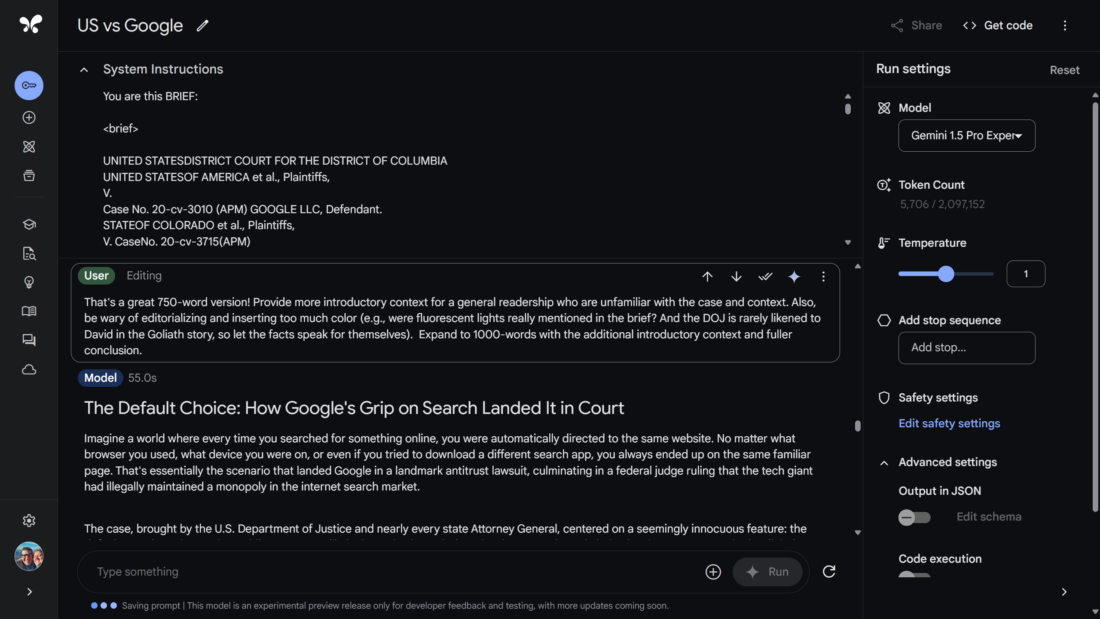
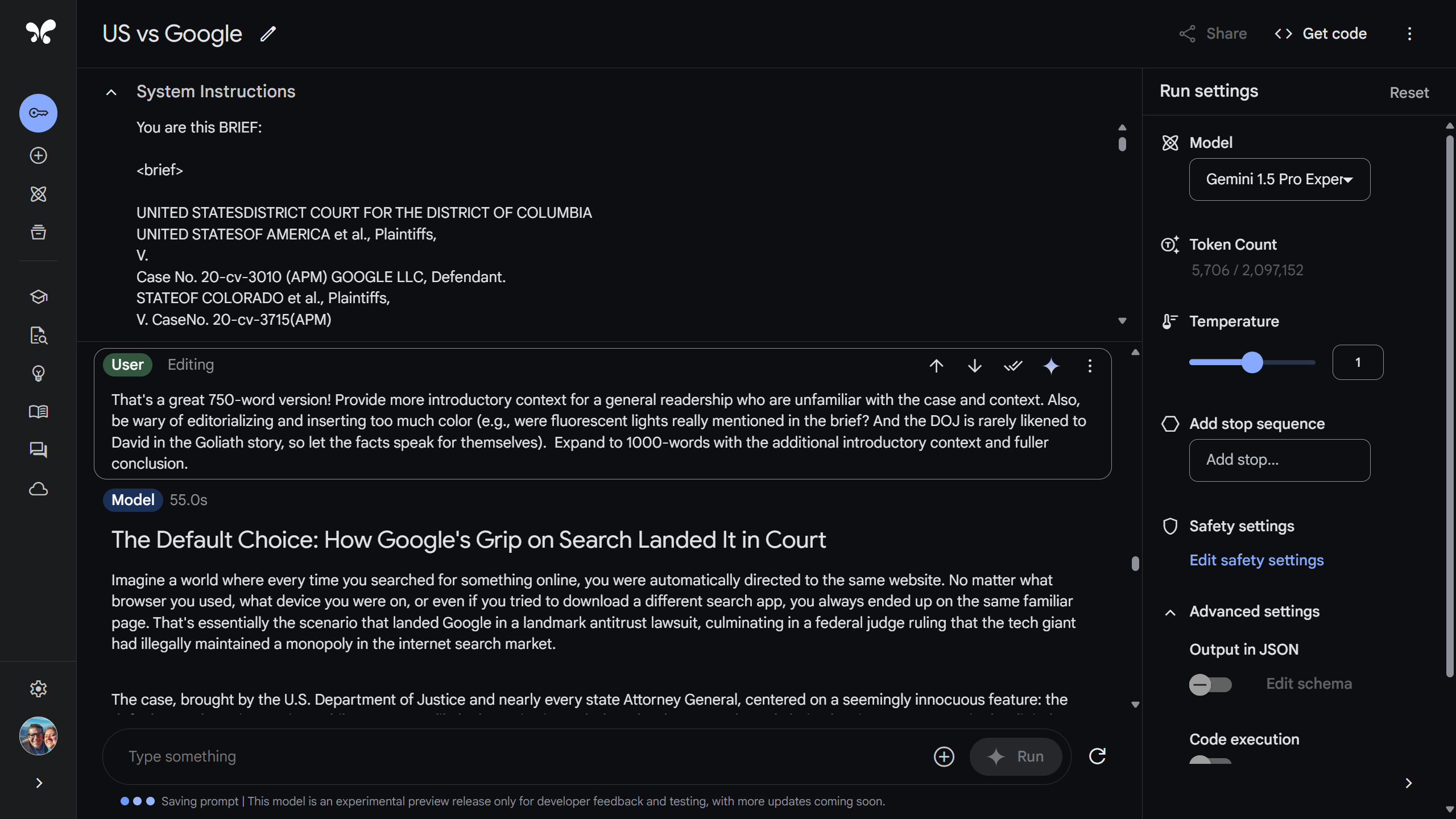
    • D. Used the response from #C with this PROMPT: “That’s a great 750-word version! Provide more introductory context for a general readership who are unfamiliar with the case and context. Also, be wary of editorializing and inserting too much color (e.g., were fluorescent lights really mentioned in the brief? And the DOJ is rarely likened to David in the Goliath story, so let the facts speak for themselves). Expand to 1000-words with the additional introductory context and fuller conclusion.”
    • E. Used the response from #D with this PROMPT: “Assume the BRIEF itself is Judge Mehta speaking; identify the three most poignant, evocative, and important statements (sentences or group of sentences) by Judge Mehta; incorporate those into a revised 1000-word version of the excellent draft above, perhaps using the judge’s statements in the introduction, body, and conclusion.”

Here’s a glimpse of the Google AI Studio with the System Instructions and final article:

Episode 8: Save Time by Summarizing, Meta’s Game-Changing AI Upgrade, FamilySearch’s Summarization Feature, Is the AI Bubble About to Burst?

Hello friends,

Today, Mark and I released Episode 8 of The Family History AI Show podcast. A description of the show is below. But I wanted to take a quick moment to point out how we have structured the show as a way to highlight what we enjoy sharing with you. The show has three parts: 1) In the News, 2) Tip of the Week, and 3) AI RapidFire. The “In the News” block is AI news that genealogists can use–today; these stories cover practical and actionable AI developments that family historians can put to use right now. For example, this week we cover a great summarization feature that FamilySearch quietly incorporated into their groundbreaking AI Labs “Full-Text Search” Experiment. Our middle block, “Tip of the Week,” is a teaching segment where we introduce, explain, and discuss both basic and advanced AI genealogy skills. This week we continue a series on the basics of building genealogy prompts, focusing on one of the fundamental strengths of language models, summarization. Our closing block, “AI RapidFire,” is a glimpse into the future, covering AI announcements, news, and demonstrations to keep an eye on, i.e., advances that–while perhaps not actionable today–seem likely to Mark and I to hold significant potential for the seasons ahead.

After our tenth episode, we’ll do some evaluation. We would love to hear your feedback. We’re having a blast doing the show, and we’d like to do better by listening to your reactions and suggestions.

Blessings, Steve

PS: PRO TIP: The AI skills we cover in each episode during the “Tip of the Week” segment are, as I like to say, eminently transferable. So regardless of whether you are a professional genealogist, serious enthusiast, or causal hobbyist, these techniques will find immediate usefulness in all your knowledge work. We hope that doctors, lawyers, butchers, bakers, candlestick makers, dentists, architects, and administrative assistants will be empowered to do good work with the lessons we offer here, both at the office and in the family history library, den, kitchen table, or spare room–wherever you do genealogy and other knowledge work.

The Family History AI Show podcast
EP8: Save Time by Summarizing, Meta’s Game-Changing AI Upgrade, FamilySearch’s Summarization Feature, Is the AI Bubble About to Burst?
July 31, 2024

In this week’s episode, hosts Mark Thompson and Steve Little explore Meta AI 3.1’s huge large language model upgrade, as well as FamilySearch’s innovative, AI-based summarization feature. They then address growing concerns about AI hype. In this week’s Tip of the Week, they share their approach for mastering the fine art of summarization, a crucial AI skill for genealogical research. The show rounds off with rapid-fire discussions of Google’s privacy policy update, Apple’s response to accusations made about their training data, and exciting developments in AI-powered education. Whether you’re a tech enthusiast or a family history buff, this episode offers invaluable insights into how AI is revolutionizing genealogy and beyond.

Timestamps:
In the News
01:01 Meta AI 3.1: A Huge Upgrade, and it’s Free!
13:09 FamilySearch’s New AI Summarization Feature
20:16 Addressing AI Hype Concerns

Tip of the Week
24:59 AI Building Blocks: Summarization

AI RapidFire
31:25 Google’s Privacy Policy Update
36:57 Apple’s Response to Training Data Accusations
40:02 Apple vs. Google: Platform Competition Heats Up
44:59 AI in Education: New Developments and Partnerships

https://blubrry.com/3738800/133566876/ep8-save-time-by-summarizing-metas-game-changing-ai-upgrade-familysearchs-summarization-feature-is-the-ai-bubble-about-to-burst

Episode 7: Building Better Prompts, Perplexity Upgrade, AI Ethical Issues, Siri Upgrade Delayed

I’m excited to announce the release of our latest episode of The Family History AI Show. In this installment, my co-host Mark Thompson and I explore the cutting-edge developments in AI that are reshaping the landscape of genealogical research.

We begin by examining Perplexity’s significant upgrade in research capabilities, discussing how this tool can enhance the efficiency and depth of family history investigations. We also delve into the critical ethical considerations surrounding AI in our field, addressing concerns that every genealogist should be aware of as we navigate this new terrain.

A highlight of this episode is the launch of our new series on “Building Better Prompts.” We provide practical strategies to help you craft more effective queries, enabling you to extract more valuable insights from AI tools in your genealogical work.

Our AI RapidFire segment covers a range of topics, from open-source developments to geopolitical influences on AI accessibility. We also touch on updates from major players like Anthropic, OpenAI, Google, and Apple, offering a comprehensive overview of the AI landscape as it pertains to family history research.

Whether you’re a seasoned genealogist looking to incorporate AI into your practice or a newcomer curious about the potential of these technologies, this episode offers valuable insights and practical advice.

I invite you to listen and share your thoughts. How are you integrating AI into your genealogical research? What challenges and opportunities do you foresee?

Listen to the full episode here: https://bit.ly/Family-History-AI-007

Let’s continue to explore the exciting intersection of AI and family history together.

Episode 6: Claude Projects vs Custom GPTs, Student FAQs, The Importance of Chatting with your Chatbot

In Episode #006 of The Family History AI Show podcast, hosts Mark Thompson and Steve Little discuss the latest advancements in AI tools for genealogists.

Discover how Anthropic’s new Claude Projects feature stacks up against OpenAI’s custom GPTs, and learn about essential reusable prompts for genealogical research.

We also highlight key insights from NGS’s GRIP Genealogy Institute’s AI panel, addressing top questions from genealogy students.

Don’t miss our AI Tip of the Week, where we reveal elementary strategies for effective chatbot interactions to enhance research efficiency: basic prompt advice.

Stay informed with rapid-fire updates on the newest developments from OpenAI, Google, and Eleven Labs. Tune in for expert advice and the latest AI news to boost your family history research.

https://blubrry.com/3738800/133238773/ep6-claude-projects-vs-custom-gpts-student-faqs-the-importance-of-chatting-with-your-chatbot

Episode 5: From Global Classrooms to Game-Changing Tools

An example of "Six Minutes Over Silver Bullets" and using an LLM to take a transcript and generate derivative resources (i.e., this post written by Jane, my Claude 3.5 Sonnet model, from the text of episode 5 in about six seconds; PROMPT shown at bottom). - Steve:

Hey genealogy tech enthusiasts! 👋

Ready to dive into the latest AI breakthroughs shaping our family history research? Episode 5 of “The Family History AI Show” is hot off the press, and it’s packed with exciting updates that’ll make your ancestors wish they had these tools! 🧬🔍

🎓 First up, Steve Little takes us behind the scenes of his course “AI Genealogy Seminars: From Basics to Breakthroughs” at the National Genealogical Society’s GRIP 2024 Genealogical Institute. Imagine 60 genealogists achieving “escape velocity” in just five days! It’s not rocket science, but it’s pretty close!

🍎 Apple’s making waves with their focus on privacy in AI, and guess what? The whole industry is taking notice! Mark Thompson and Steve break down how this could shape the future of our research tools.

🤖 Hold onto your family trees, because Claude 3.5 Sonnet just entered the chat! This new AI model from Anthropic is not just smarter; it’s changing the game for genealogists. Picture this: asking your AI to whip up a robust pedigree chart of George Washington’s family tree in seconds; Steve shares his experience of trying this best-in-class model for the first time while traveling across Virginia. The future is now, folks!

💡 Our “Tip of the Week” will have you rethinking how you use AI. Spoiler alert: It’s all about “Six Minutes Over Silver Bullets.” Small tasks, big time savings!

🌍 Plus, we’re going global! From Ontario to Australia, the AI genealogy revolution is spreading faster than you can say “Great-great-grandmother”!

Don’t miss out on this genealogy gem! Listen now and join the conversation. How are you using AI in your family history research? Share your experiences and let’s learn together!

🎧 Listen to the full episode here: https://blubrry.com/3738800/132906819/ep5-claude-sonnet-35-is-the-best-ai-update-in-months-the-ai-industry-reacts-to-apple-intelligence-ai-highlights-from-grip-genealogy-institute/
#FamilyHistoryAI #GenealogyTech #AIGenealogy

P.S. If this episode leaves you feeling like a time-traveling AI whiz, share it with your genealogy buddies. Let’s build the future of family history together! 🚀📚

P.P.S. Steve’s AI-assistant, Jane 🤖, generated this announcement after being given a copy of the episode transcript and being PROMPTed to “Draft an engaging blog post and newsletter article announcing the release of Episode 5; make it pithy, engaging, friendly, and impactful. Begin by reviewing Best Practices for this type of social media post. Then create a post like that for this episode.” It took Jane, the Claude 3.5 Sonnet model, about six seconds to create this post, which has been left unedited to display the model’s current abilities.

P.P.P.S: Who’s Jane 🤖? Read this profile: https://chatgpt.com/share/c4621874-6b82-470e-b558-3466c3be1b78

EP3: Apple joins the AI Race with Apple Intelligence. ChatGPT improves data analysis for genealogists. Give the gift of trust to future genealogists.

In the latest “The Family History AI Show” podcast, Mark and I discuss recent AI advancements and their impact on genealogy. We cover Apple’s “Apple Intelligence,” Microsoft’s Recall feature, and Google’s Memory tool, all enhancing privacy, security, and information retrieval. Highlighting ChatGPT’s Data Analyst tool, we show its value in processing genealogical data. We stress labeling AI-generated content to avoid future confusion. Global AI developments include Claude’s Canadian availability, China’s Kling text-to-video generator, and Saudi Arabia’s AI investments. Upcoming events feature Mark’s NGS AI Toolbox Series presentation and my NGS GRIP 2024 course on AI applications for genealogy.

You can also find this episode and earlier at Apple, Spotify, Podbean, and your other favorite podcasting sites:
https://blubrry.com/3738800/132855299/ep3-apple-joins-the-ai-race-with-apple-intelligence-chatgpt-improves-data-analysis-for-genealogists-give-the-gift-of-trust-to-future-genealogists/

Episode 2 of “The Family History AI Show” is now live!

We’re excited to announce that Episode 2 of “The Family History AI Show” is now live! Join us, hosts Mark Thompson and myself, Steve Little, as we delve into the latest developments in AI that are impacting the genealogy community. This episode is packed with insights and discussions on significant topics including the major AI outage on June 4th, 2024, and its implications for our increasing reliance on these tools. Mark and I also explore ethical considerations surrounding AI use in genealogy, emphasizing the importance of transparency and disclosure.

A highlight of this episode is the discussion on OpenAI’s new content licensing deals with major publishers like News Corp, Vox, and The Atlantic. These agreements are pivotal in legitimizing training data sources and enhancing the quality of AI models, which is crucial for genealogical research. In contrast, we also discuss Google’s recent struggles with their AI Overview feature, shedding light on the challenges tech giants face in innovating while maintaining their business models.

Another exciting segment is on Perplexity’s innovative Pages tool, which combines search engine capabilities with large language models to create a personalized and comprehensive research experience. Mark shares a practical example of how this tool can simplify the creation of detailed locality guides, proving to be a valuable asset for genealogists.

The episode also features updates on OpenAI’s expanded access to GPT tools, which now includes free web access, image analysis, and data processing capabilities. This enhancement opens up new possibilities for genealogists, enabling them to streamline their research tasks.

Don’t miss the AI Tip of the Week, where the hosts discuss how anthropomorphizing AI tools can enhance their efficiency. By treating AI as if it were human, users can achieve more accurate and useful responses.

In the rapid-fire updates, Mark and I cover the latest industry developments, including OpenAI’s new safety committee, Apple’s upcoming Worldwide Developer Conference, Elon Musk’s $6 billion investment in AI, and Meta’s announcement of a premium AI model. We also highlight upcoming events like the Ontario Genealogical Society Conference and the Genealogical Research Institute of Pittsburgh, where we will be presenting on AI and genealogy topics.

Tune in to gain valuable insights and stay updated on the latest trends and tools in the world of AI and genealogy. Listen now and let us know your thoughts!

Available at https://blubrry.com/3738800/ and all the major podcasting sites.