Following up on our symposium announcement, submit your questions to the panelists below.
Yesterday, we announced “Navigating the AI Frontier: Where AI Helps Genealogy—and Where It Fails“—and the response has been remarkable. Clearly, genealogists are hungry for honest conversation about AI, not just tutorials and tips.
But here’s what we’ve been thinking about since then: Are we asking the hard enough questions?
The Questions Behind the Questions
In our announcement, we touched on concerns that go beyond “how do I use this tool”:
- What about bias in training data?
- Where did the training data come from? What about copyright and consent?
- What’s the environmental cost?
- How do we maintain trust in evidence?
These questions deserve more than a passing mention. They deserve a framework.
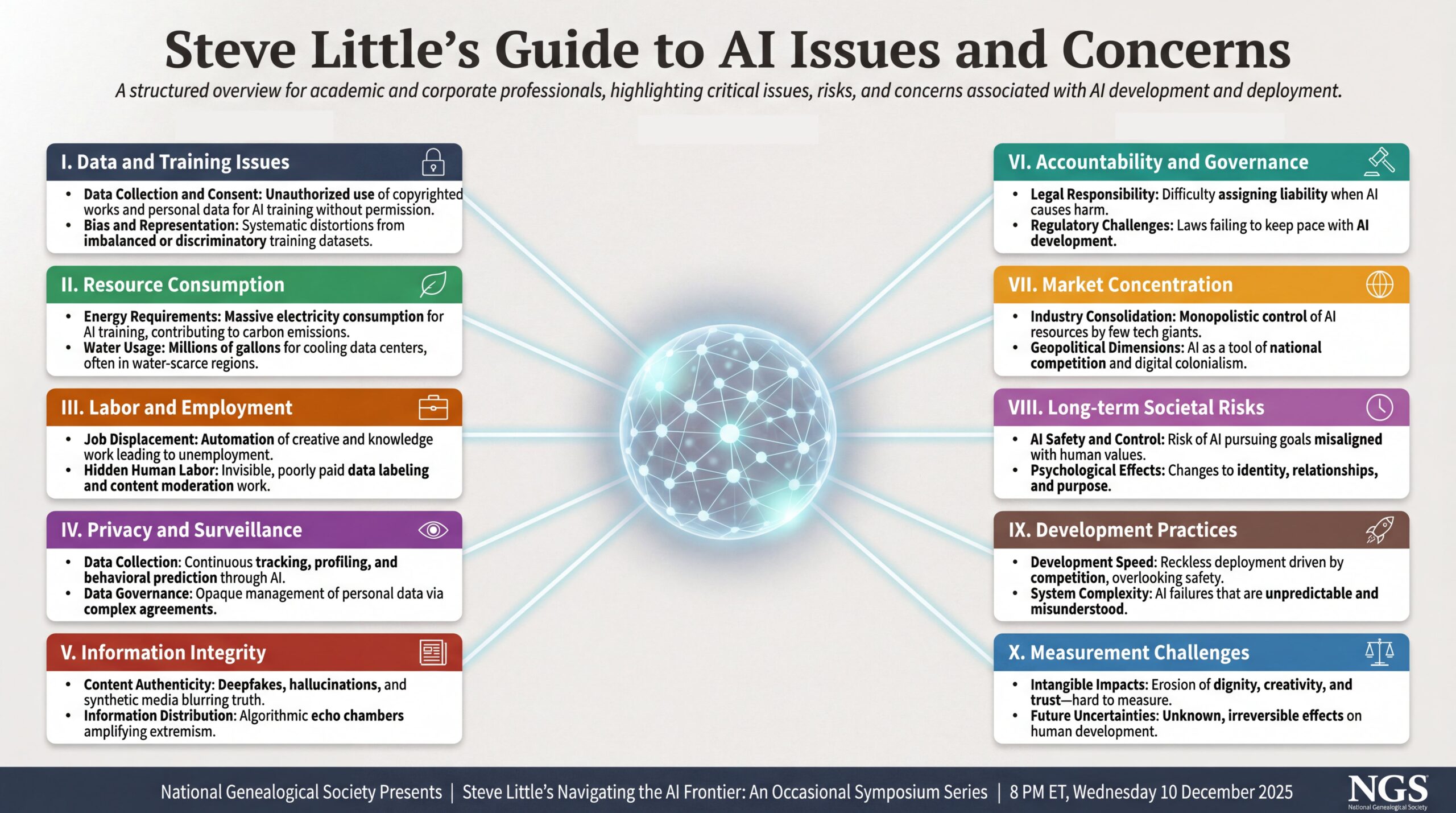
Introducing: Steve Little’s Guide to AI Issues and Concerns
We’ve developed a structured overview of the critical issues, risks, and concerns associated with AI—organized into ten categories that every thoughtful genealogist should understand:
- Data and Training Issues — Consent, bias, and the inability to trace where AI outputs come from
- Resource Consumption — The massive energy and water costs of running these systems
- Labor and Employment — Job displacement and the hidden human labor behind “automated” AI
- Privacy and Surveillance — Continuous tracking, profiling, and opaque data governance
- Information Integrity — Deepfakes, hallucinations, and algorithmic echo chambers
- Accountability and Governance — Who’s responsible when AI causes harm?
- Market Concentration — A few tech giants controlling the infrastructure
- Long-term Societal Risks — AI safety, alignment, and psychological effects
- Development Practices — Reckless speed and incomprehensible complexity
- Measurement Challenges — The erosion of values we can’t easily quantify
This isn’t meant to be alarmist. It’s meant to be complete. If we’re going to use AI responsibly in genealogy, we need to understand what we’re dealing with—all of it.
Four that hit closest to home for genealogists:
- Data and Training — Where did the training data come from? Whose records? With what consent?
- Information Integrity — Hallucinations, fabricated citations, synthetic content that erodes trust
- Accountability — Who’s responsible when AI gives you wrong ancestors?
- Measurement Challenges — What are we losing that we can’t easily quantify?
And the broader concerns we can’t ignore:
- Labor — The invisible, often exploited human workers behind “automated” AI
- Privacy and Surveillance — Our data feeding systems that track and profile us
- Long-term Societal Risks — What happens when AI reshapes how we understand identity and relationships?
We’ve created a visual guide to all ten categories—included above. Feel free to save it, share it, or use it to spark conversation in your genealogical society or study group.
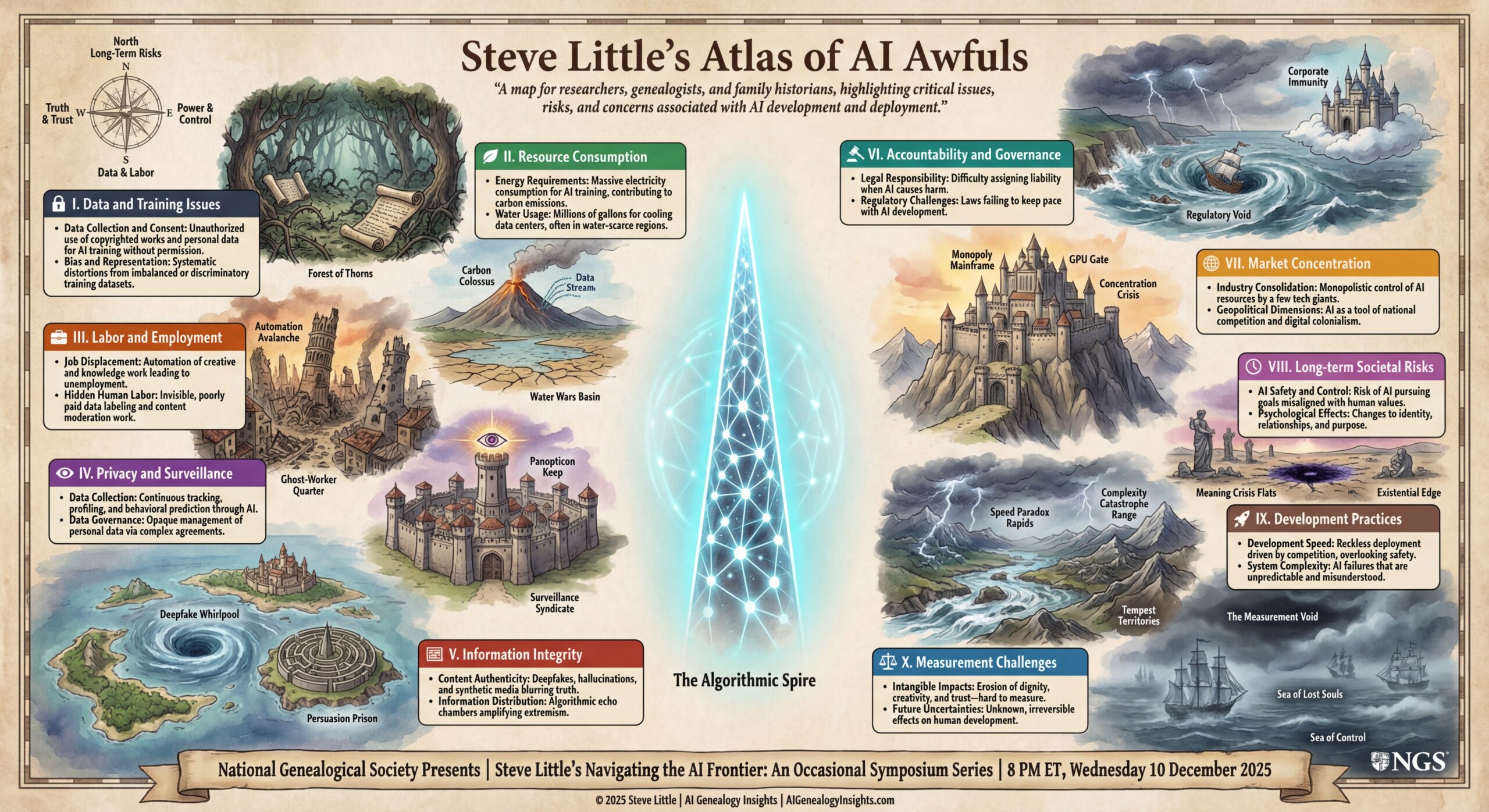
To go with the structured infographic, we’ve also drawn Steve Little’s Atlas of AI Awfuls—a fantasy map of the “AI deplorables.” Instead of bullet points, you’ll see forests of scraped data, ghost‑worker quarters, surveillance citadels, and stormy seas of things we can’t yet measure. Try printing the map and asking: Which regions feel closest to your own practice? Which ones are you ignoring? It’s a tool for teaching, discussion, and honest self‑assessment.
Feedback submitted
We Want Your Hard Questions
Here’s where you come in.
We’re inviting you to submit your hardest, most challenging questions about AI in genealogy. Not just “how do I prompt ChatGPT better”—but the questions that keep you up at night:
- Questions about ethics and consent
- Questions about accuracy and trust
- Questions about what we might be losing
- Questions you’re afraid to ask because they might sound “anti-technology”
There are no wrong questions. The uncomfortable ones are often the most important.
Submit Your Question Here: https://forms.gle/ehgvTDjKCKBTPK3AA
Deadline: 11:59 PM ET, Sunday, December 7, 2025
Questions submitted by the deadline will be considered for the live Q&A on December 10. We’ll address others in future events in this series.
Quick Recap: December 10 Symposium
Navigating the AI Frontier: Where AI Helps Genealogy—and Where It Fails
When: Wednesday, December 10, 2025 | 8:00–9:30 PM ET
Panelists:
- Ashley Bens — professional AI researcher and AI educator, workflow specialist
- Blaine Bettinger — founder of The Genetic Genealogist and “Genealogy and Artificial Intelligence”
- Kristin Britanik — digitization expert and Legacy Tree senior genealogical researcher
- Bryna O’Sullivan — professional genealogist and French-to-English genealogical translator
- David Rencher — NGS President and Chief Genealogical Officer at FamilySearch
Format:
- Lightning rounds (~35 min): Real success and failure stories
- Moderated roundtable (~35 min): Honest differences and deeper questions
- Live Q&A (~20 min): Your scenarios and edge cases
Register (Free via Zoom*): https://us02web.zoom.us/meeting/register/Jc69ZTCBTqm50m54sD1_dQ#/registration
*PLEASE NOTE: NGS Zoom event registration requires an authenticated Zoom account. Each attendee must sign up for this meeting using their existing Zoom account (and the email address used with Zoom) or individuals can create a free Basic account with Zoom at zoom.us/pricing.
Why This Matters
We’re at an inflection point. AI tools are becoming embedded in genealogical workflows faster than our professional standards can adapt. The vendors are moving fast. The hype is loud. And the hard questions are getting drowned out.
This series exists to change that.
Evidence over hype. Standards over speed. Honest assessment over marketing claims.
We’ll see you on December 10—and we look forward to your hard questions.
—Steve Little
This is part of “Navigating the AI Frontier,” a series by Steve Little presented in partnership with the National Genealogical Society.
© 2025 Steve Little | AI Genealogy Insights | AIGenealogyInsights.com
